The Amazon CRO playbook:
How to optimize your listings and beat your competitors
But how does CRO on Amazon differ from CRO on other websites?
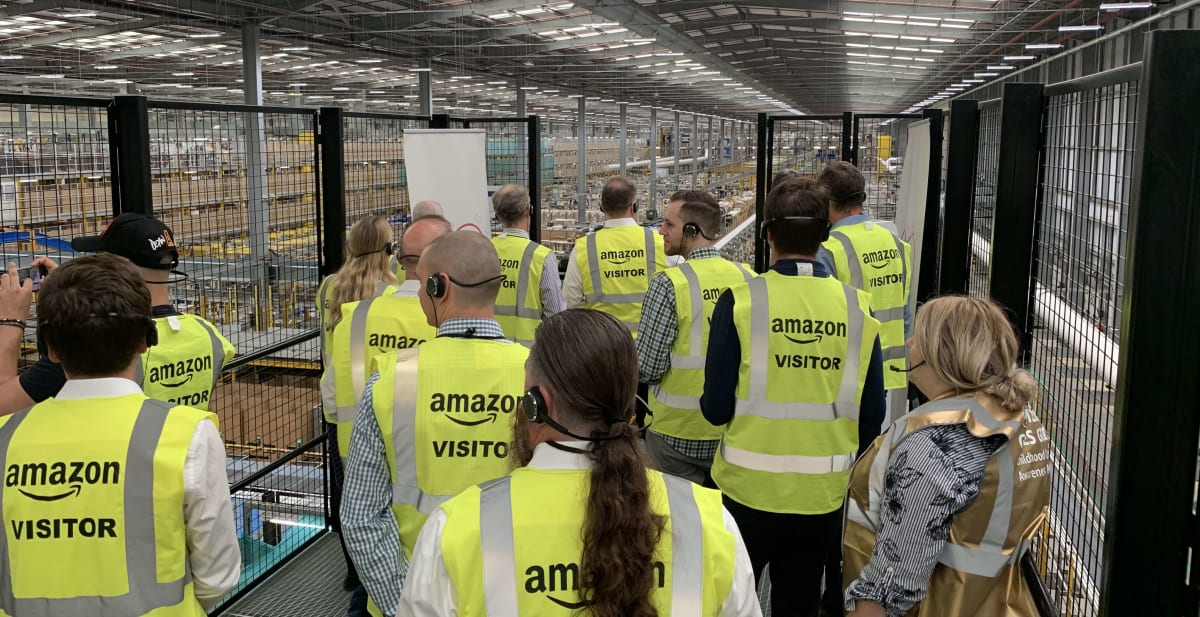
In this article—for the first time—we’ll share how we bring our research and testing discipline to selling on Amazon. You’ll learn:
- The research that will tell you what’s worth testing before you touch your listing.
- What Amazon’s built-in testing tool can and can’t test.
- The timing trap built into every Amazon experiment.
- How to bundle changes on Amazon to get the best results.
- And how we get more testing done than Amazon’s one-test-at-a-time limit appears to allow.
The challenge of growing on Amazon
Amazon can be a tough place to grow. The huge audience of ready-to-buy visitors guarantees competition in every niche, with sellers often pressured from below on price and above on features and finish.
For example, there are currently over 10,000 results for “iPhone cases 17 Pro Max” on Amazon.com. What’s it like to be the 10,000th listing? Or even the 50th? Pretty quiet!
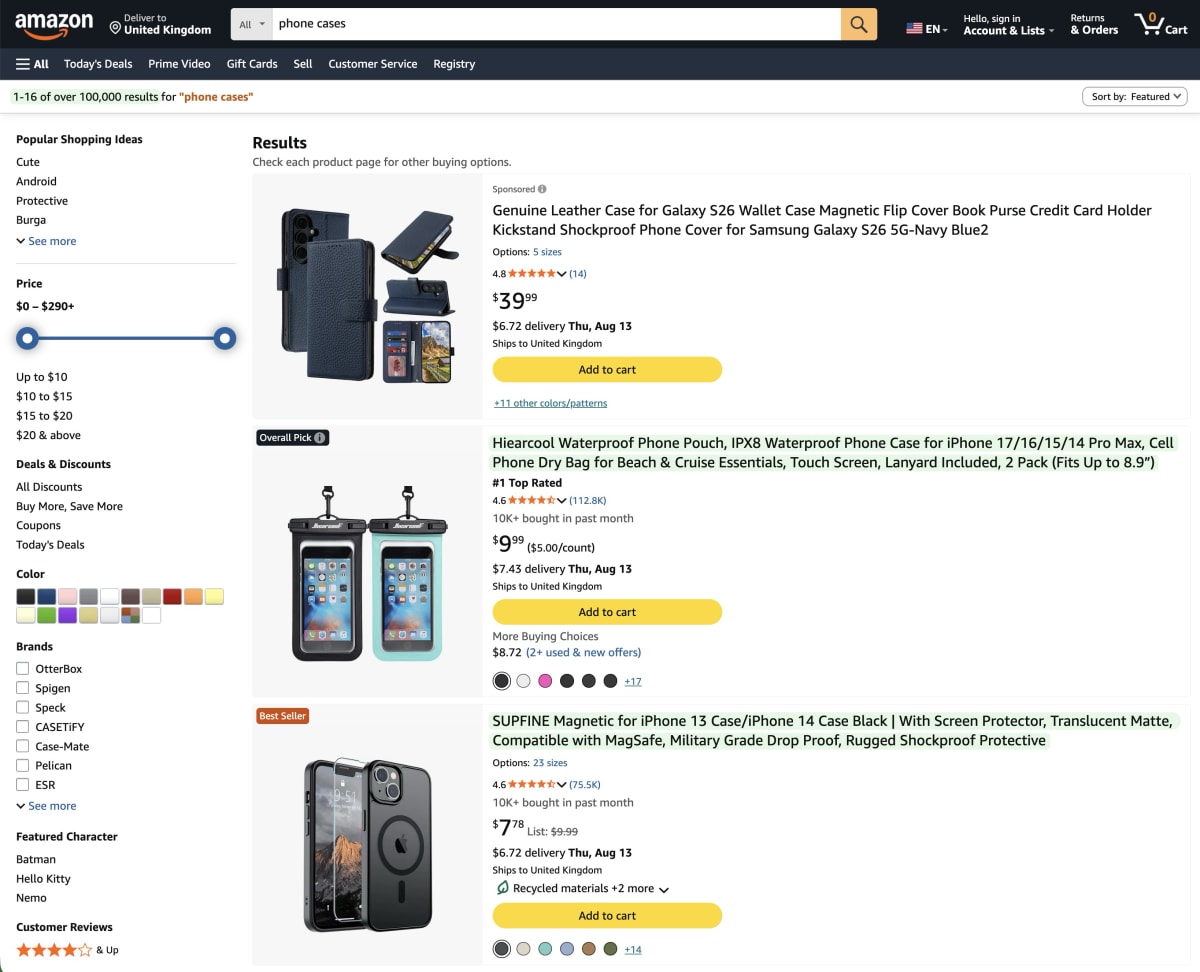
But on the other hand, what would it be like to be highly ranked in a category with lots of traffic? Game-changing, as we know from experience.
User behavior is complex, but when Jungle Scout asked over 1,000 consumers about their Amazon shopping, the reported trend was stark:
- 73% of shoppers click on the top listing in search results.
- 14% of shoppers click on the second listing.
- 5% of shoppers click on the third listing.
This is only what the participants said that they did, but there’s obviously a huge difference between being on page one of an Amazon keyword listing and being at the bottom of page five. In addition to more attention, highly placed listings get more sales, more feedback (via reviews), and faster A/B test results. (As sellers on Amazon know, even high-traffic A/B tests can take 2–3 months to reach completion.)
So your listing placement for relevant keywords makes a huge difference to your ability to grow, but what makes a huge difference to your listing placement?
Less than you might think.
In our guide to unstoppable growth for CEOs and founders, we discussed Noah Lyles’s 100 m win at the 2024 Olympics. (He won by 5 milliseconds.):
The second and less obvious implication of the Olympic 100 m race is this: If you want to be twice as profitable as your competitors, you don’t have to be twice as good as them. You just have to be slightly better.
Is the first-placed entry on an Amazon listing fifty times better than the fiftieth-placed one? Probably not. In a highly competitive marketplace, the aggregation of slight edges in your favor has an outsized impact. The challenge is knowing how to get them.
If you’ve searched for ways to grow your sales on Amazon, you’ll likely have seen the same advice everywhere. Get better images, write punchier bullets, gather more reviews, or lower your prices.
While none of this advice is wrong per se, it’s easy to fall into the spaghetti-against-a-wall trap. Sellers read an article or two, change some things on their listing in line with “best practice,” and cross their fingers. Sometimes the listing position or conversion rate changes. Sometimes it doesn’t. But even if it does, can they really be sure what made the difference… or how the result should impact their sales strategy elsewhere?
Even the sellers who A/B test ideas on Amazon are often just guessing that something might work.
Guessing is never a long-term growth strategy. Our methodology calls for a different approach. The real winners start their work long before they make a change to a listing.
And they follow a tried and tested process.
Why you should always start with research
As we said in Making Websites Win, no sensible person would start taking medication before they’ve been diagnosed with a real and specific problem.
Before you touch anything on your listing, it pays to understand what is actually happening. This is the discipline we call Diagnose → Problem → Solution (DiPS). In essence, you want to:
- Identify specific problems.
- Design specific fixes.
- Build them into a testing plan.
By doing the deep research to diagnose issues before making changes, you can hugely increase your chances of outperforming competitors. To take one simple example, if you can identify the key objections your prospects have about you or your products, you can add counter-objections.
That diagnosis matters more on Amazon than almost anywhere else because your prospects have so many other options to turn to.
Here are some specific areas of research to target, starting with your Amazon funnel.
Amazon funnel research
Start by accessing your traffic-and-sales analytics within Seller Central. You want to focus on three key numbers:
- How often your product is seen within a visitor search (impressions).
- How many users go on to see the full listing (sessions).
- What percentage of those convert (sales).
The gaps between them tell you which issue to address first:
High impressions but low sessions (a click-through rate under 2%)?
CTR here is sessions ÷ impressions, and most well-ranked organic listings sit somewhere between 2% and 5%. Anything meaningfully below 2% suggests shoppers are seeing your listing but scrolling past it. To address this, you might (eventually) test a stronger title, better main image, or more competitive price.
High sessions but low Unit Session Percentage (sales under 8–12%)?
This is a conversion problem that lives on the listing itself. 8–12% is a typical range across most categories, so anything below that, especially with healthy traffic, points to the page failing to close the sale. Since this means the problem isn’t visibility, you’d (eventually) want to focus on the page content first: images, bullets, reviews, and pricing on the page itself rather than anything at the search-results level.
In addition to these on-platform insights, you can often learn useful things about the previous step in the funnel:
- What are your best sessions telling you? Segment your conversion by traffic source inside Seller Central: organic, sponsored, external. A listing that converts well on branded search but poorly on paid traffic doesn’t have a listing problem; it has a targeting problem. You should (eventually) focus on improving the ad before changing the listing.
We keep saying “eventually” because changing anything at this stage will be going back to guessing. While this funnel research step can provide valuable data within a few minutes, it tells you where in your funnel to focus, not what to focus on.
For that, you need to go deeper.
Voice of the customer research
Knowing what your customers like and dislike about your product is worth its weight in gold for CRO. We call this voice of the customer (VoC) data, and you can capture huge value by asking just five golden questions. Here they are:
- Where exactly did you first find out about us?
- What persuaded you to purchase from us?
- Which other options did you consider before choosing our product?
- What’s the one thing that nearly stopped you buying from us?
- What was your biggest challenge, frustration, or problem in finding the right product or service online?
While we are sure you can see the value these questions uncover, you might be wondering who to ask.
The ideal answer is what we call qualified non-buyers. These are people who are genuinely in the market for a product like yours, have seen your listing, but didn’t convert. Changing their minds is the fastest way to increase our conversion rate, right?
Well, yes, but there’s a problem.
Qualified non-buyers are hidden inside the much larger group of everyone who didn’t buy. Imagine you sell a stainless-steel dog crate on Amazon. Some of your sessions come from shoppers genuinely comparing crates for a new puppy, but others land on your listing from a broad-match Amazon PPC ad that also serves outdoor dog kennels. If you surveyed the second group, you wouldn’t learn anything useful because they were never in the market for a dog crate in the first place.
So, what’s the next best group that we can easily target?
The answer is customers who almost didn’t convert. When we ask question 4 (What’s the one thing that nearly stopped you from buying from us?), we get as close as possible to understanding our qualified non-buyers. That’s one of the things that makes the voice of the customer research so valuable.
But wait, doesn’t Amazon own all those customer relationships?
Not exactly.
While it’s true that Amazon owns the template, the checkout, and the customer relationship on the platform, it doesn’t own your ability to talk to your audience. You usually have far more VoC data within reach than you might expect. This includes:
- Your website visitors, if you also sell directly. You can engage them on the site itself, or after they make a purchase.
- Your email subscribers, if you have a list, or sell from other online stores.
- Your social media following, which belongs to you rather than to Amazon.
- External discussions on sites like Reddit or Facebook.
- Third-party review sites like Trustpilot.
- Support calls and chats, if your product’s users come directly to you.
- Amazon reviews, which often contain remarkably unfiltered feedback. (Competitor reviews are amazingly useful for the same reason.)
At the top end, you can recruit a carefully screened panel of qualified shoppers who buy within your specific category. That’s what we do for clients, and the panel earns its keep twice—once for gathering VoC feedback, and again for pre-testing ideas before they ever reach Amazon. (More on that below.)
Extracting VoC research from Amazon reviews
Amazon reviews are a treasure house of VoC research. Customers say what they think, and even if you don’t have many reviews to go on, you can study your competitors. While our in-house research process goes through multiple stages of tagging and analysis, AI provides a shortcut if you are looking for basic insights. Try giving a prompt like this 100 reviews to work with:
You are analyzing a batch of Amazon customer reviews for a single product. It may be my own product or a competitor’s. Either way, “us” and “our product” below mean whoever sells the product being reviewed, not me.
Mine the reviews for evidence that speaks to five questions:
- Where exactly did you first find out about us?
- What persuaded you to purchase from us?
- Which other options did you consider before choosing our product?
- What’s the one thing that nearly stopped you buying from us?
- What was your biggest challenge, frustration, or problem in finding the right product or service online?
Reviewers never sat down to answer a survey, so they won’t address these directly. Infer from what they do say, but never beyond it. Report only genuine findings. Where a question has little or no evidence in this batch, say so plainly and say why. Never invent a finding to fill a gap.
Take each question in turn and give me three things: what the reviews show, roughly how common each pattern is (most, a sizable minority, a handful), and the phrases buyers keep reaching for in their own words. Synthesize. Don’t quote any review verbatim, and don’t name any reviewer.
Here are the reviews:
[PASTE REVIEWS HERE]
In our experience, a prompt like this can deliver some insights for questions 2–5. Question 1 is often a little light because the discovery part feels self-evident on Amazon.
You may have noticed that we included a specific instruction to find “the phrases buyers keep reaching for in their own words.” That’s because learning how prospects talk about your products will help you speak your customers’ language.
Wherever you find your VoC data, it will help you add problems and hypothesized fixes to your potential testing plan. Nothing is set in stone yet, but if your reviews surface a specific objection, you can prepare a counter-objection and add it to your ideas list. If your reviewers are disappointed in some aspect of your product after it arrives, you can consider whether your copy is overpromising… and add it to your ideas list.
(In some cases, your research will turn up both the objection and the counter-objection that persuaded someone to buy anyway. We call that a double win!)
Method marketing research
Part of our extensive research for every client is trying their product ourselves. This process, method marketing, draws inspiration from actors who immerse themselves deeply in their roles. (The canonical example is Robert De Niro’s stint as a real taxi driver to prep for his role in Martin Scorsese’s movie… Taxi Driver.)
Of course, you can do your own method marketing. When was the last time you purchased your own product on Amazon? How did it compare to competitors in the listings? Was it clear which version you should get? Did it arrive on time and undamaged? What was it like to unpack it, to understand it… or to use it?
Would you honestly recommend the experience to a friend… and if not, why not?

Method marketing your own products delivers tacit knowledge—the kind of understanding that can only be acquired through personal experience—like being a parent or having a hangover. (No matter how well someone describes them, you can only really “get it” by living through them.)
User test your Amazon funnel (and your competitors’)
At its core, user testing involves asking someone to complete a task and capture their thoughts, questions, and experiences as they do.
At CRE, we use a panel of screened participants who closely match our clients’ buyers, but you can start with anyone who has a fresh set of eyes.
- Set them a relevant task. (For example, find and add my product to your cart.)
- Record their screen and voice.
- Have them narrate their thoughts out loud.
A word of warning. User tests can be brutal. We guess that you’ll be surprised (and occasionally dismayed) by what people do and say. Just keep in mind that the harshest feedback is often the most valuable. (That last sentence was proudly sponsored by CRE’s content team… who welcome your feedback below!)
Because you are user testing your real Amazon listing, you can also capture reasons why the specific listing wouldn’t convert. This kind of data isn’t always captured by the general voice of the customer research, so we’ll usually add a version of the “What’s the one thing that nearly stopped you buying from us?” question at the end of the test.
If it helps deal with the pain, user testing your competitors’ products can be both useful and deeply cathartic. The more insights you can collect, the better. Just remember to treat your user testers well… they can be just as useful a little later in the process.
Turn your research insights into test ideas
Research doesn’t automatically give you a testing plan. It gives you something more useful: specific problems to solve. The next step is to turn each problem into possible solutions.
This is where a lot of optimization goes wrong. Sellers see that their conversion rate is low, then jump straight to tactics: “Let’s improve the images,” “Let’s shorten the title,” or “Let’s add more benefits to the bullets.”
That’s solution-first thinking—the same guessing we were trying to avoid in the first place.
Instead, take each important finding from your research and ask this question: What would need to change in the shopper’s mind for this problem to disappear?
Let’s say your review research reveals that shoppers repeatedly worry that your laptop stand will wobble when they’re typing. The problem isn’t “our images need improving.” The problem is:
Shoppers aren’t convinced the product will be stable enough.
That objection is a “lock” on your sales. Now you can generate solutions specifically designed to overcome that objection. For example:
- Show the stand supporting a heavy laptop in one of the images.
- Add a close-up showing the construction that makes it stable.
- State the maximum supported weight prominently.
- Add a comparison showing its stability against competing designs.
- Rewrite a bullet to explain why the design doesn’t wobble.
- Add customer evidence of sturdiness to the A+ Content. (The enhanced branded images and text below the listing.)
Notice that these aren’t six random “Amazon best practices.” They’re six possible keys for the same lock, and you can use the same process to generate ideas to address every issue or objection:
- If shoppers don’t understand what makes your product different, make the difference unmistakable.
- If they understand the features but not why they matter, translate the features into benefits.
- If they don’t believe your claims, look for stronger proof.
- If they’re worried about a product’s compatibility, make compatibility impossible to miss.
- If they think you’re expensive, demonstrate why the extra cost is justified.
- If they’re choosing a competitor, identify the criteria on which you can credibly win and make those differences easier to compare.
The important thing is not to stop after coming up with the first plausible solution. A good research insight can generate several competing ideas. Add all of them to your ideas list. At this point you aren’t deciding which one is right—you’ll do that through prioritization and testing.
There’s another useful source of ideas that we mentioned earlier… the things that already persuaded real customers.
When you are analyzing your research data, don’t just record the objections. Look for the answers that successfully overcome them. Your customers may even give you the language to use.
We once did exactly this while selling phones face-to-face. We kept a simple spreadsheet with two columns—the objections customers raised and the counter-objections that proved most effective at overcoming them. Those tried-and-tested responses became our sales copy.
You can do the Amazon equivalent with your research:
Insight → Problem → Counter-objection → Amazon improvement
This is DiPS with an Amazon-shaped final step. For example:
- Insight: “I nearly bought the cheaper one because I couldn’t see why this was worth $20 more.”
- Problem: The reason for the higher price isn’t clear.
- Counter-objection: The extra money buys you a specific benefit that the cheaper alternatives don’t provide.
- Possible Amazon improvements: Demonstrate that benefit in the image stack; quantify it in the first bullet; show a side-by-side comparison in A+ Content.
Do this for the most important findings from your research, and you’ll quickly have more ideas than you can test. And that’s a good problem to have.
The next job is deciding which ideas deserve one of your precious Amazon experiments.
Building your testing plan
Testing sits at the very heart of our methodology. While research brings insights, the ability to scientifically measure the effect of new content over old is the engine of continual growth.
Not to guess that something is better, but to know.
Running experiments is equally important on Amazon, but there are some things to understand before we start. Amazon only lets sellers run one experiment at a time on a listing, and a single test can take eight to twelve weeks to produce a reliable answer. That’s a handful of opportunities a year, which is why it is so important to rank our ideas.
There’s one more factor to address. If your listing genuinely gets low traffic, a statistically valid A/B test may not be practical (or even available) within any reasonable time frame.
If so, don’t worry. Even if a listing has lots of traffic, we often get faster, bigger insights from user testing and A/B usability testing (see below). These techniques rapidly surface the data you need to make major improvements. You can then layer in full A/B testing later when the traffic arrives, or to validate higher-risk changes. (This is exactly the methodology we recommend for low-traffic websites—though it holds up well beyond that context too.)
What you can actually change
Before ranking anything, it’s worth being clear about the levers you can pull on Amazon.
On a traditional website, CRO projects can often go very deep. For example, changing a menu structure or developing a redesign strategy. On Amazon, of course, you have no control over the site’s page design and structure. Instead, you can change the following elements of your listings:
- The main image and image stack.
- The product title.
- The description or bullet points.
- The A+ Content (the enhanced branded images and text below the listing) and Premium A+ modules.
- The price and promotions.
- The volume and recency of your reviews, and how you respond to them.

The good news is that these few elements are where nearly all the persuasion happens. Most of them can be A/B tested inside Manage Your Experiments. Two of them can’t, and we’ll come back to those shortly, because the workaround shapes how you test everything else.
Prioritize your tests to create a ranked list
Step 6 of our methodology is called Creating your experimental strategy. It is just as relevant to Amazon CRO as it is elsewhere, and it explains why the time an A/B test takes to run depends on traffic volume and the size of the change.
It’s a myth that you can transform a business by making “meek tweaks”; extraordinary improvements come from extraordinary ideas. We take all of the ideas we’ve generated from the research and prioritize those big, bold, targeted ones that will grow your business in the shortest time.
Bold changes give you more profit, and you get quicker, larger returns (it’s a statistics thing). And they’re usually more fun. If you carry out “meek tweaking,” on the other hand, your tests seldom reach significance, you get disheartened, and, most upsettingly of all, you lose the commitment of your colleagues.
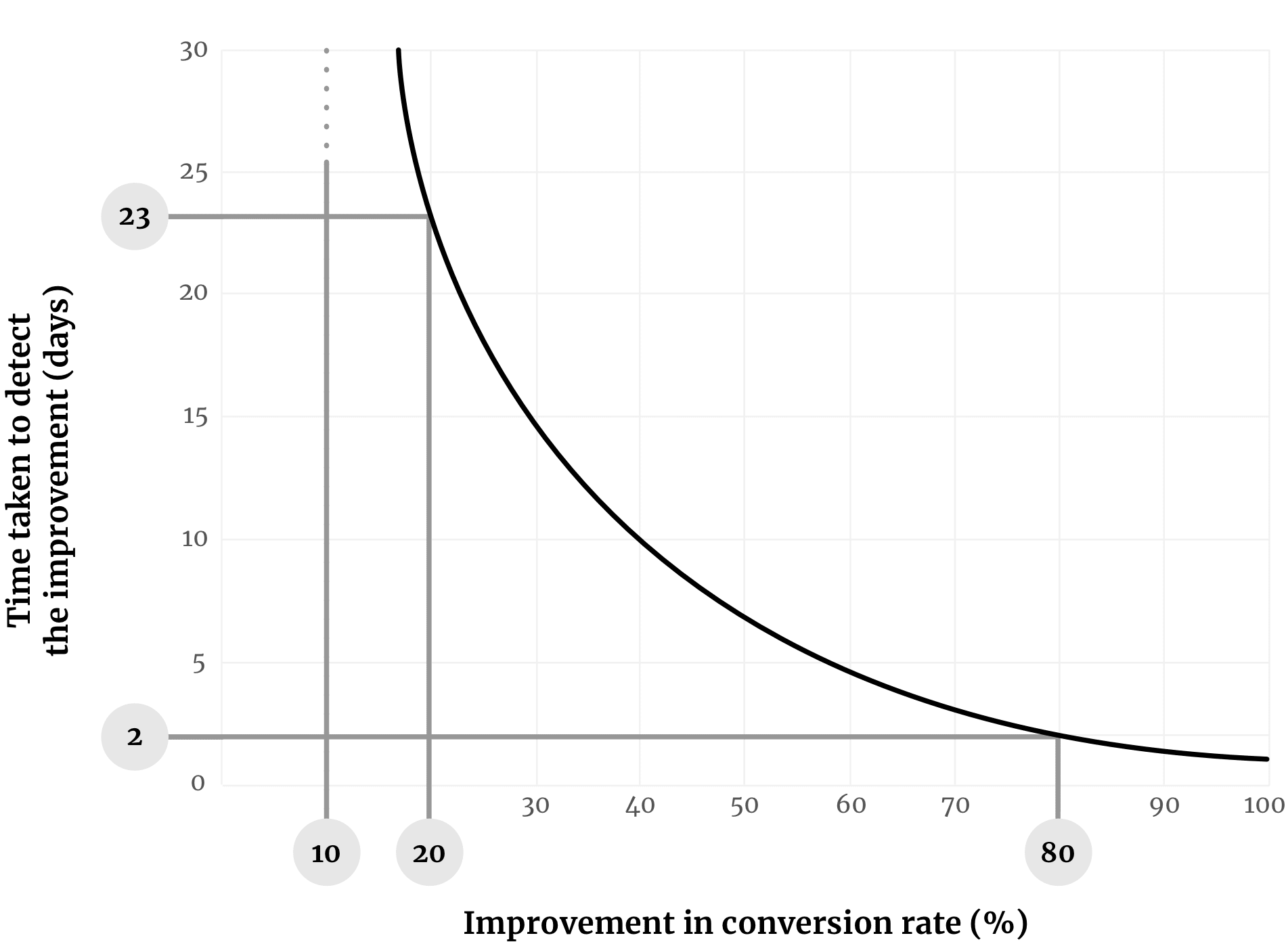
After collating all the ideas, we prioritize them based on three simple metrics:
How likely is it to double your conversion rate? Asking this question helps to ensure that we’re prioritizing the big opportunities. Bigger, bolder tests are given a higher priority; meek tweaks are demoted.
How easy is it to implement the test? We’re looking for the quick wins with the biggest financial impact, so changes that are easy to implement are given a higher priority.
Has this idea worked before? Once you’re testing, you’ll quickly start learning what your visitors respond to. Every test we develop is documented so that we can review and prioritize ideas that are inspired by winning tests.
The whole point of ranking your ideas is to ensure that you are testing big, bold ideas that are likely to make the biggest positive difference. Running bold tests matters even more on Amazon because your one experiment per listing can take weeks or months to complete. While it can be tempting to do a quick fix, “meek tweaks” rarely shift the overall conversion rate even when they win.
Your testing plan doesn’t have to be more complicated than a spreadsheet that lists the issues you have discovered, the solutions you have identified, the estimated difficulty of the fixes, and the potential upside. To be clear, these will almost always be rough numbers, but the resulting list can go a long way to prioritizing the most valuable tests.
If you are struggling to decide what to test first, our Amazon CRO team will often start with one of these:
- Replacing the main image with one built around the single biggest objection. This is the only creative element that appears in search results and the main listing, so it can drive both clicks and conversions.
- Rewriting the value proposition into the first line of the title and first bullet, rather than leading with a generic descriptor.
- Upgrading to Premium A+ Content on the highest-traffic listing rather than spreading effort thinly across the whole catalog.
- Rewriting the entire bullet block around benefits rather than specs, and testing it as a single unit, not one bullet at a time. (Bullets can make a big difference.)
To maximize the chances of getting big wins, we will also cluster multiple changes into one variation. On Amazon, where each answer costs you two to three months, the bigger the change, the quicker the learning.
So let’s say that you have your plan, and your first big test is ready. It’s time to go, right?
Yes, just not in the way that you might think.
Run your first test (but not on Amazon)
The best Amazon optimizers test their ideas before committing to a 2–3‑month test (or longer).
User testing and A/B usability testing
Remember your user testers from the research phase? We said that they’d be useful again. Now is the time to create mockups of your new page and get feedback before you commit to a long-term A/B test.
Taking this a step further, A/B usability testing involves running a closed A/B test, where the “traffic” consists of participants in a usability test. Participants see multiple versions of a page (for example, your existing Amazon page versus your proposed one), choose a favorite, and explain why.

A/B usability testing is particularly useful because it allows you to:
- Get feedback fast.
- Learn specifically why testers like and dislike certain versions.
- Iterate quickly across multiple versions.
Running these panels through four or five iterations of a test can often get you very meaningful insights within a couple of weeks. The results can either validate an A/B test idea before you run it, or give you the confidence to just make the change on low-traffic listings.
The two things Amazon won’t let you test
There’s another good reason to lean on off-platform testing. Two of the most important elements on an Amazon listing have no randomized test on the platform at all.
- Your secondary images. Only your main image is testable under Manage Your Experiments. Your supporting stack, meaning the lifestyle shots, infographics, and comparison charts, has no native randomized test of its own.
- Your price. Despite what some blogs claim, price is not a testable attribute in Manage Your Experiments. And there’s a sound reason for that. As Amazon’s own economist explains it:
“Because we practice nondiscriminatory pricing—all visitors to the Amazon Store at the same time see the same prices for all products—we need to apply experimental treatments to product prices over time, rather than testing different price points simultaneously on different customers.”
Live A/B tests split traffic at the same moment, which is exactly what Amazon won’t do with price. So the only way to test pricing is outside the platform, either through the user testing above or via a service like price optimization analysis.
In both cases, the answer is the same. If Amazon won’t test it for you, take it to a group of shoppers who will. By using this process, you can refine your testing plan into a list of validated ideas to test on Amazon itself.
It’s time to test on Amazon, finally
It may feel like it took a long time to get to actually running an Amazon test, but all the work above gives you the highest likelihood of having a big impact. Assuming that you have the traffic to run an A/B test in reasonable time, two rules govern what happens next:
- You get one test at a time. On your website, you can run as many concurrent A/B tests as you like. On Amazon, it’s one test at a time per product. So if you sell several similar products on the platform, you can run a different test on each. That’s the closest thing to parallel testing that Amazon offers, and if you have a catalog, we recommend it. It’s the fastest way to multiply your learning rate.
- Each test runs until it’s sure. Like any credible A/B testing platform, Amazon runs its experiments to significance. In other words, they’ll keep collecting data until they are confident that the “winner” is not the result of a statistical fluke. Amazon says that results can arrive “as soon as four weeks” on high-traffic listings. Still, in our experience, lower-traffic listings routinely need 8–12 weeks, or even longer, because they gather data so slowly.
Once the test is set up, it’s time to sit back and wait.
And it’s vitally important that you remember to wait—and we mean really wait—for the real result.
The mistake that costs sellers the most
Let’s imagine that you have been through the process above and have ten tests ready in your test plan. You like them. Your usability group likes them. They are ready to go!
The problem, of course, is the waiting… and the temptation to cheat:
Two weeks into an eight-week test, your new page variation is hammering the original. Amazon hasn’t called a winner yet, but numbers don’t lie… Do they? The new version is obviously better… and if you call it a winner now, you can bank the win and move to the next test. Can’t you?
No. Don’t do it. Results fluctuate all the time, but especially in the early days of a test.
This is a classic CRO trap. To make sure that you avoid it:
Test to significance with Amazon’s default setting. Testing “to significance” removes the temptation to call a result before the data has settled. If you absolutely must set a custom duration, treat 8–10 weeks as a minimum for anything but your highest-traffic listings.
Check the test results after a couple of days to make sure it’s collecting data, then ignore it until it reaches its natural end.
This is why the research is so important. Even if your highest-traffic listing can reach significance in four weeks, you’ve only got twelve testing opportunities per year. If it takes eight to ten weeks, you have far fewer. Unless you sell multiple similar products, you’re testing in sequence, not in parallel.
Likewise, depending on your business, there will be seasons and events that add noise to your data. Black Friday. Prime Day. Christmas. A test that runs through one of these may not be measuring what you think it’s measuring.
If a holiday matters to you, either pause your test or plan around it. Don’t let an eight-to-ten-week window accidentally swallow your biggest sales event of the year.
A brief word on reviews
We can’t complete an Amazon CRO article without touching on the importance of reviews, although mostly we advise caution.
Many Amazon-seller blogs appear to suggest tactics that are explicitly prohibited in Amazon’s own Communication Guidelines. Beware. Sellers who try to incentivize good reviews, channel only their happiest customers into leaving reviews, or use a multitude of other shady tactics risk losing their ability to sell anything to anyone on Amazon.
The best advice we can offer on getting good reviews is also the simplest. Deliver what you promised.
Yes, that’s a long-term strategy, but the good news is that your optimization process will help. As you optimize your listing, you’ll attract more people who will better understand what you are selling, choose to buy, and get what they expected.
There’s nothing to fear in asking for an honest review when you fully and completely deliver on your promises.
Build your Amazon CRO process
This article is about growing your sales on Amazon, but hopefully we’ve helped you see that the highest-leverage work often happens away from the store. This is the part that no competitor or algorithm change can take from you, because it comes down to how well you understand your customer.
Real growth starts with research. Sellers who excel use customer insight to design potential improvements, trial and iterate them rapidly off-platform, push the best and boldest ideas with A/B tests, and let the data decide what goes live.
And then, they do it again and again and again.
Optimizing your Amazon listings is as simple and as hard as that.
Good luck.
If you’d like help building your Amazon research and testing program, book a strategy session with one of our consultants. It’s free, and you’ll come away knowing exactly what we’d test first.
How much did you like this article?
What’s your goal today?
1. Hire us to grow your company
We’ve generated hundreds of millions for our clients, using our unique CRE Methodology™. To discover how we can help grow your business:
- Read our case studies, client success stories, and video testimonials.
- Learn about us, and our unique values, beliefs and quirks.
- Visit our “Services” page to see the process by which we assess whether we’re a good fit for each other.
- Schedule your FREE website strategy session with one of our renowned experts.
Schedule your FREE strategy session
2. Learn how to do conversion
Download a free copy of our Amazon #1 best-selling book, Making Websites Win, recommended by Google, Facebook, Microsoft, Moz, Econsultancy, and many more industry leaders. You’ll also be subscribed to our email newsletter and notified whenever we publish new articles or have something interesting to share.
Browse hundreds of articles, containing an amazing number of useful tools and techniques. Many readers tell us they have doubled their sales by following the advice in these articles.
Download a free copy of our best-selling book
3. Join our team
If you want to join our team—or discover why our team members love working with us—then see our “Careers” page.
4. Contact us
We help businesses worldwide, so get in touch!
© 2026 Conversion Rate Experts Limited. All rights reserved.
A Brandwidth Group Company.