Copywriting Friday: Five techniques from Amazon’s relentlessly tested product pages
(By the way, to get articles like this free in your inbox, subscribe to our newsletter.)
Copywriting Friday highlights the tools and techniques of persuasive content. Some of the examples may seem dated, but the principles are timeless (and critical for conversion rate optimization). Enjoy.
Copywriting Friday tends to analyze classic ads that have stood the test of time, but this week we’re looking at something that evolves continually—an Amazon product page.
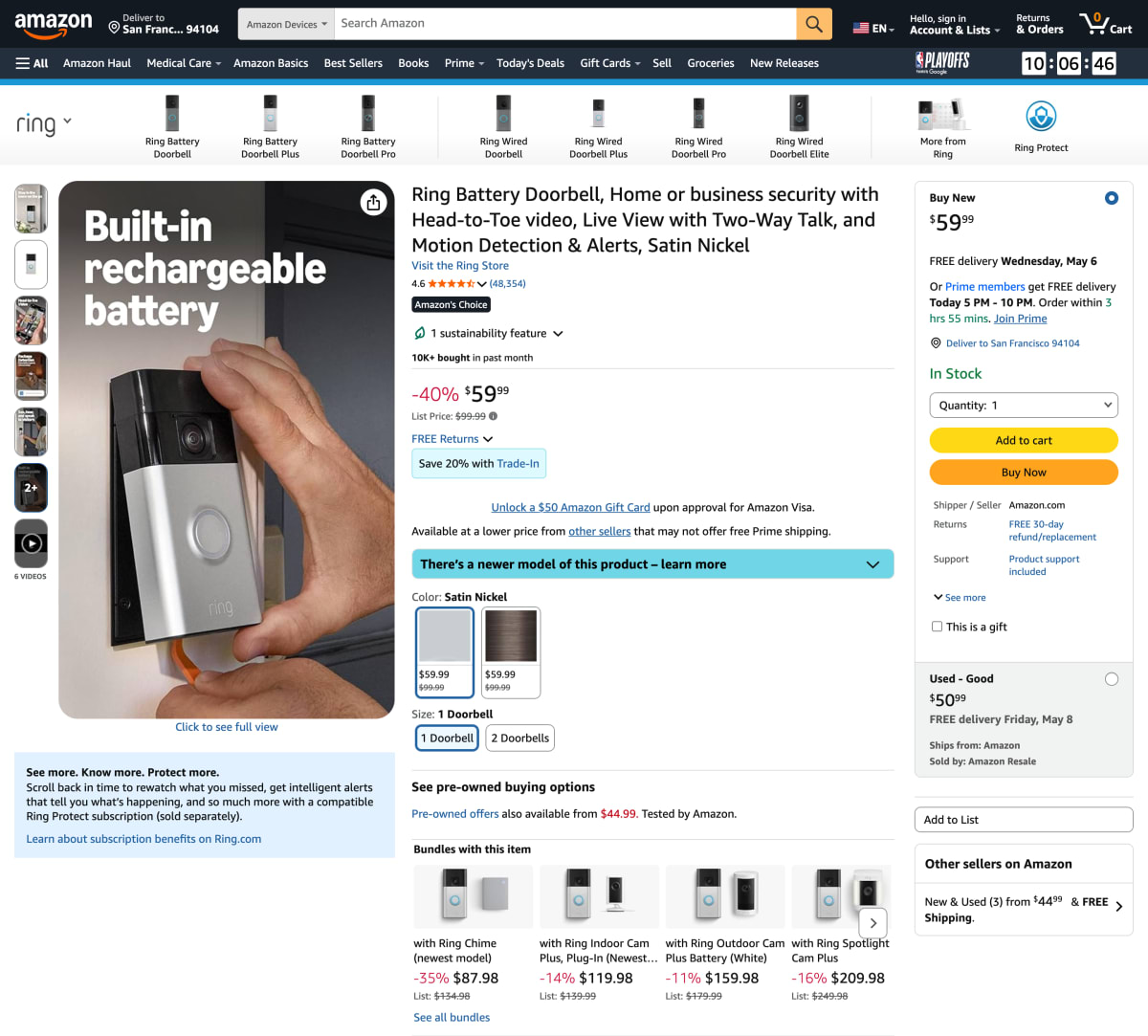
Specifically, this is a page for one of Amazon’s Ring doorbell cameras.
Direct response copywriters have always relentlessly tested their copy. In the past, unique coupon codes, PO boxes, and phone numbers allowed writers to measure the success of different headlines, CTAs, prices, and more.
The web, of course, takes that practice to the next level.
Amazon tests everything. When we look at the page above, we know that every headline, bullet point, and image has earned its place in real transactions with real buyers. Let’s walk through what the copy is doing, and how you can borrow every one of these techniques.
Five techniques (and how you can use them)
1. Emotional and algorithmic appeals
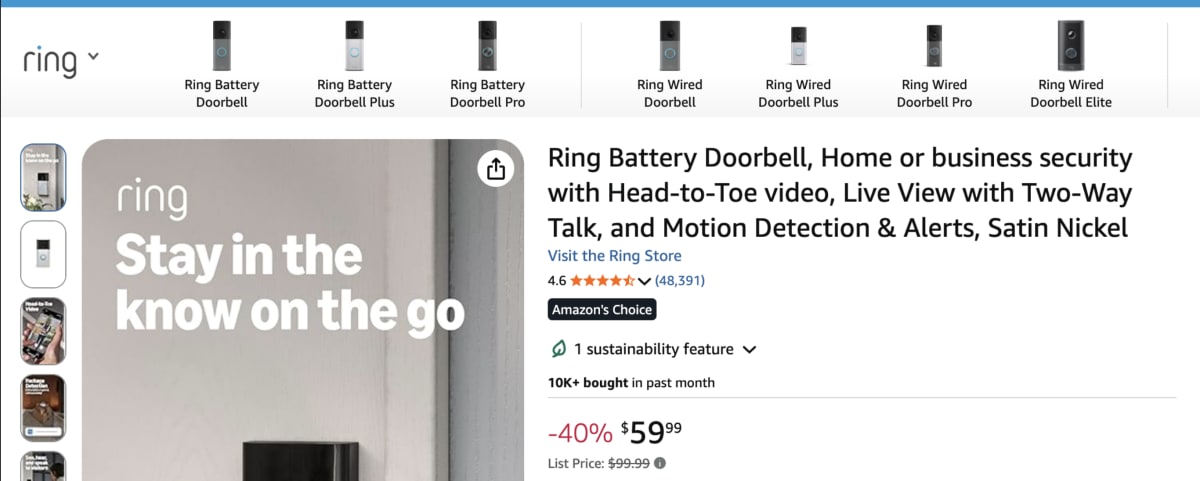
The most visually dominant message at the top of the page isn’t about doorbells at all.
Stay in the know on the go.
The headline is about staying connected to what matters at home, wherever you are.
The best copy doesn’t introduce new ideas to the reader—it enters the conversation that’s already happening in their head. Homeowners who need a video doorbell are already thinking about stolen packages, someone calling while they are at work, or not knowing who’s at the door. Stay in the know on the go meets that conversation exactly where it is.
And that emotional message is paired with the product’s full listing title:
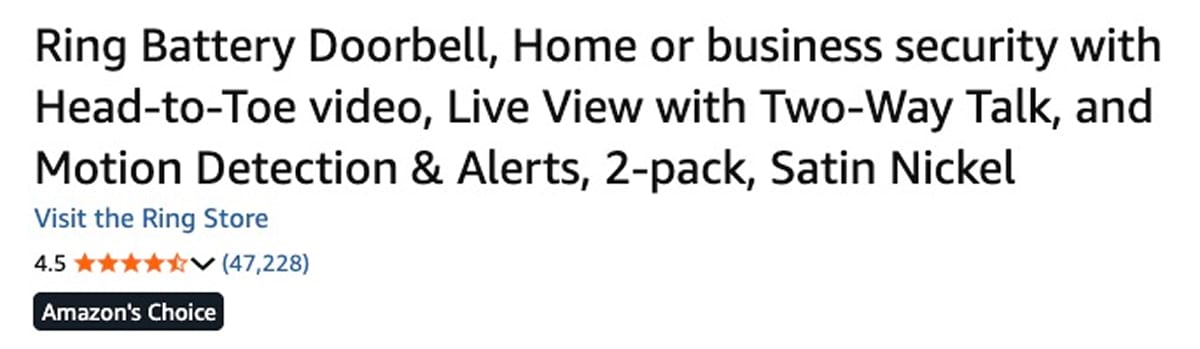
Ring Battery Doorbell, Home or business security with Head-to-Toe video, Live View with Two-Way Talk, and Motion Detection & Alerts, 2-pack, Satin Nickel
Amazon’s search engine—like Google’s—rewards titles that contain the words people type. This is written for the algorithm, and for shoppers who already know what they need. But even within the title, notice that the features use benefit-inflected language wherever possible. Not “180-degree vertical field of view” but “Head-to-Toe video.” Not “passive infrared sensor” but “Motion Detection & Alerts.”
Both headlines are looking to create an emotional yes—to make the right person feel understood before they’ve read a single word of explanation.
How could you use this? What’s the conversation your prospect is already having with themselves before they find your product? Not just the features they’ll appreciate once they own it—the worry, the desire, the half-formed hope that’s already there.
This approach follows the jobs to be done framework. People don’t buy products; they “hire” them to make progress in their lives. The job a video doorbell gets hired for isn’t “monitor the front door”—it’s something more like “stop worrying about parcels sitting outside my door.” The closer your copy gets to the actual job your product is hired to do, the less work the reader (and search algorithm) has to do to recognize its relevance.
2. Every subhead pulls double duty
The Ring page isn’t just built for one type of reader. Some people will read it top to bottom. Most won’t.
Any long page must accommodate what we explored in our analysis of the classic Ogilvy travel ad. In this dual-track reading behavior, some visitors read every word and others scan only the signposts. The Ring page solves this elegantly because every section subhead is a complete benefit statement.
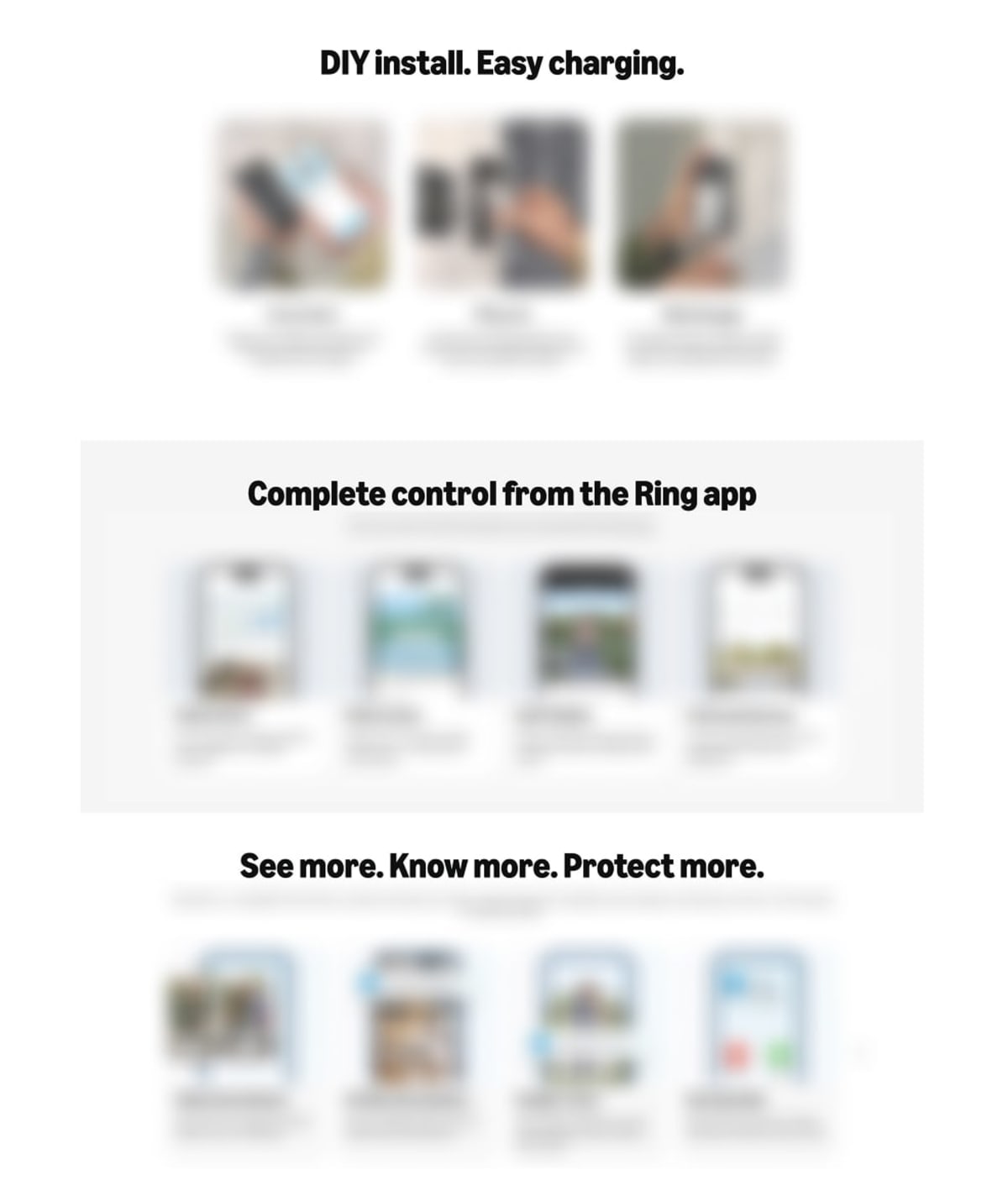
Here’s a list of all the subheads:
- Know what’s up—and down. (Head-to-toe vision).
- Stay connected to who’s there.
- DIY install.
- Easy charging. Complete control from the Ring app.
- See more. Know more. Protect more.
- Works with Alexa.
That’s a full sales pitch, compressed into under 40 words that a scanner can absorb in under ten seconds. For readers who slow down, each subhead introduces body copy and visuals that deepen the case. The subheads serve both groups simultaneously, without sacrificing anything for either.
How could you use this? Run the “subheads only” test on your own pages. If you read just the section headers—nothing else—do they make a coherent, compelling argument for your product? If they don’t, your scanners are leaving unconvinced.
3. Two objections neutralized in four words
The installation section deserves its own study. Two sentences. Four words. Two big objections pre-empted. DIY install. Easy charging.
Every potential buyer of a smart home device has the same anxieties: Is this going to be a pain to install? and What happens when the battery dies? The copy doesn’t wait for those objections to crystallize in the reader’s mind. It answers them upfront, before the questions are even asked.
This is the Objection/Counter-Objection (O/CO) approach that sits within step 3 of our methodology—identifying the concerns that kill purchases and neutralizing them as early as possible on the page. The Ring page does it in a subhead.
Notice also what the copy doesn’t say. It doesn’t say “simple installation,” which is vague and could mean anything. “DIY” is specific and carries a particular meaning. You can do this yourself today. That specificity is doing work that a softer phrase couldn’t.
How could you use this? List the two or three objections your customers typically have before they buy. Now ask: where does your copy address them? If the answer is “buried in the FAQs” or “in the third paragraph,” you have a clear opportunity to bring those answers forward. Earlier is better.
(If you need a way to gather customer objections, read our article on the five golden questions.)
4. The “slippery slide” to make installation feel simple
Below the “DIY install. Easy charging.” subhead, the copy reduces the entire installation process to three verbs: Connect. Mount. Recharge.

Joe Sugarman described this kind of approach as the “slippery slide”—the idea that every element of copy should keep the reader moving forward rather than giving them a reason to pause. A complicated installation section is the opposite of a slippery slide. Three simple verbs feel frictionless.
Contrast this with how the same information might have been written as a paragraph:
First, download the Ring app and connect the device to your home Wi-Fi network. Then, mount the doorbell to your door frame using the included installation kit. Finally, recharge the battery via USB cable when the indicator light shows low power.
That’s accurate, but reading it feels like work.
The three-verb version isn’t hiding information; it’s making a promise. This is the kind of thing you can do. The rest of the page delivers on that promise with visuals and step-by-step detail. But the first impression is one of lightness.
How could you use this? Where are you making something feel more complicated than it is? Every additional step, every caveat, every “but first you’ll need to” adds perceived friction. What can you collapse or eliminate without losing meaning?
5. Different types of proof for different types of skepticism
The Ring page includes piles of proof, but it doesn’t deliver it all in one place. It distributes it deliberately across the entire experience.
At the top: star ratings and review counts—social proof, immediately visible to any visitor.
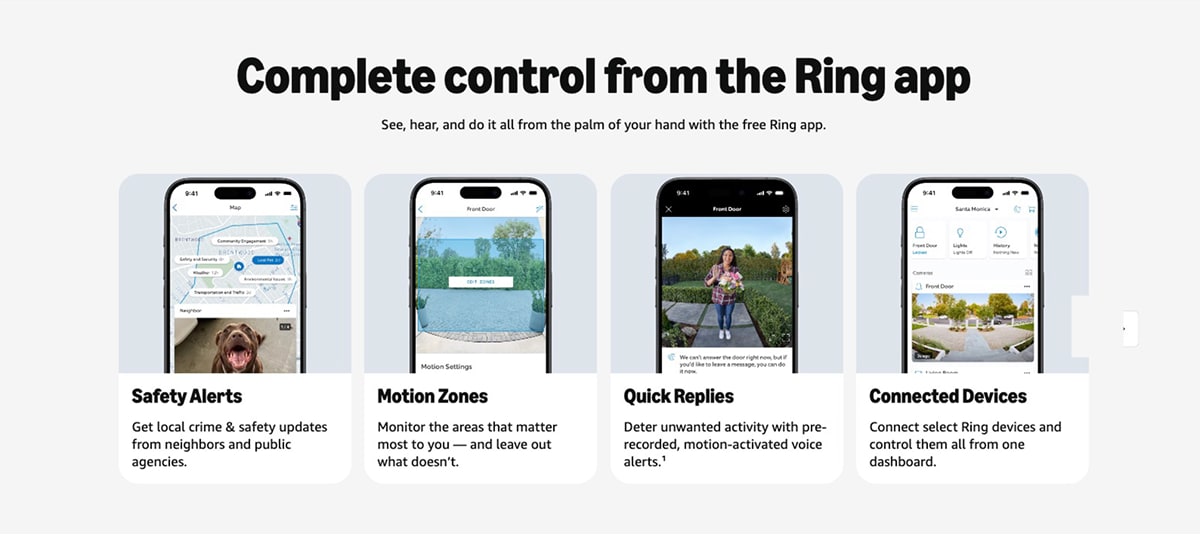
As we’ve seen before, the benefits sections includes app interface screenshots (demonstration proof) showing you exactly what the experience looks like.
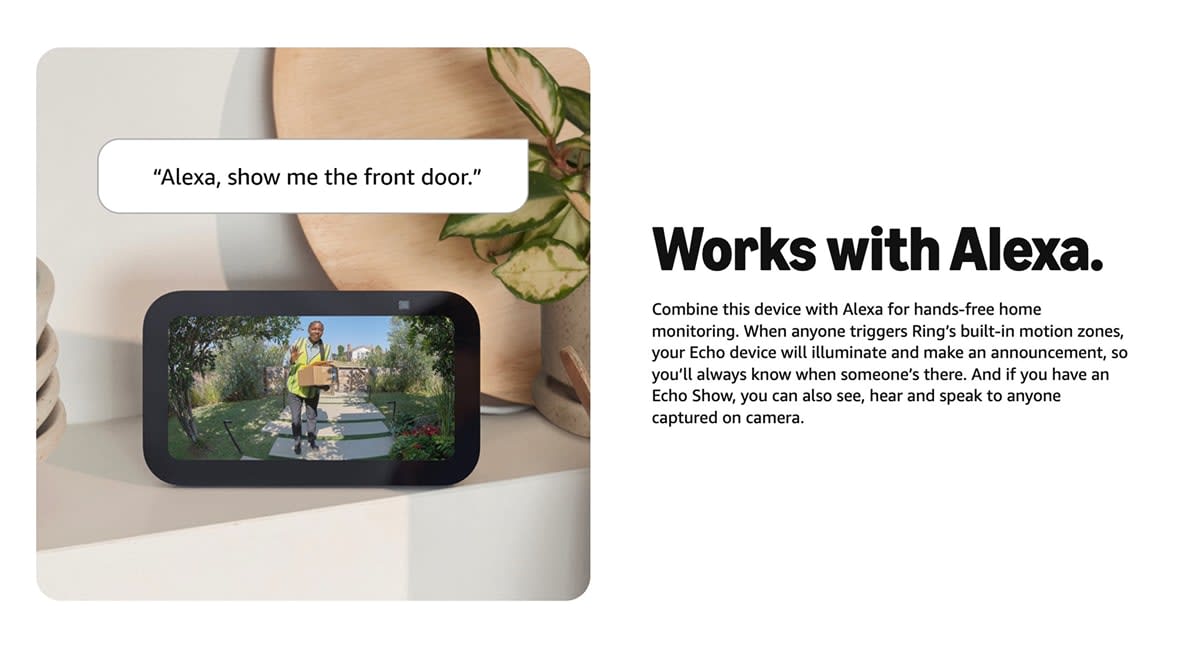
Then the “Works with Alexa” section—borrowed authority from one of the biggest brands in consumer technology.
There’s even a technical details table (which we’ll save you from here) that provides the exact specs and capabilities for buyers who need them.
Can you see how each type of proof speaks to a different kind of skepticism?
- Star ratings reassure first-time buyers who are on the fence.
- App screenshots reassure people who want to know what the experience will actually feel like.
- The Alexa integration reassures people who worry about compatibility with what they already own.
- Technical specs reassure geeks (like us at CRE) who go deep into the details.
Our ultimate guide to proof identifies seven types of persuasive proof elements—and the Ring page uses at least five of them, spaced across the page so the reader encounters fresh reassurance at each scroll depth. Skepticism never gets time to build.
How could you use this? You probably have proof of your own—testimonials, data, guarantees, demonstrations—but where does it appear?
If it’s all concentrated at the bottom of the page, you’re asking readers to make most of the journey unconvinced. Ensure that you spread proof across the experience so there’s always a reason to keep believing.
The lab that never closes
Here’s what makes the Ring Amazon page worth your time: it isn’t the work of one copywriter’s best instincts. It’s the accumulated result of real experiments run against real buyers, where sales is the only metric that matters. When copy performs in that environment, it’s not a fluke.
See you next time on Copywriting Friday.
How much did you like this article?
What’s your goal today?
1. Hire us to grow your company
We’ve generated hundreds of millions for our clients, using our unique CRE Methodology™. To discover how we can help grow your business:
- Read our case studies, client success stories, and video testimonials.
- Learn about us, and our unique values, beliefs and quirks.
- Visit our “Services” page to see the process by which we assess whether we’re a good fit for each other.
- Schedule your FREE website strategy session with one of our renowned experts.
Schedule your FREE strategy session
2. Learn how to do conversion
Download a free copy of our Amazon #1 best-selling book, Making Websites Win, recommended by Google, Facebook, Microsoft, Moz, Econsultancy, and many more industry leaders. You’ll also be subscribed to our email newsletter and notified whenever we publish new articles or have something interesting to share.
Browse hundreds of articles, containing an amazing number of useful tools and techniques. Many readers tell us they have doubled their sales by following the advice in these articles.
Download a free copy of our best-selling book
3. Join our team
If you want to join our team—or discover why our team members love working with us—then see our “Careers” page.
4. Contact us
We help businesses worldwide, so get in touch!
© 2026 Conversion Rate Experts Limited. All rights reserved.
A Brandwidth Group Company.