Copywriting Friday: How Old Spice made itself new
Copywriting Friday highlights the tools and techniques of persuasive content. Some of the examples may seem dated, but the principles are timeless (and critical for conversion rate optimization). Enjoy.
Although the buyer and the user are the same for many businesses, for a surprising number, they aren’t. And when they aren’t, knowing which you are speaking to can make a massive difference.
How one brand flipped its fortune by horsing around
In 2010, a grooming brand for men bet its comeback on that distinction. Old Spice had aged into a punchline, the smell of your grandfather’s medicine cabinet. They made a decision that flipped the brand’s fortunes… a decision about who to talk to.
The result, “The Man Your Man Could Smell Like,” became the most-talked-about grooming ad of the decade. Let’s take it apart, because underneath the surface, there’s a lesson you can use on your next email, headline, or landing page.
The ad starred Isaiah Mustafa, a former NFL practice-squad player. He and the crew delivered the whole thing in a single take (after three days of trying) with minimal visual effects.
Here’s the whole script:
Hello, ladies, look at your man, now back to me, now back at your man, now back to me. Sadly, he isn’t me, but if he stopped using ladies’ scented body wash and switched to Old Spice, he could smell like he’s me. Look down, back up, where are you? You’re on a boat with the man your man could smell like. What’s in your hand, back at me. I have it, it’s an oyster with two tickets to that thing you love. Look again, the tickets are now diamonds. Anything is possible when your man smells like Old Spice and not a lady. I’m on a horse.
The copy reads as comedy, especially if you know the ad. It’s a delight to read, but this is Copywriting Friday, so we’re going to dig into the serious strategy going on beneath the inanity.
What’s happening beneath the humor
It speaks to the buyer, not the user
Look at the first two words again. Hello, ladies. This is men’s body wash, and it opens by addressing women. That’s not a gag. It’s the strategy.
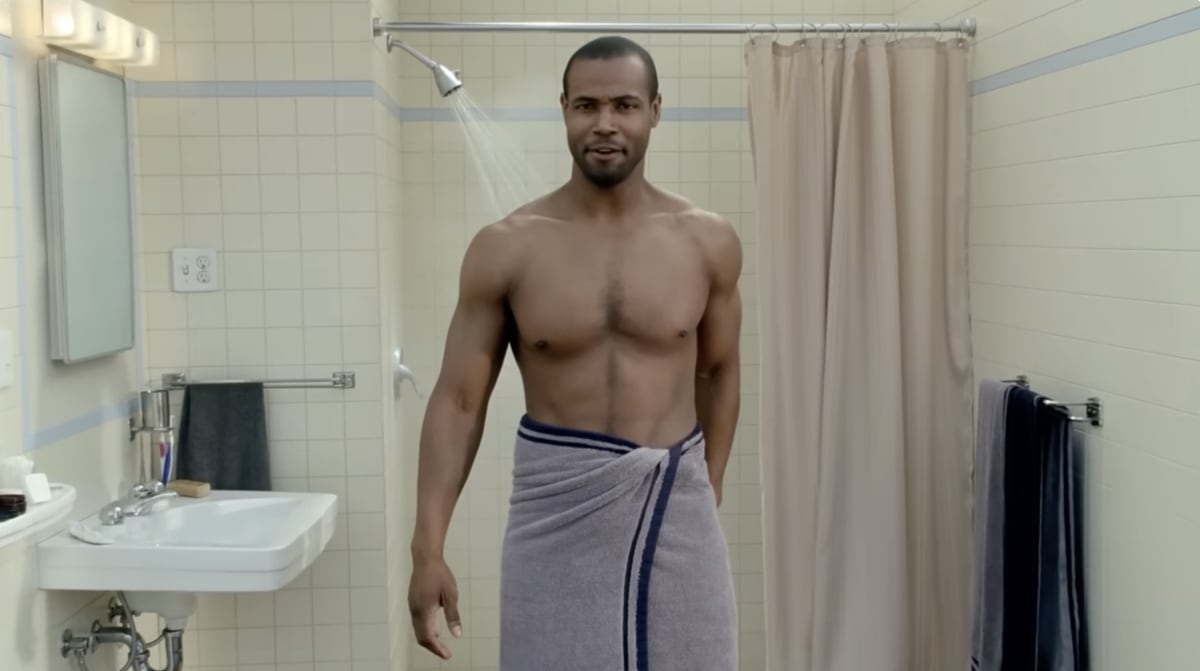
The brand’s research had told them that women made about 60% of men’s body-wash purchases. So the team stopped writing to the man in the shower and started writing to the woman in the aisle. While competitors fought to persuade men, Old Spice persuaded the other (larger) audience who were making most of the decisions.
From there, they followed what may be the oldest rule in direct response, the one Robert Collier gave us a century ago in The Robert Collier Letter Book: “Always enter the conversation already taking place in the customer’s mind.” So before you sit down to write, consider whether you should separate these two roles:
- The user is the person who’ll actually use what you sell.
- The buyer is the person who chooses it, pays for it, or signs it off.
Are they the same person for your product and service, or not? The distinctions can be subtle but powerful. For example… a developer lives in the project-management tool, but the team lead expenses it. The kid wears the shoes, but the parent buys them. Find the moment their worries diverge: the developer wants fewer clicks, the team lead wants to look good to their boss.
If it turns out that your user and buyer are different, reread your homepage and ask whose concerns it answers. If every headline or bullet speaks to the user, you may be relying on their ability to convince the person who really matters.
Do you trust them to do it right?
The salutation is a three-second filter
“Hello, ladies” does a second job beyond charm. It sorts the room. A woman watching knows immediately that this one is for her.
Calling out your reader in the opening line is one of the oldest moves in copywriting. It works because attention is selective. We lean in when we hear our name, our job, or our problem. If you’ve followed Copywriting Friday, you’ll know that we’ve broken this down before, in an ad written for sports fans who already know everything and in a golf headline that names its exact reader. The Old Spice wrinkle is who gets called out… the buyer instead of the user.
You’ve found your buyer. Now make your first line prove it to them. One test: could the opening be addressed to anyone? If it could, it’s addressed to no one.
Name them outright, the way “Hello, ladies” does. Watch what it does to a generic opener:
- “Managing a remote team is hard.” becomes: “You’re the manager on a team of twelve who have never met in person.”
- “Our software saves you time.” becomes: “You’ve got a board deck due Friday, and half the numbers are still sitting in someone’s inbox.”
The second version doesn’t describe the reader. It drops them into the exact room they’re standing in, and the right reader leans in because it’s unmistakably about them.
It sells the feeling, not the feature
Here’s something that the ad doesn’t do… it never really talks about the product. There are no scent notes, ingredients, or specific claims. Instead we get a boat, an oyster, two tickets to that thing you love, diamonds, and a horse.
As a side note, “that thing you love” is just a perfect line. Makes us smile every time.
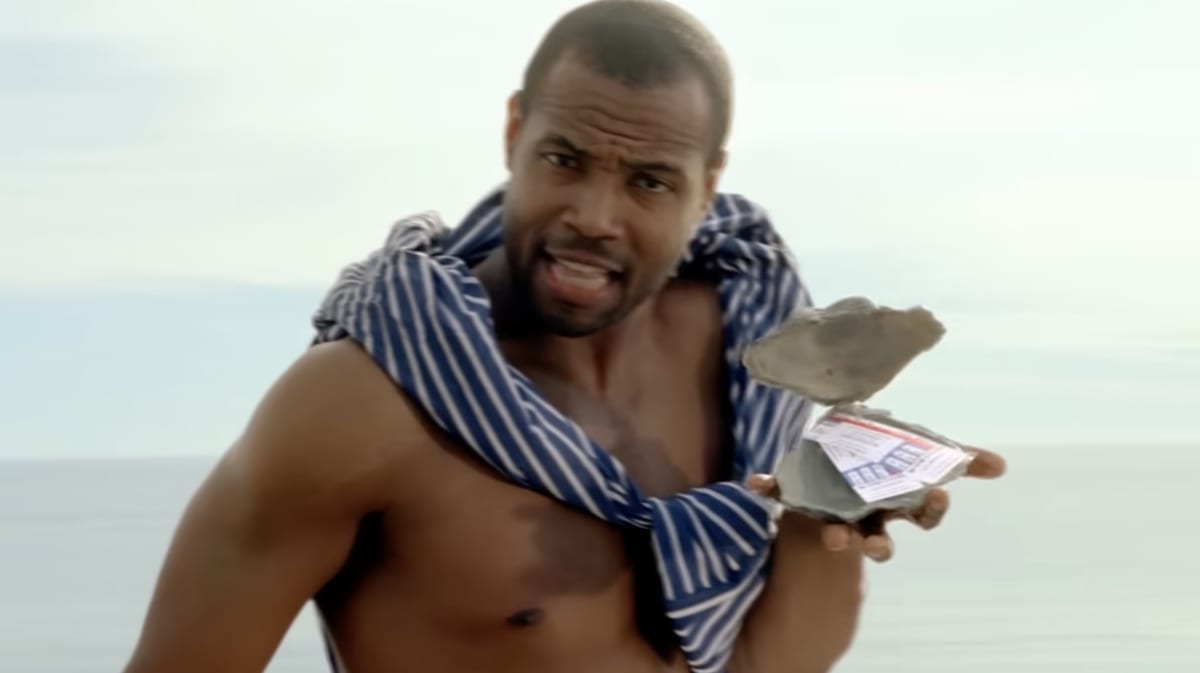
But listen, the product is soap. As we’ve seen before, soap is a pretty basic thing. What Old Spice sells is the transformed man and the life around him.
Copywriters call this the benefit of the benefit. It’s not the feature, not even the direct benefit of the feature, but the result the buyer is really shopping for. She isn’t buying scent. She’s buying the dream of a confident, attractive partner, and the ad hands it to her in fifteen seconds of escalating nonsense. Sell the sizzle, not the steak, the old sales maxim goes. This ad is all sizzle. It never once mentions the steak.
Try laddering one of your own features up to the dream:
- Feature is what it is. “256-bit encryption.”
- Benefit is what it does. “Your data is secure.”
- Benefit of the benefit is the life that buys. “You sleep through the night without wondering if today’s the day you get breached.”
Old Spice skips the bottom two rungs and hands the buyer the top one with no shame. Try writing your top rung first. Your features will still be useful later, as you start to build proof.
The comedy is the pitch
In many ads, humor sits on top of the message. It’s a technique to make the “sell” easier to swallow. Here, there’s no ask to soften. The whole thing is comedy, and it works by never slowing down long enough to let you argue.
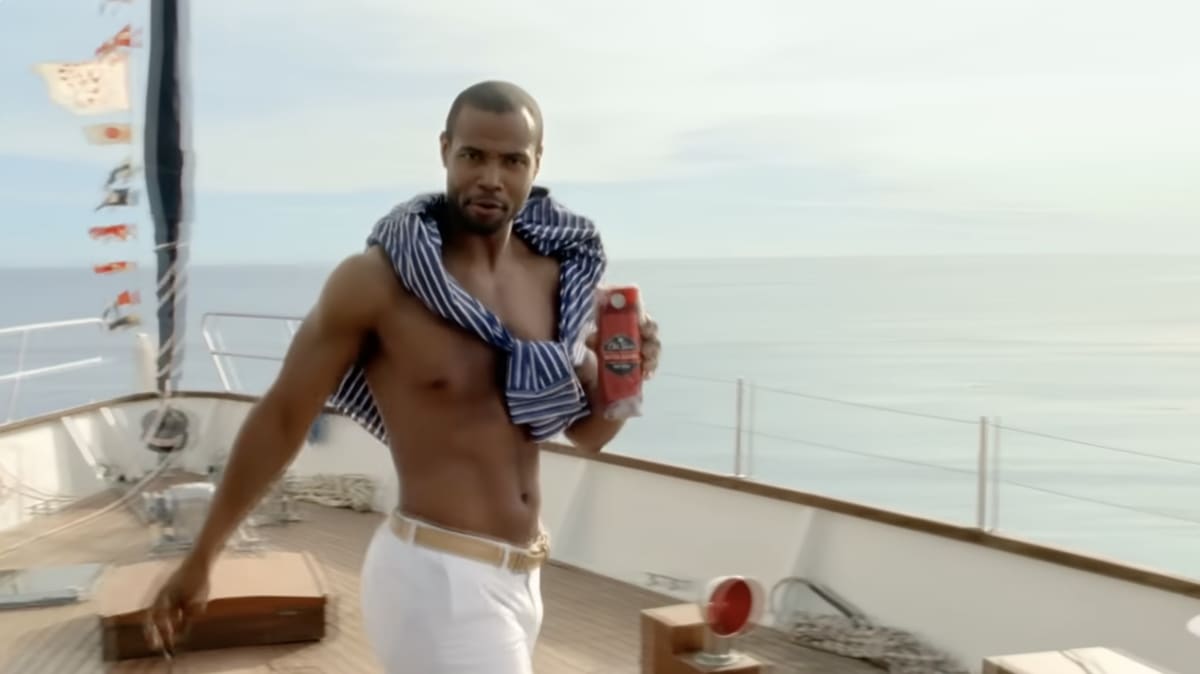
No waiting. Every beat delivers some new absurdity and snatches it away before you can object. Boat, oyster, tickets, diamonds, horse. Joe Sugarman called this the slippery slide. Each moment’s only job is to get you to the next one, until you reach the bottom without meaning to. Here, the jokes are the grease.
But look at what holds the whole thing together. Nerve. There’s no proof, no comparison, and no guarantee. Just a man in a towel narrating an impossible sequence, never once doubting you’ll follow him onto the horse. Body wash is a commodity, one bottle much like another, so when a product can’t win on features, the voice becomes the product.
Old Spice wins on sheer assurance. (The single unbroken take is that assurance made visible. A cut might break the spell.)
For the rest of us, this means finding the line where our copy hedges instead of being certain. “We think this might help.” “One of the benefits could be…” Soft qualifiers like these allow readers to slow down and start to argue.
We think you should probably cut them wherever you can.
To be clear, we’re not saying that you should make a claim you can’t back up. But where you have the evidence, say it plainly. Confidence, calibrated to what you can prove, reads as competence.
The response that made it legendary
The 30-second spot in 2010 made Old Spice famous to a new generation. What happened five months later made it the kind of thing we want to analyze on Copywriting Friday.
In July, Old Spice put Mustafa back in the bathroom set and had him record short, personalized video replies to fans, journalists, and celebrities who’d mentioned Old Spice online. Over the next two and a half days, the team filmed and posted 186 of these responses… some going from a stranger’s tweet to a finished video in under fifteen minutes. Mustafa replied to celebrities with millions of followers and to ordinary people with barely any.
Here’s one of his replies to Alyssa Milano:
The first day drew 5.9 million YouTube views. By day three, more than 20 million.
But views mean reach, not results. The number that counted showed up on the shelf. According to Nielsen data, Old Spice body-wash sales rose 55% over the three months around the campaign, and up 107% in its strongest month.
The brand supported the campaign with promotions and other marketing, so it’s not possible to attribute all gains to this one ad. But we do know that by the end of 2010, Old Spice was the best-selling men’s body wash in the United States.
An aging punchline became the category leader by deciding, in some significant part, to talk directly to the real buyer.
The lesson here isn’t to “make 186 videos”; it’s the power of the personal touch. Whether celebrities or not, the targets of the videos responded just as we would… if we were singled out by someone who mattered, who answered our specific comment, who said our name.
Being realistic, most businesses can’t staff a film crew for two days, but we can borrow the instinct. Where could a personal, specific, fast reply replace a generic one in your business? A founder’s two-line video answer to a prospect’s question. A support reply that uses the customer’s own words back to them. A thank-you that names what this buyer actually bought. Your channel may be smaller than Old Spice, or bigger. It doesn’t matter. The principle behind this always scales.
The writers you’d like to write like
The genius of “The Man Your Man Could Smell Like” isn’t the horse, the towel, or the single take, delightful as they are. It’s a handful of decisions any of us can make in our marketing. If you want to write like the writers you admire, try these:
- Write to the buyer, not the user. Of course, you may need to sell to each at different stages of the customer journey, addressing the distinct worries and hopes of both.
- Call them out in the first line. Make the opening unmistakably theirs, so the right reader leans in and everyone else moves on.
- Sell the benefit of the benefit. Skip the feature and the freshness. Hand them the life on the other side of the purchase.
- Win on nerve when you can’t win on features. Cut the hedges, keep the reader moving, and say what you can prove without apologizing for it.
- Answer like it’s personal. Wherever a fast, specific, named reply can replace a generic one, use it.
Not one of these needs a horse or a film crew. They need you to decide who’s holding the wallet, then write as though that person were the only one in the room.
So before you polish your next headline: look at your product, now back to your buyer. Now back to your product, now back to your buyer. Are you sure you’ve been writing to the right one?
See you next time on Copywriting Friday.
How much did you like this article?
What’s your goal today?
1. Hire us to grow your company
We’ve generated hundreds of millions for our clients, using our unique CRE Methodology™. To discover how we can help grow your business:
- Read our case studies, client success stories, and video testimonials.
- Learn about us, and our unique values, beliefs and quirks.
- Visit our “Services” page to see the process by which we assess whether we’re a good fit for each other.
- Schedule your FREE website strategy session with one of our renowned experts.
Schedule your FREE strategy session
2. Learn how to do conversion
Download a free copy of our Amazon #1 best-selling book, Making Websites Win, recommended by Google, Facebook, Microsoft, Moz, Econsultancy, and many more industry leaders. You’ll also be subscribed to our email newsletter and notified whenever we publish new articles or have something interesting to share.
Browse hundreds of articles, containing an amazing number of useful tools and techniques. Many readers tell us they have doubled their sales by following the advice in these articles.
Download a free copy of our best-selling book
3. Join our team
If you want to join our team—or discover why our team members love working with us—then see our “Careers” page.
4. Contact us
We help businesses worldwide, so get in touch!
© 2026 Conversion Rate Experts Limited. All rights reserved.
A Brandwidth Group Company.