Copywriting Friday: How to compete when you can't outshine the giants
(By the way, to get articles like this free in your inbox, subscribe to our newsletter.)
Copywriting Friday highlights the tools and techniques of persuasive content. Some of the examples may seem dated, but the principles are timeless (and critical for conversion rate optimization). Enjoy.
Procter & Gamble, Lever Brothers, and Colgate-Palmolive were spending fortunes telling homemakers that their detergents contained miracle ingredients. These exotic and branded compounds promised whiter whites, smoother hands, and, by implication, happier lives.
Then, in September 1949, a small California business called the Stryker Soap Company ran an ad in Reader’s Digest that did the unthinkable.
It told the truth.
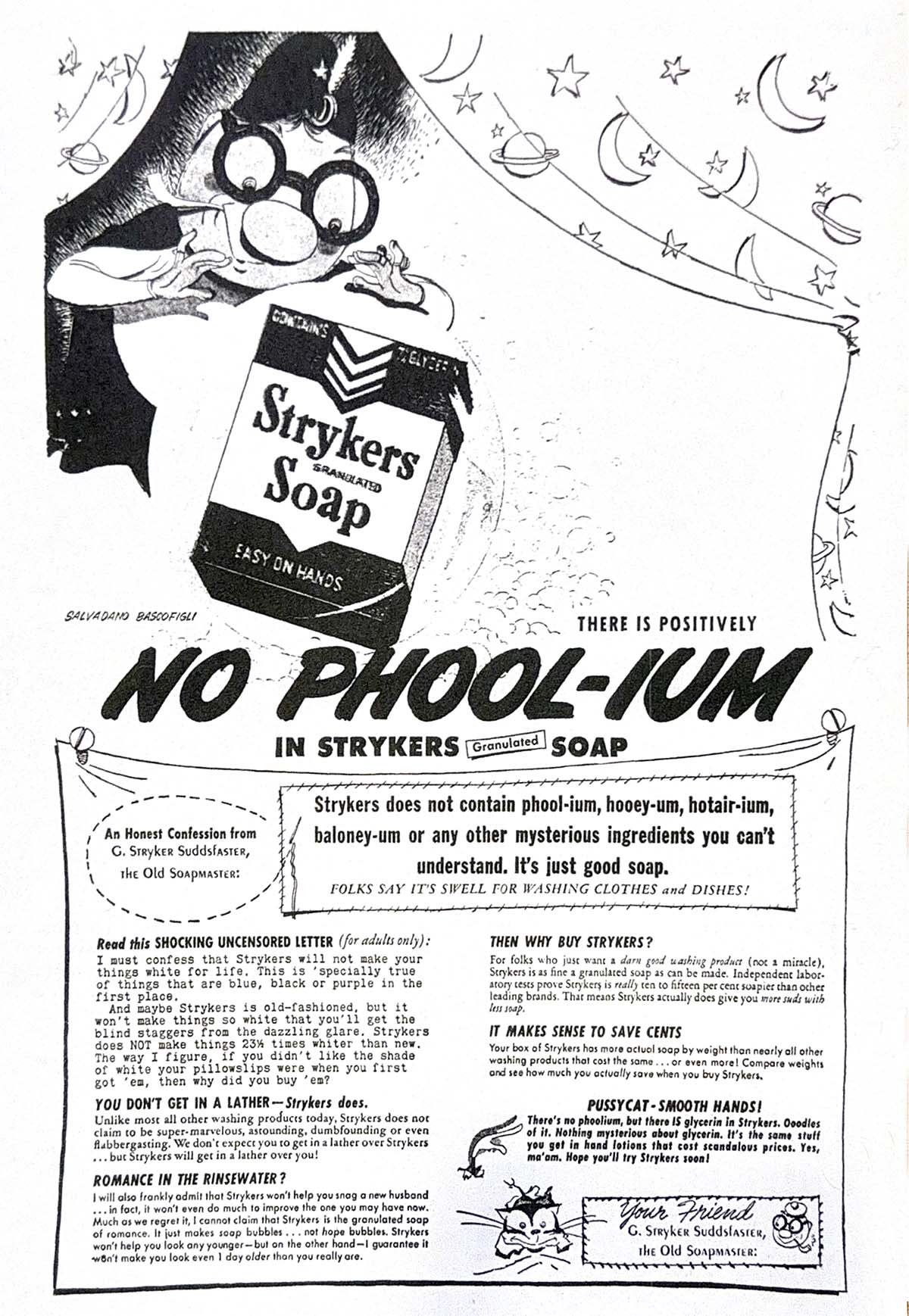
What makes this ad worth studying isn’t just a grab bag of techniques; it’s a strategic positioning choice that allowed Strykers to compete against far bigger brands.
Positioning before copy
Let’s look at that strategic choice before we look at how.
Every other soap was positioning itself the same way: a miracle product, full of mysterious ingredients, capable of transformations that border on the supernatural. The subtext to the audience of the day was transparent. Buying it will make you a better spouse. A more loved parent. A more enviable neighbor.
The Strykers ad took the opposite position. We’re the soap that’s just soap. Not a miracle. Not a transformation. A darn good washing product, fairly priced, made by a company that’s happy to tell you exactly what’s in the box.
The ad has great copy, but that’s only possible because of the positioning. The counter-category framing gave the copywriter the license to write a creative, playful, and honest ad.
And we’re guessing they did it with a smile on their face.
What the position lets the ad do
Mocking the category’s language
For starters, the headline names something that doesn’t exist:
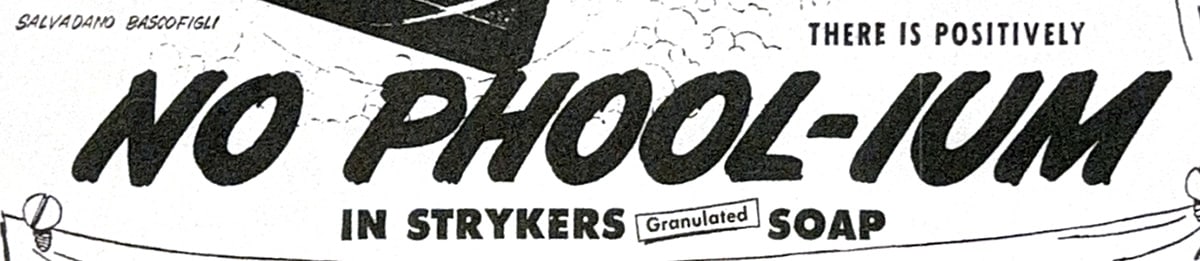
Phool-ium, we can confirm, is not a real ingredient. Nor are hooey-um, hotair-ium, or baloney-um, all of which Strykers cheerfully confirms its soap also doesn’t contain. The joke hits the target audience because they have seen the ads too.
The goal here is pattern interruption at the category level. While every other ad on the newsstand is shouting about a proprietary breakthrough, Strykers is naming the genre and making it look silly. The reader, who has been steeped in years of “Now with Ingredient X!” copy, looks up—Wait, this one’s different.
This only works because of the position. You can’t credibly mock the category’s hype if you’re planning to add some hype of your own. The position has to be authentic before the parody can land. (We’ve written before about how picking a fight with the conventions of a niche builds rapport.)
How could you use this? Every category has its own phool-ium, the overwrought claims, the buzzwords nobody really understands, the imaginary syllables added to ordinary ingredients. If you can name them and gently mock them, you create instant separation.
But to do that successfully, you have to earn the right.
Admitting the weaknesses up front
The ad’s main block of copy is framed as a “shocking uncensored letter” from the Old Soapmaster, and most of the body is a list of things Strykers won’t do for you:
- It won’t make your whites white for life.
- It won’t make things 23½ times whiter than new.
- It won’t get you in a lather (Strykers will, but you won’t).
- It won’t help you snag a new husband.
- It won’t even do much to improve the one you may have now.
- It won’t make you look any younger.
As the ad says (and we love this line):
“It just makes soap bubbles… not hope bubbles.”
Humor aside, the psychology at play here is straightforward. When a person or product tries the hard sell, our defenses go up. When they tell us what they can’t do, we tend to relax. The ad is leveling with us in a humorous way. And from that point on, every positive claim Strykers does make lands with much more weight.
Notice that this also only works because of the position. A brand selling miracle ingredients can’t run a list of damaging admissions; it would contradict the entire pitch.
Earning the right to be specific
Once the damaging admissions have done their work, watch what happens when Strykers finally turns to selling. The ad gets two short paragraphs to make its case, and the specifics are striking:
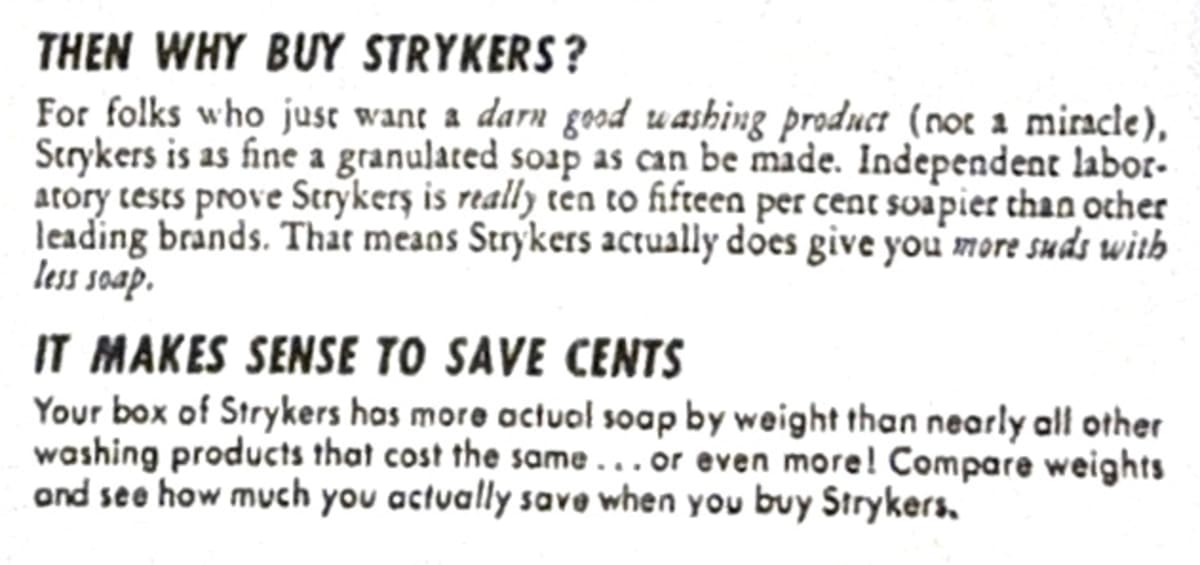
Look at how concrete those claims are. Not “better.” Not “more effective.” Ten to fifteen per cent soapier. More actual soap by weight.
Here’s the thing about specifics: they only persuade if the reader believes you. Strykers’ competitors were also full of numbers (“23½ times whiter!”), but the reader had learned to discount them. The damaging admissions earlier in the ad have flipped the polarity. Now, when the writer says “ten to fifteen per cent,” the reader thinks: Well, if he’s been this honest about what the soap doesn’t do, the number is probably real.
Proof works in context, not in isolation. A guarantee, a statistic, or a test result is only as persuasive as the surrounding copy allows it to be. (See our ultimate guide to proof for the main categories of proof you can deploy, and our analysis of how to persuade skeptical audiences for how the order of claims affects whether they get believed.)
The point here is that the structure of this ad matters. Because Strykers earns the right to be specific, their claims land harder.
Naming what’s actually in the box
Finally, the copywriter calls back to the ad’s headline to turn the joke into a sale. The last block of body copy is a lovely piece of work:
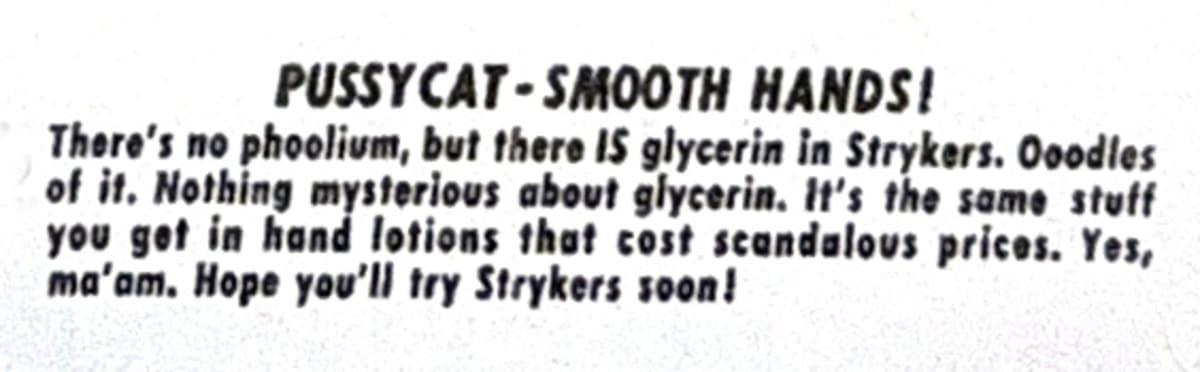
The competitors’ strategy was to take a common ingredient and give it an exotic name. Strykers does the opposite. They name the real ingredient, explain what it is in plain English, and connect it to something the reader already values—the same stuff you get in hand lotions that cost scandalous prices.
And, again, the only reason this works is the position. A brand selling miracles couldn’t credibly say “it’s just glycerin.” A brand selling honesty can, and the unvarnished description makes the product feel more premium, not less, because the reader does the work of comparing it to expensive hand lotion themselves.
The lesson is much broader than soap. If your product has a genuine, demonstrable advantage, the most persuasive thing you can do is describe it the way a friend would describe it. No exotic words or trademarks… just what it is and what it does.
Copy like this feels more like a conversation among friends than a pitch, but it still sells.
Can your brand make a clean break?
Over 75 years after the ad was published, most marketing categories still run on phool-ium. Products get dressed up with capitalized ingredients, vague superlatives, and breathless promises. The arms race never really ends and nobody wins it, because readers learn to discount the whole genre.
The lesson of the Strykers ad is that the way out is a different position. Decide what you’re going to claim, and decide what you’re going to refuse to claim, and let the copy follow.
When Volkswagen ran their classic “Think Small” ad for the VW Beetle a decade after Strykers, they were drawing on the same playbook. Tell the truth. Admit the weaknesses. Trust the reader to do the math. This positioning strategy works.
In your business, the question isn’t whether your competitors are running on phool-ium. They almost certainly are. The question is whether you have the position that lets you run without.
See you next time on Copywriting Friday.
How much did you like this article?
What’s your goal today?
1. Hire us to grow your company
We’ve generated hundreds of millions for our clients, using our unique CRE Methodology™. To discover how we can help grow your business:
- Read our case studies, client success stories, and video testimonials.
- Learn about us, and our unique values, beliefs and quirks.
- Visit our “Services” page to see the process by which we assess whether we’re a good fit for each other.
- Schedule your FREE website strategy session with one of our renowned experts.
Schedule your FREE strategy session
2. Learn how to do conversion
Download a free copy of our Amazon #1 best-selling book, Making Websites Win, recommended by Google, Facebook, Microsoft, Moz, Econsultancy, and many more industry leaders. You’ll also be subscribed to our email newsletter and notified whenever we publish new articles or have something interesting to share.
Browse hundreds of articles, containing an amazing number of useful tools and techniques. Many readers tell us they have doubled their sales by following the advice in these articles.
Download a free copy of our best-selling book
3. Join our team
If you want to join our team—or discover why our team members love working with us—then see our “Careers” page.
4. Contact us
We help businesses worldwide, so get in touch!
© 2026 Conversion Rate Experts Limited. All rights reserved.
A Brandwidth Group Company.