Copywriting Friday: How to prove an unbelievable claim
Copywriting Friday highlights the tools and techniques of persuasive content. Some of the examples may seem dated, but the principles are timeless (and critical for conversion rate optimization). Enjoy.
That was Joe Karbo’s problem. Readers of American newspapers and magazines in the 1970s had seen every get‑rich promise there was, and Karbo’s was the least believable of the lot. He was offering riches for not working.
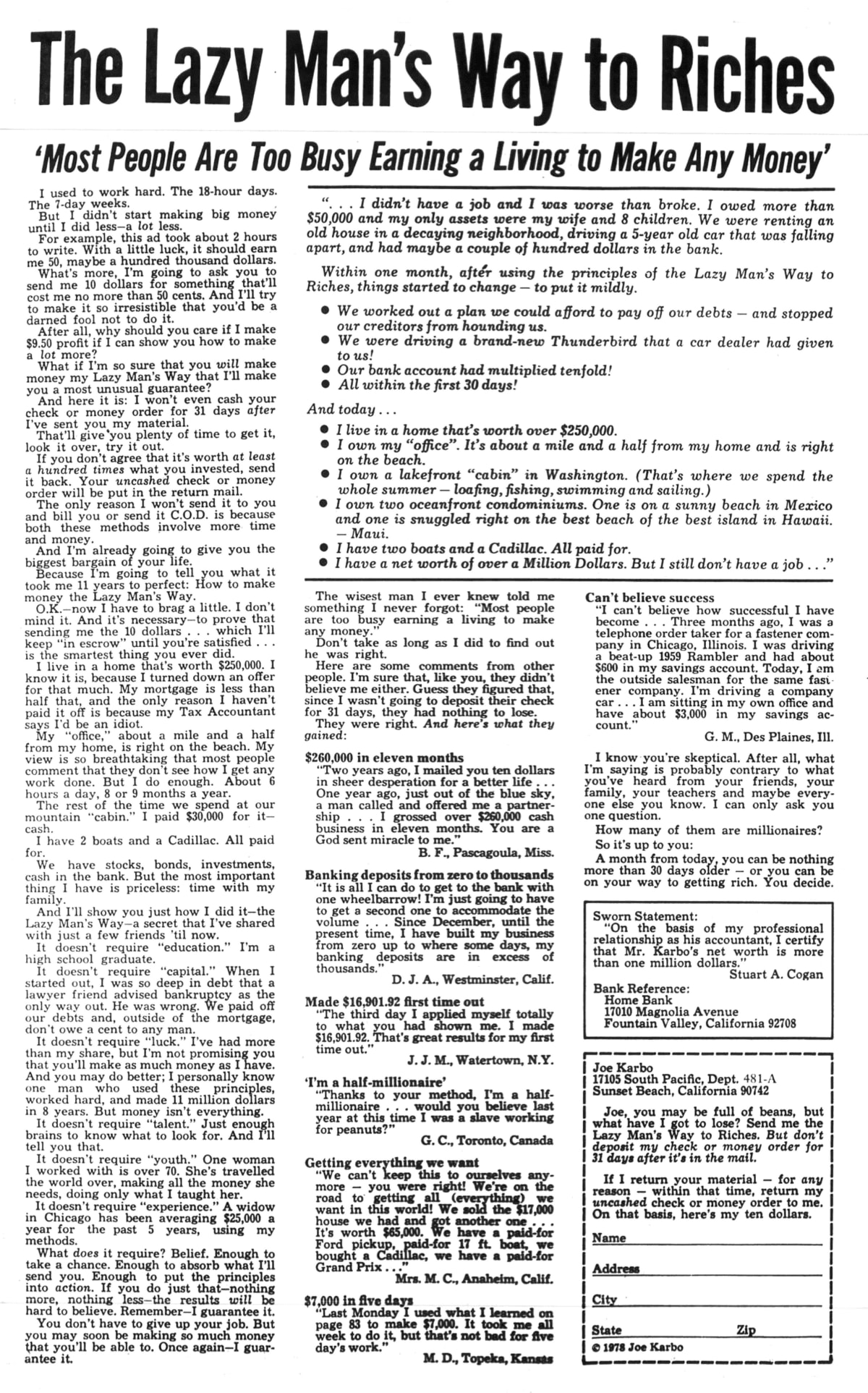
Despite the headline’s unbelievable claim, the book sold. In October 1973, TIME reported that Karbo’s $10 paperback, The Lazy Man’s Way to Riches, had sold around 139,000 copies in six months. And it was still being advertised and selling six years later. (Famed copywriter Joe Sugarman—who knew Karbo—later put the total at 3 million.)
Karbo got there by giving skeptical readers ways to check up on him. Regular readers will recognize the family resemblance with other articles in this series. Claude Hopkins gave his readers a test, and Vitsœ gave its customers reasons they could check. Karbo went a step further and gave them his accountant.
In this Copywriting Friday, we’ll look at how he did it, and how you can do the same for the claims your prospects find hardest to believe.
Karbo ran versions of this ad for most of a decade. In the version above, the headline is the book’s title, and the subhead is a line that Karbo credited to “the wisest man I ever knew” (although he never named him):
“Most People Are Too Busy Earning a Living to Make Any Money.”
Then comes a letter, plain‑spoken and slightly braggy. Karbo describes owing more than $50,000, with eight children to feed. Then he describes the beach office, the boats, and the Cadillac, “All paid for”. It reads like a man talking across a kitchen table:
“O.K.—now I have to brag a little. I don’t mind it. And it’s necessary—to prove that sending me the 10 dollars . . . which I’ll keep ‘in escrow’ until you’re satisfied . . . is the smartest thing you ever did.”
Plenty of ads brag. What makes this one worth studying is how open Karbo is about what he’s doing.
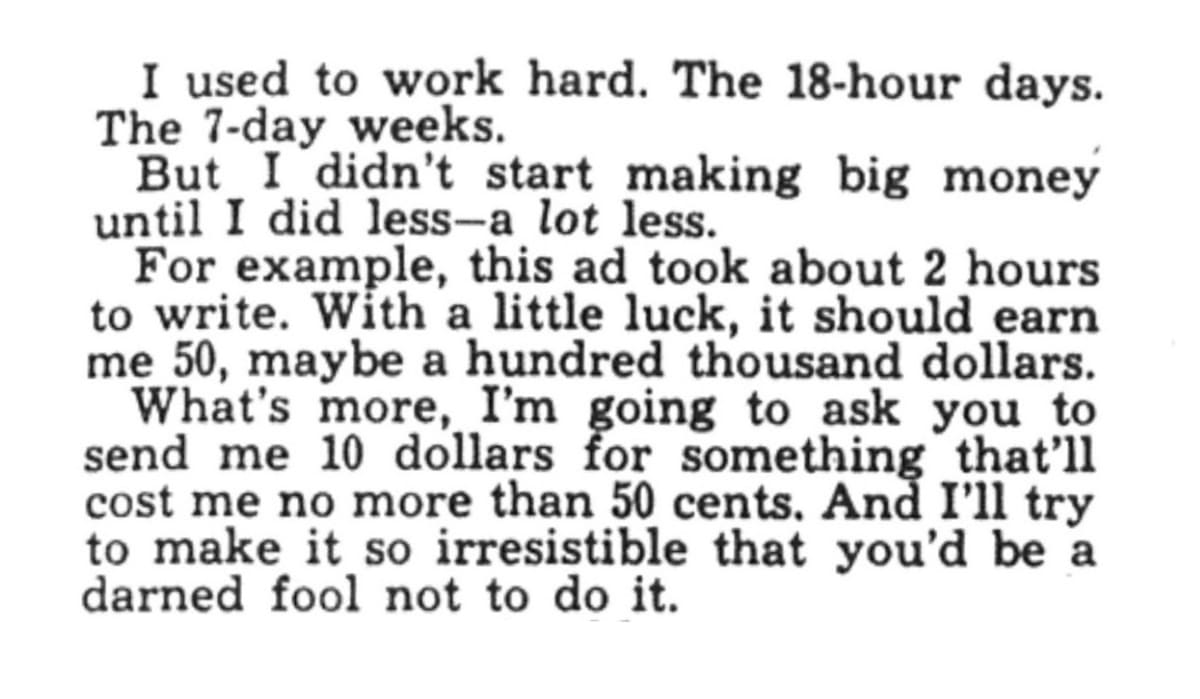
The disarming honesty in the “What’s more…” paragraph is closely related to a damaging admission. Aside from straightforward tone, it makes everything that comes later seem that much more credible.
Proof that asks to be checked
Karbo uses a lot of space to describe his wealth, but he doesn’t just ask the reader to believe him. Look at the box near the foot of the ad, just above the coupon. He’s telling skeptical readers who to ask:
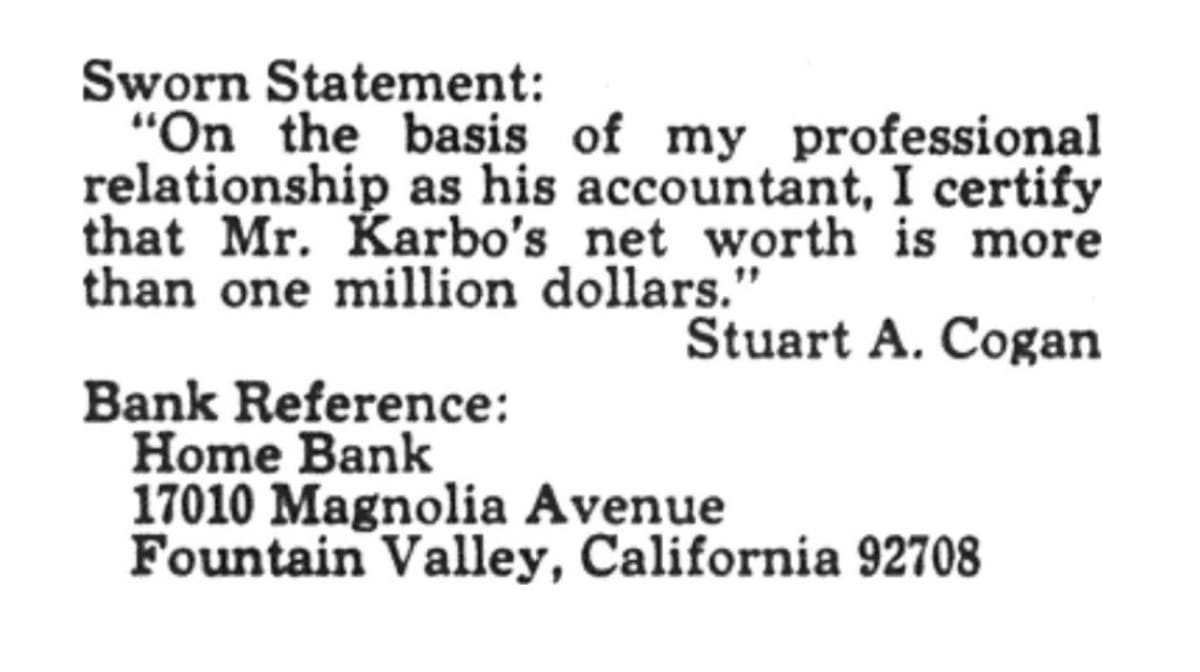
To be clear, most readers would never have tried. The ad gives no firm or phone number for Stuart A. Cogan, and a bank was unlikely to discuss a customer’s net worth with a stranger who wrote in.
It’s the sense that a reader could check that’s doing the work. A named accountant could be tracked down. A named bank with a street address could be written to. Printing them in the ad invites exactly the scrutiny a con artist avoids, because one curious reader with a stamp could start to unravel the claim. It’s the costly signal we explored in our Copywriting Friday on Vitsœ. A claim becomes more believable when it costs a lot for someone with ill intent to make it.
So what could your prospects actually check?
It might be a client who has agreed to take reference calls, an independently audited figure, or an ISO certification that a buyer can look up. Our ultimate guide to proof and our Copywriting Friday on proving your claims by demonstration cover the many kinds of proof. Karbo’s ad suggests a question to ask of each of them. Could the reader check it?
Despite having our own logo wall, we try to create checkable proof wherever we can. Our clients and results page invites prospects to speak with our clients before they hire us.
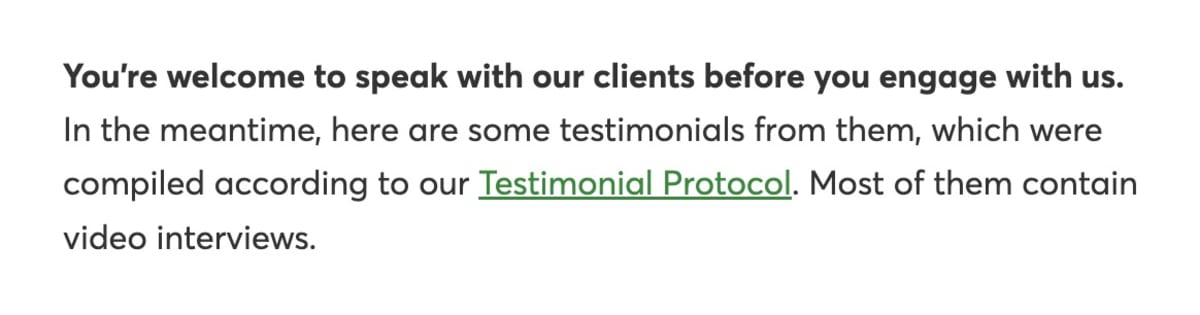
We also invest in recording video testimonials whenever possible, so that anyone who doubts a quote we use can go to the video and watch the client say it.
Make them worry you’re being too generous
Did you notice what Karbo slipped into his apology for bragging? He’ll keep your $10 “in escrow” until you’re satisfied. That phrase calls back to an offer he made a few paragraphs earlier:
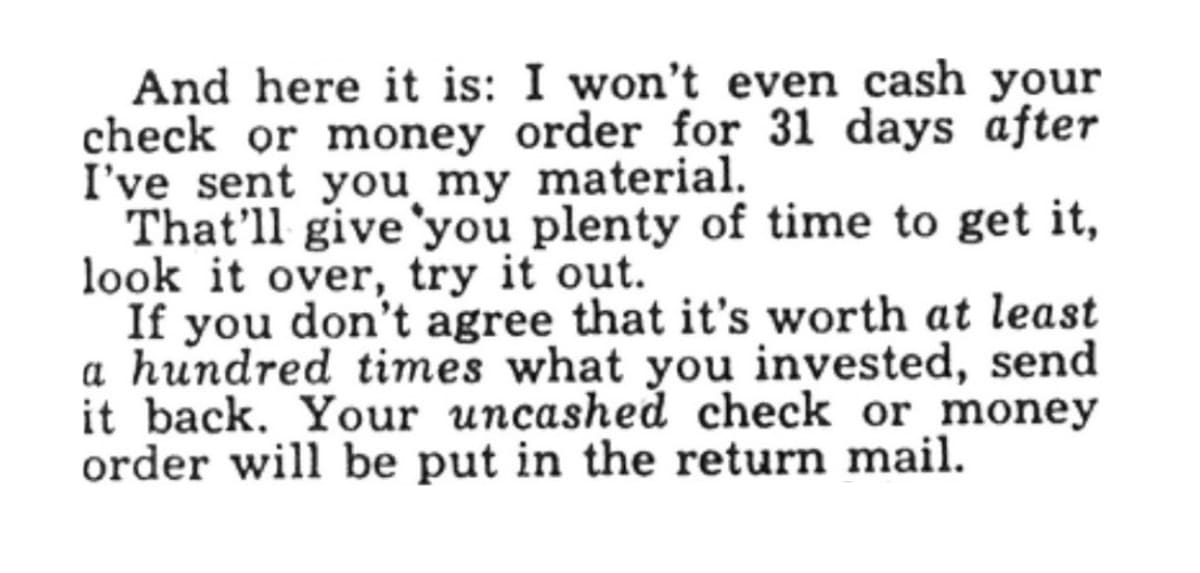
In the 1970s, this was startling. Joe Sugarman, who analyzed the ad in The Adweek Copywriting Handbook, called it “a novel approach.” He also gave the technique a name:
“It was what I call a ‘satisfaction conviction’ because your reaction might have been, ‘Boy, a lot of people are going to rip him off. They’re going to get his book, read it and then return it and get their uncashed check back in the mail.’”
That reaction is the whole point. The offer is so generous that the reader starts worrying on the seller’s behalf. And a reader who’s worried for you has stopped worrying about you.
It works as proof, too. A seller who expected a flood of returns would never make it, and readers could do that math. The conviction of the offer tells us what Karbo expects, and he’s the one person who knows how good the book is.
Compare it with an ordinary money-back guarantee, which asks the buyer to trust that the refund will come. Karbo’s reduces the trust required. The check never gets deposited, so there’s nothing to claw back. “He doesn’t have my money yet” is a very different thought from “I could get my money back,” and a far more comforting one.
Karbo even makes the reader say it. The coupon at the foot of the ad is written in the buyer’s voice:
“Joe, you may be full of beans, but what have I got to lose? Send me the Lazy Man’s Way to Riches. But don’t deposit my check or money order for 31 days after it’s in the mail.”
The skeptic gets to keep their skepticism (“you may be full of beans”) and order anyway.
So what could you offer that would make your prospects worry about you?
Free trials and free returns are expected now, so they no longer startle anyone. A satisfaction conviction has to go beyond the norm in your market. Sugarman’s test is simple. If a prospect reads your offer and thinks, “How can they do that?” you’ve found one.
Tell them what you’re making
Every skeptical reader of a get-rich ad asks the same question. If this works so well, why is he selling it to me for ten bucks? As we’ve already seen, Karbo answers it in the first few paragraphs:
“What’s more, I’m going to ask you to send me 10 dollars for something that’ll cost me no more than 50 cents.”
“After all, why should you care if I make $9.50 profit if I can show you how to make a lot more?”
That’s a startling thing to print. He even admits the ad “took about 2 hours to write” and should earn him “50, maybe a hundred thousand dollars.”
We called this a damaging admission above, but it’s also getting his motive out in the open. Hidden motives make readers suspicious. Once Karbo’s is on the table, and it turns out to be a boringly ordinary one (he makes money selling books), the reader can stop hunting for the catch.
We’ve covered the wider idea of sitting on the buyer’s side of the table. Karbo applies it to his own profit.
Where would your prospects wonder what’s in it for them? A free tool, a free audit, an unusually low price, and a generous trial all invite the question. Answer it plainly, on the page, before the prospect has to guess.
Here’s another example from us. We love writing Copywriting Friday articles because A) we’re obsessed with copy, B) it’s a massive part of conversion rate optimization, and C) we like sharing things that benefit our readers. It feels good to do it.
But none of those reasons are why we write them.
We write these articles (and all the others) because, D) we know that continually demonstrating our expertise will encourage some readers to book a free strategy session, and a proportion of the companies they represent will see the value of becoming clients.
As a reader of our work, we know that you know this… just as you know that D does nothing to invalidate A-C.
Put a case next to every claim
The direct‑response copywriter Gary Bencivenga has a rule we’ve quoted before: “Never make your claim bigger than your proof”.
Karbo follows it through a run of objections. His method doesn’t require education, he says, or capital, luck, talent, youth, or experience. Each objection gets a small, specific case rather than a bigger promise:
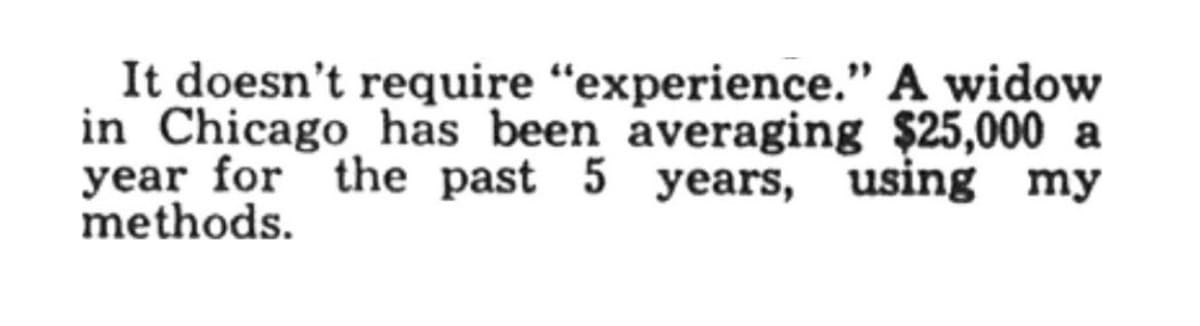
These aren’t checkable from the ad, but the specificity of the objection and the examples, add a sense of realism.
His testimonials work the same way. One reads:
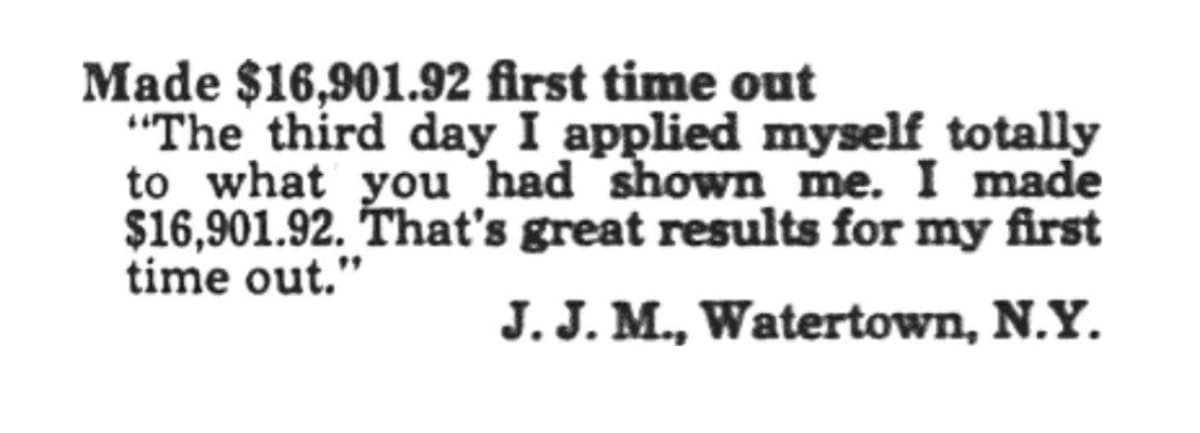
See how those 92 cents feel real, though with only initials to go on, nobody could check them. We just have the sense that no one would make 92 cents up.
Almost every big number in the ad has a case standing next to it, even if the case has no surname.
The lazy way to prove your claims
Karbo’s wisest man said most people are too busy earning a living to make any money. Most websites have the same trouble with proof. They’re too busy making claims to prove any of them.
Karbo’s approach was, fittingly, the lazy one. He handed the skeptic the accountant’s name, the bank’s address, and an uncashed check, and let the reader do the rest.
So take the hardest‑to‑believe claim on your own page, and ask three questions of it:
- Could the reader check it?
- Do they keep control of their money until they’re satisfied?
- Is there a specific case next to it?
Every “no” marks a spot where visitors have to take you on trust, and gives you the opportunity to improve your conversion rate—as Karbo did through multiple versions of his classic ad.
According to TIME magazine, only 10% of Karbo’s customers returned the book in its first six months of sales. The other 90% let him cash the check.
See you next time on Copywriting Friday.
How much did you like this article?
What’s your goal today?
1. Hire us to grow your company
We’ve generated hundreds of millions for our clients, using our unique CRE Methodology™. To discover how we can help grow your business:
- Read our case studies, client success stories, and video testimonials.
- Learn about us, and our unique values, beliefs and quirks.
- Visit our “Services” page to see the process by which we assess whether we’re a good fit for each other.
- Schedule your FREE website strategy session with one of our renowned experts.
Schedule your FREE strategy session
2. Learn how to do conversion
Download a free copy of our Amazon #1 best-selling book, Making Websites Win, recommended by Google, Facebook, Microsoft, Moz, Econsultancy, and many more industry leaders. You’ll also be subscribed to our email newsletter and notified whenever we publish new articles or have something interesting to share.
Browse hundreds of articles, containing an amazing number of useful tools and techniques. Many readers tell us they have doubled their sales by following the advice in these articles.
Download a free copy of our best-selling book
3. Join our team
If you want to join our team—or discover why our team members love working with us—then see our “Careers” page.
4. Contact us
We help businesses worldwide, so get in touch!
© 2026 Conversion Rate Experts Limited. All rights reserved.
A Brandwidth Group Company.