Copywriting Friday: Run your tongue across your teeth
Copywriting Friday highlights the tools and techniques of persuasive content. Some of the examples may seem dated, but the principles are timeless (and critical for conversion rate optimization). Enjoy.
The brand was Pepsodent, and the copywriter behind the campaign was Claude Hopkins, whose Palmolive ad we’ve looked at before. In his 1927 memoir, My Life in Advertising, he describes making a million dollars from Pepsodent.
Here’s one of the ads that generated that result.
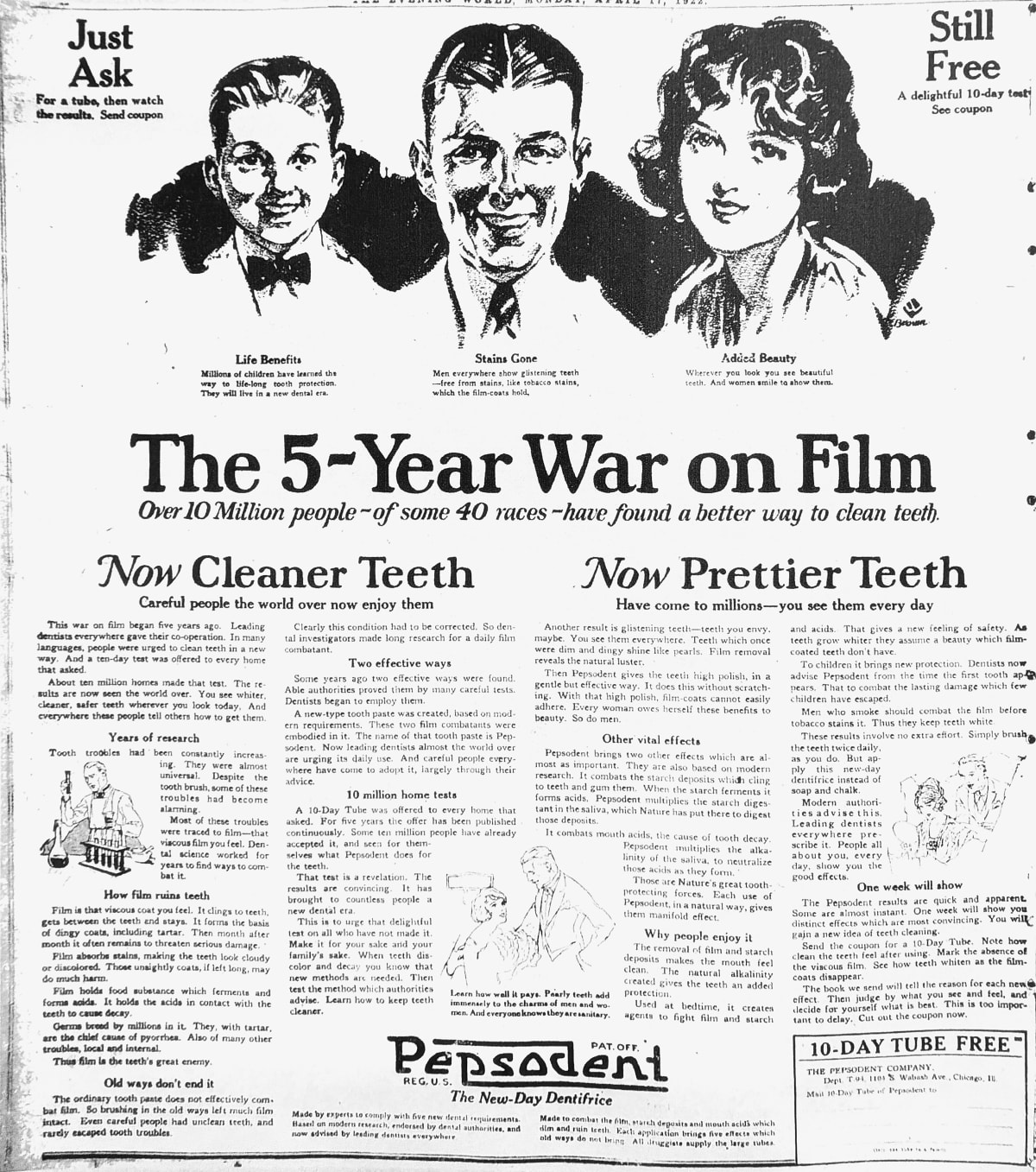
It’s worth noting how many times this ad uses the word test (or tests). We count eight, including the small print in the top‑right corner under “Still Free,” which offers “A delightful 10‑day test.”
That word is the key. The ad asks readers to run two tests: one before they finish reading and one at home. Both are worth looking at, as well as the tests that Hopkins ran on his own work.
1. The three‑second test (Are your teeth coated with “film”?)
Like all the Pepsodent ads we’ve seen, this one leads with the problem, not the product. Hopkins’s headline, “The 5‑Year War on Film,” sets a scientific tone, but almost all of the ad’s early content focuses on building the case.
If we read the copy in column one, we don’t find any mention of Pepsodent. But we do find case‑building subheads and a clever implicit suggestion.
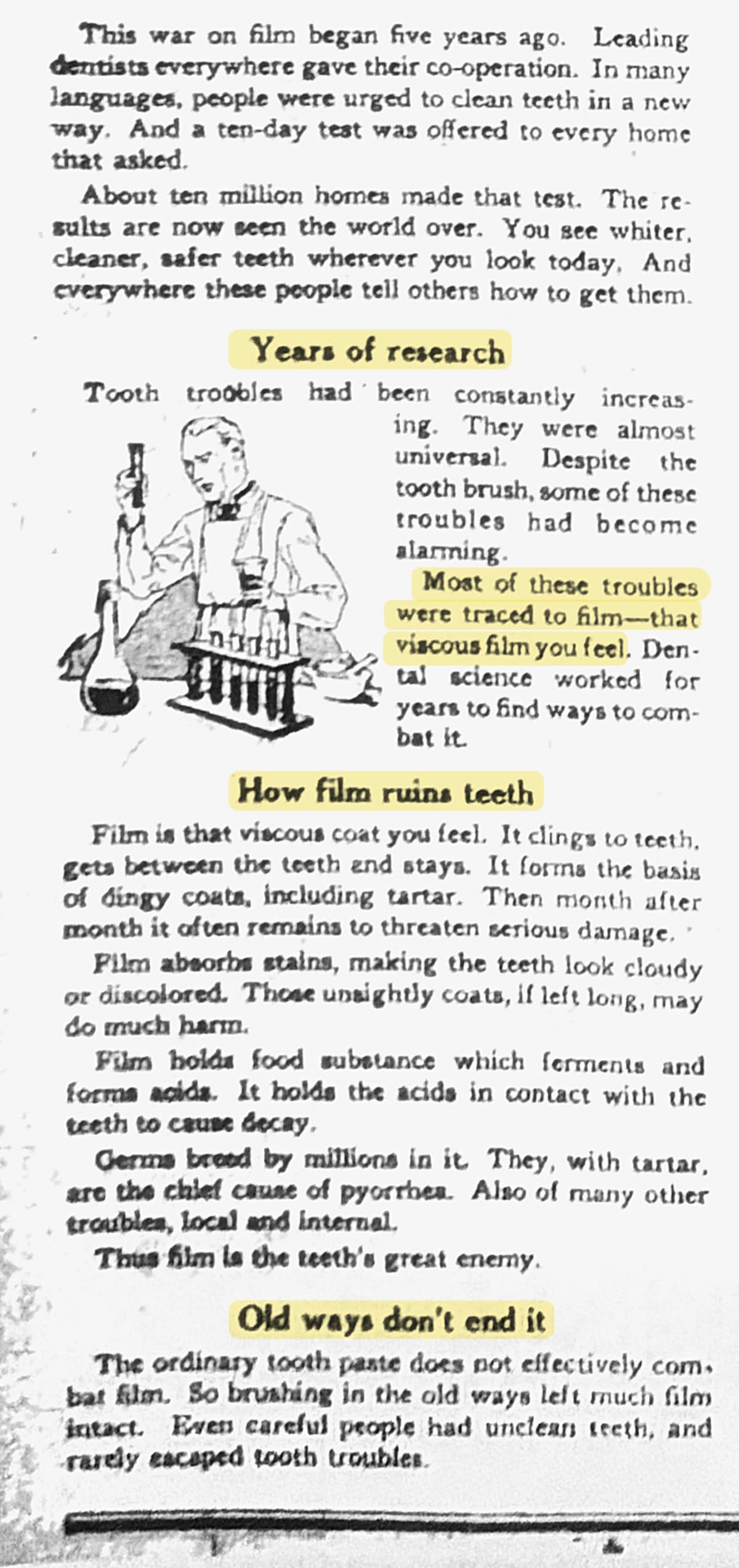
The subheads read:
- Years of research.
- How film ruins teeth.
- Old ways don’t end it.
And the implicit suggestion is one of the two tests we mentioned above:
“Most of these troubles were traced to film—that viscous film you feel. Dental science worked for years to find ways to combat it.”
This line, or something like it, appears in every Pepsodent ad Hopkins wrote because it contains his genius idea—that readers should test their teeth for film. Here’s another version from a different ad that puts it more plainly:
“Dental science has proved that the great tooth wrecker is a slimy film. You can feel it with your tongue.”
How hard is it not to run your tongue across your teeth right now?
When you do, we trust that you’ll feel no viscous film, but you might remember that time you woke up and felt that fuzzy feeling.
That was Hopkins’ first test, and he wrote it into the DNA of the campaign. The point here is that he hadn’t invented a benefit for Pepsodent; he’d found a problem that his audience was carrying around in their mouths. Then he named it and gave readers a 3‑second test to verify it as they were reading.
As with other opportunities that Hopkins discovered, he got there by doing his due diligence:
“I read book after book by dental authorities… But in the middle of one book I found a reference to the mucin plaques on teeth, which I afterward called the film. That gave me an appealing idea.”
Reading gave him the problem. His experience told him how to sell it, and it’s a choice most marketers get backward. The obvious play for a toothpaste is prevention of tooth decay, but Hopkins wouldn’t lead with it.
“My long experience had taught me that preventive measures were not popular. People will do anything to cure a trouble, but little to prevent it.”
The genius of “film” (Hopkins’s name for those mucin plaques) is that it solved this problem. His audience might not have been willing to brush their teeth to prevent decay in future decades, but film was a problem that they could confirm right now. It made Pepsodent a necessary cure rather than an optional precaution.
What problem do your customers already have, right now, that you can help them solve?
2. The 10-day test (Did Pepsodent remove the film?)
Now let’s look at what the ad does (and doesn’t) ask readers to do.
Most obviously, it never quotes a price. The only hint that Pepsodent is for sale is a line of small print at the bottom of the page saying druggists stock the large tubes. Instead, the type in the top corners, either side of the faces, says “Just Ask” and “Still Free.”
The ad offers only a free ten‑day tube.
That was deliberate. When Hopkins asked people to buy, they were apathetic. When he asked them to send ten cents for a sample, he says, “they almost ignored me.”
So he stopped asking for the sale:
“The whole object of the ad was to induce a test for the good of the parties concerned. I never even mentioned that Pepsodent was for sale. I never quoted its price.”
The ad’s last section, “One week will show,” also tells readers how to run the test:
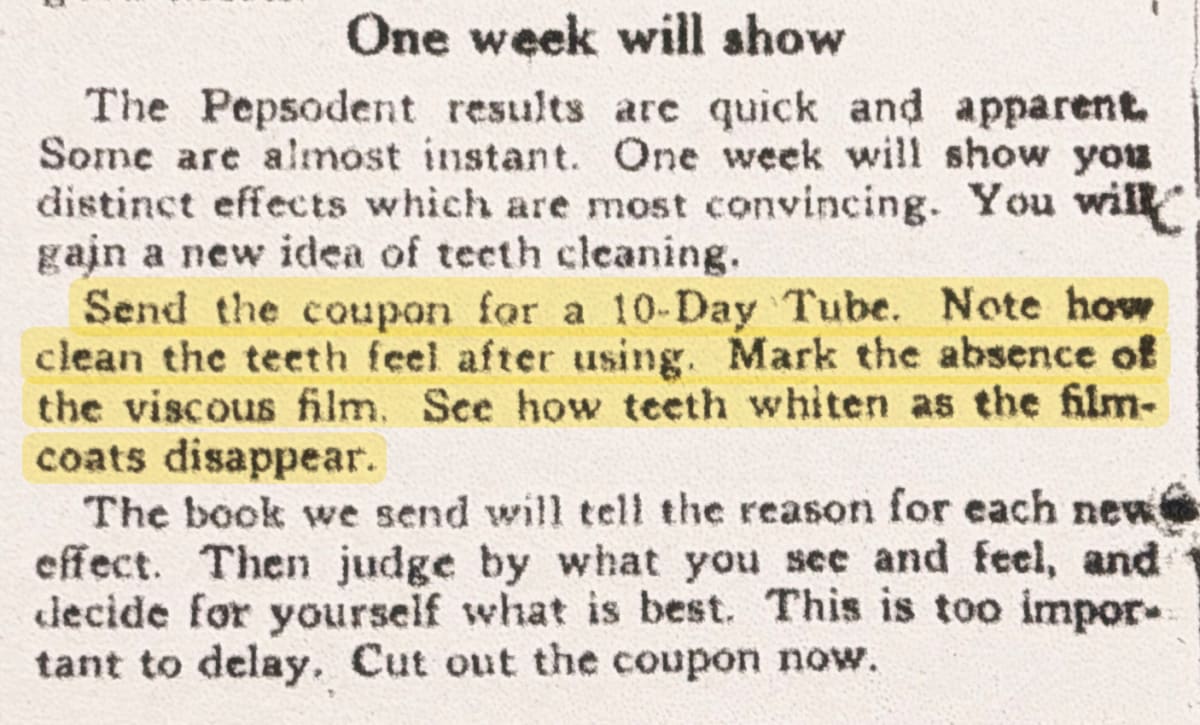
“Send the coupon for a 10‑Day Tube. Note how clean the teeth feel after using. Mark the absence of the viscous film. See how teeth whiten as the film‑coats disappear… Then judge by what you see and feel, and decide for yourself what is best.”
In other words, Hopkins doesn’t leave readers to stumble over the benefit on their own. He’s specific. He points them straight back at the film he taught them to feel earlier in the ad. In other words, the ad names the problem, suggests a free test of the product, and tells readers how to check that it works.
If you offer a free trial, a sample, or a demo, does it tell your market what to notice?
The two business tests (What converts best?)
The free tube offer did a second job. Hopkins wrote hundreds of different ads, and every one had a coupon with a unique department number that allowed him to see which headlines worked best. Ours is Dept T94.
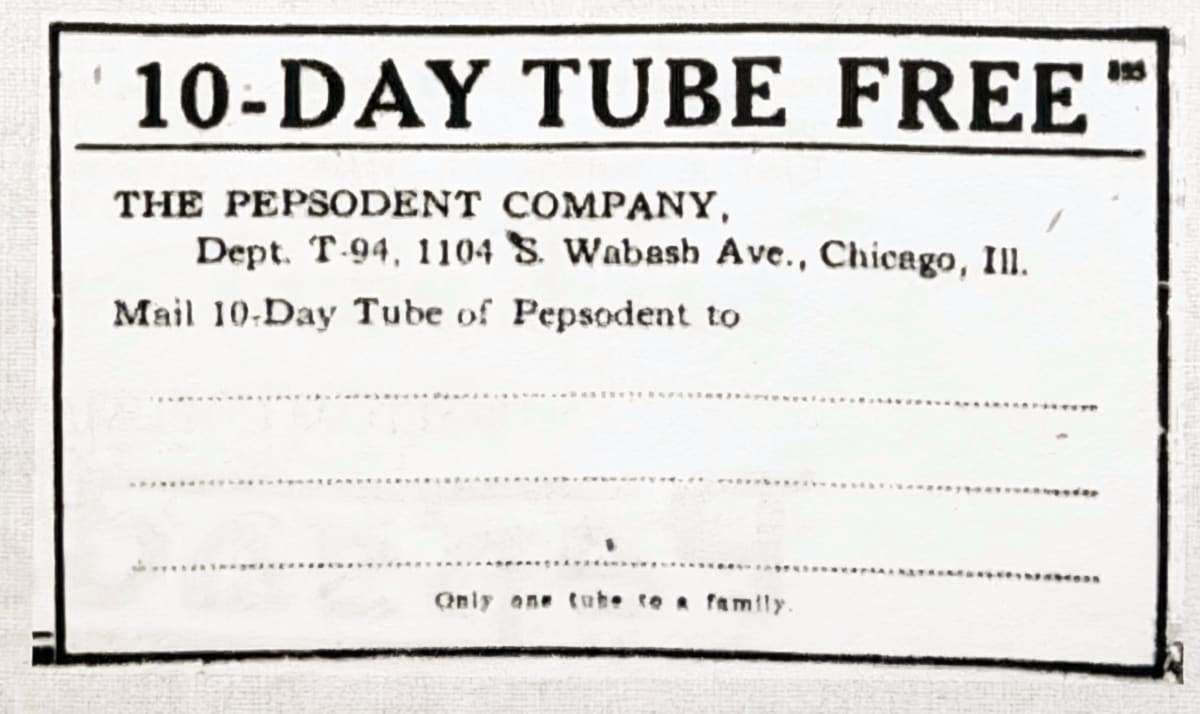
“We keyed every ad by the coupon. We tried out hundreds of ads. Week by week the results were reported to me, and with each report came the headline we employed.”
It’s a direct ancestor of the testing we use to grow our clients’ businesses, and it allowed Hopkins to hone his ads over time. For example, his biggest surprise came from the word “free.” In most lines, like food products, it multiplied the response to his ads. On toothpaste, it did the opposite:
“When we featured a free offer at the top of our ads, we divided our results by four.”
We can see how Hopkins used the feedback to evolve his messaging. Leading with “free,” he wrote, “made us traders, simply seeking to sell, not scientists seeking to benefit.” Consider the difference between the ad we saw above and an earlier one in the series.
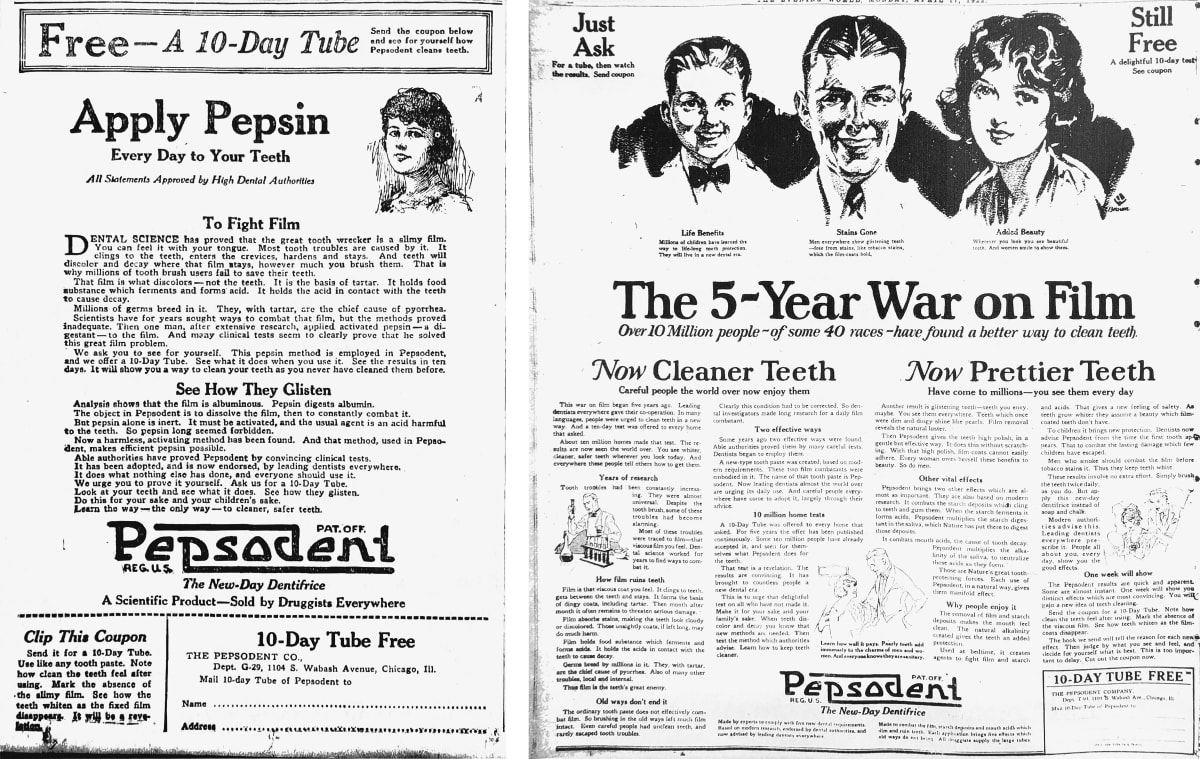
The first makes free the first thing on the page; the second moves it to the far right corner as the lead‑in for “a delightful 10‑day test.”
The fact that Hopkins, a thirty‑year advertising veteran, demanded to be led by data should give us all pause about the value of gut‑check decision‑making. In fact, he relied on evidence at every level of the campaign. Before Pepsodent went US‑wide, and long before it was sold in 51 other countries, he tested his early ads in a single city:
“In our first test city we spent $1,000, which came back with a profit before the advertising bills were due.”
Only when that paid off did Pepsodent’s backers commit real money.
Notice the pattern that Hopkins worked to. Whether a reader, a backer, or himself, he never asked anyone to take his word for something. He gave them a test that would settle the question.
- Do you have dangerous film on your teeth? Test them now.
- Does Pepsodent remove the film that you feel? Try a free 10‑day sample.
- Which of these headlines converts better? Tally the coupons.
- Is this product worth investing in? Test one city before we commit.
See you next time on Copywriting Friday.
How much did you like this article?
What’s your goal today?
1. Hire us to grow your company
We’ve generated hundreds of millions for our clients, using our unique CRE Methodology™. To discover how we can help grow your business:
- Read our case studies, client success stories, and video testimonials.
- Learn about us, and our unique values, beliefs and quirks.
- Visit our “Services” page to see the process by which we assess whether we’re a good fit for each other.
- Schedule your FREE website strategy session with one of our renowned experts.
Schedule your FREE strategy session
2. Learn how to do conversion
Download a free copy of our Amazon #1 best-selling book, Making Websites Win, recommended by Google, Facebook, Microsoft, Moz, Econsultancy, and many more industry leaders. You’ll also be subscribed to our email newsletter and notified whenever we publish new articles or have something interesting to share.
Browse hundreds of articles, containing an amazing number of useful tools and techniques. Many readers tell us they have doubled their sales by following the advice in these articles.
Download a free copy of our best-selling book
3. Join our team
If you want to join our team—or discover why our team members love working with us—then see our “Careers” page.
4. Contact us
We help businesses worldwide, so get in touch!
© 2026 Conversion Rate Experts Limited. All rights reserved.
A Brandwidth Group Company.