Copywriting Friday: One of the few things on the Space Shuttle that didn’t have a backup system
Copywriting Friday highlights the tools and techniques of persuasive content. Some of the examples may seem dated, but the principles are timeless (and critical for conversion rate optimization). Enjoy.
You could talk about your “rigorous testing,” your “high-quality materials,” or your “satisfied customers.” But in a world where every competitor is making the same claims, those words often fall on deaf ears. They’ve become “wallpaper copy”—text that people see but don’t actually process.
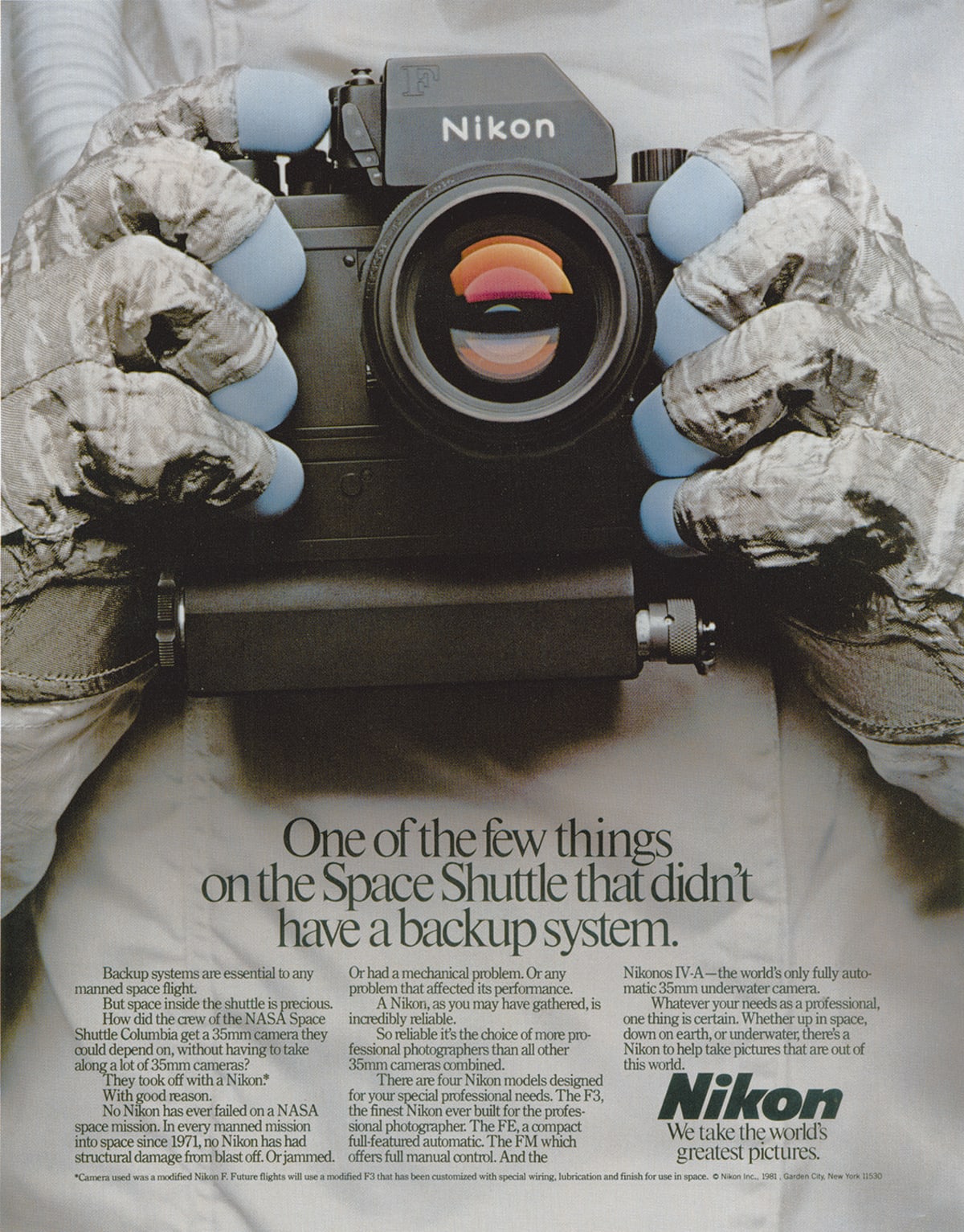
The ad we’re looking at today, a 1981 masterpiece from Nikon—and part of a wider, iconic campaign—avoids the “we are reliable” trap by using a high-stakes association that is impossible to ignore.
Here is the ad:
Four persuasion techniques behind why this ad works
If you break the ad down, you’ll find four persuasion techniques—each doing a specific job, and together creating something far more convincing than any single claim could.
1. Let someone else make your biggest claim
The headline is a masterclass in high-stakes positioning:
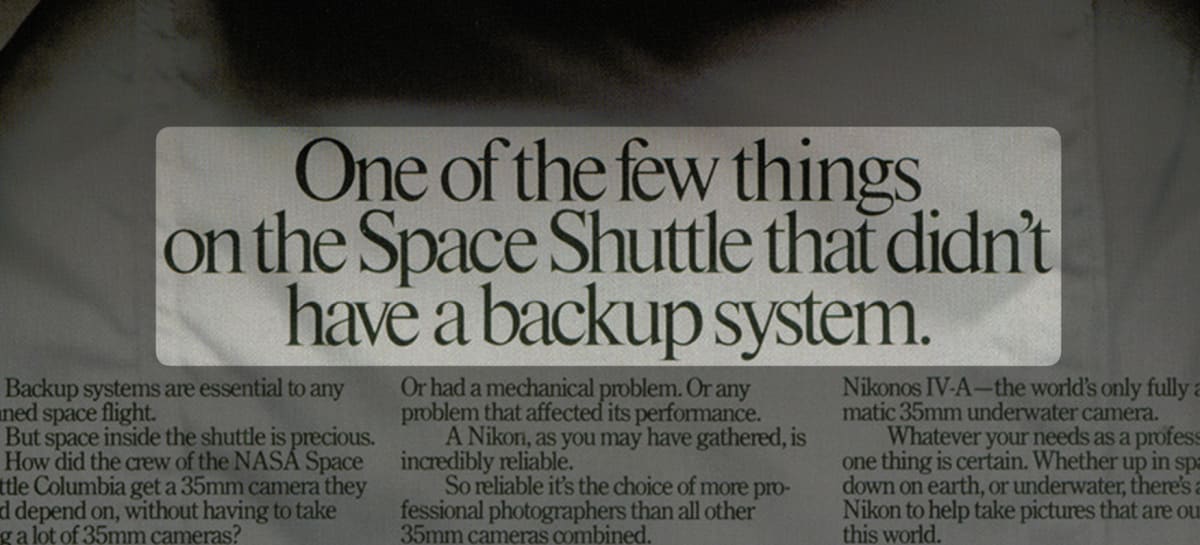
In 1981, the Space Shuttle was the pinnacle of human engineering. Everyone knew that space flight was a world based on redundancy—everything had a backup, and those backups had backups. By positioning Nikon as the deliberate exception, the ad isn’t saying the camera is “good.” It’s saying it is beyond question.
This is proof by absence. The lack of a backup doesn’t just imply reliability—it demonstrates it. And crucially, Nikon doesn’t make that argument directly. NASA’s standards make it for them. The authority of the space programme is transferred wholesale to the camera in your local shop. This is a classic application of Authority Bias, the psychological tendency to respect and trust the judgment of experts and institutions.
That’s the move worth studying: Nikon didn’t borrow NASA’s logo. They borrowed NASA’s judgment. The question for your own product is the same: who is the most demanding user you have, and are you telling that story? An expert or world-class organisation relying on your product for their hardest problems is worth more than any claim you could make about yourself.
2. Use specificity as a credibility signal
The image pulls you in—an astronaut’s gloved hands holding the camera. It creates intrigue and draws the eye. But it’s the copy that does the heavy lifting, grounding that curiosity with specific, credible proof.
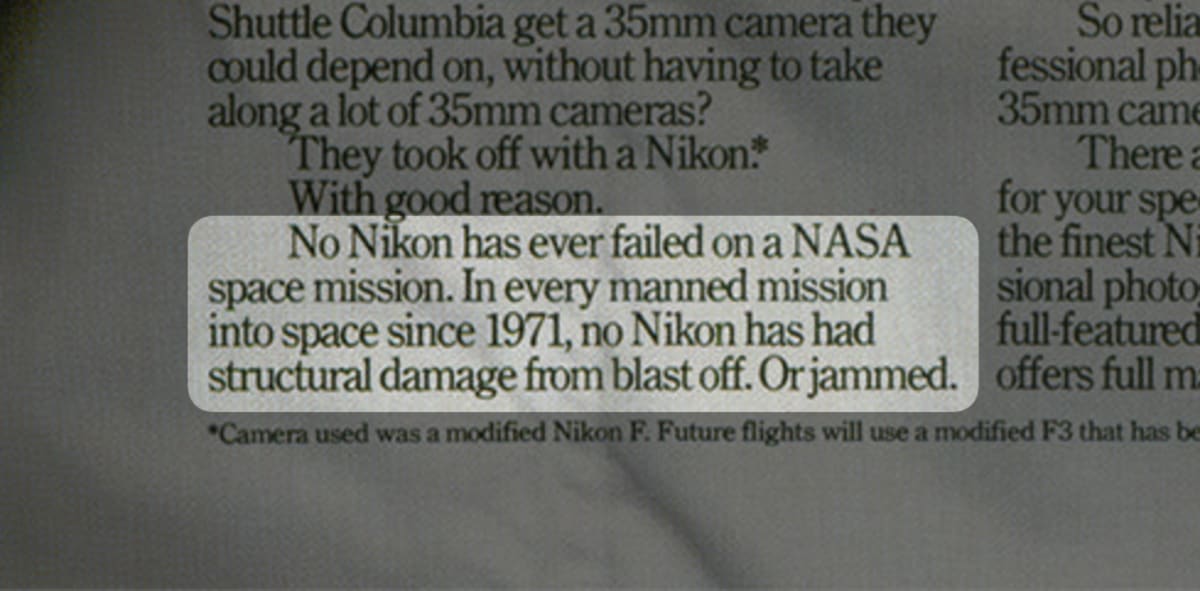
Notice the date: 1971. Not “for years” or “for decades”—a specific year. Vague claims feel like marketing; specific facts feel like history. If you can swap a generalisation in your own copy for a date, a number, or a named client, do it.
Then comes the footnote at the bottom of the ad:
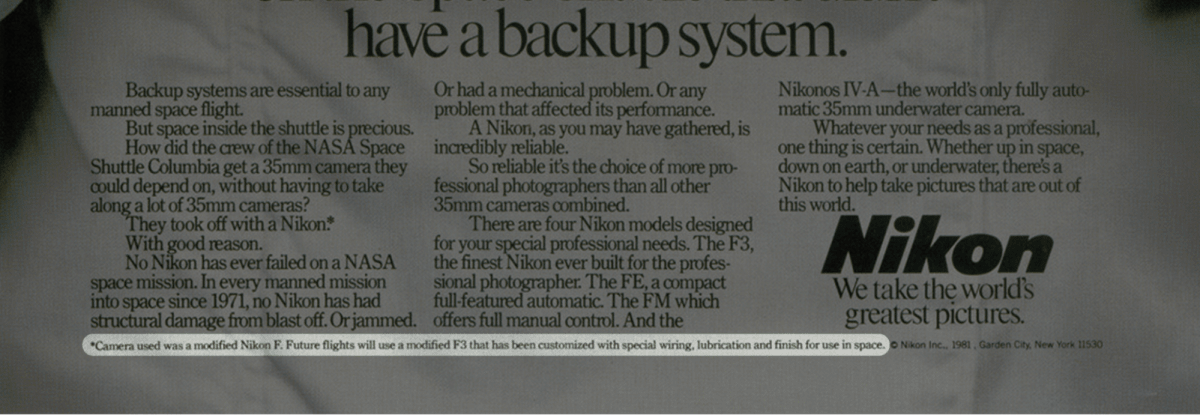
At first, you might think it would be best to omit the word “modified,” but by volunteering that limitation, they make every other claim feel more trustworthy.
Readers sense—consciously or not—that a brand willing to disclose the small stuff probably isn’t lying about the big stuff. It’s a principle worth applying to your own proof points: a minor qualification, honestly stated, often makes the surrounding claims land harder.
3. Always connect it back to the reader
Marketers often focus on impressive extremes. But unless you clearly show what that means for the reader, the message stays abstract—an impressive story about someone else.
Nikon does this in a single move:
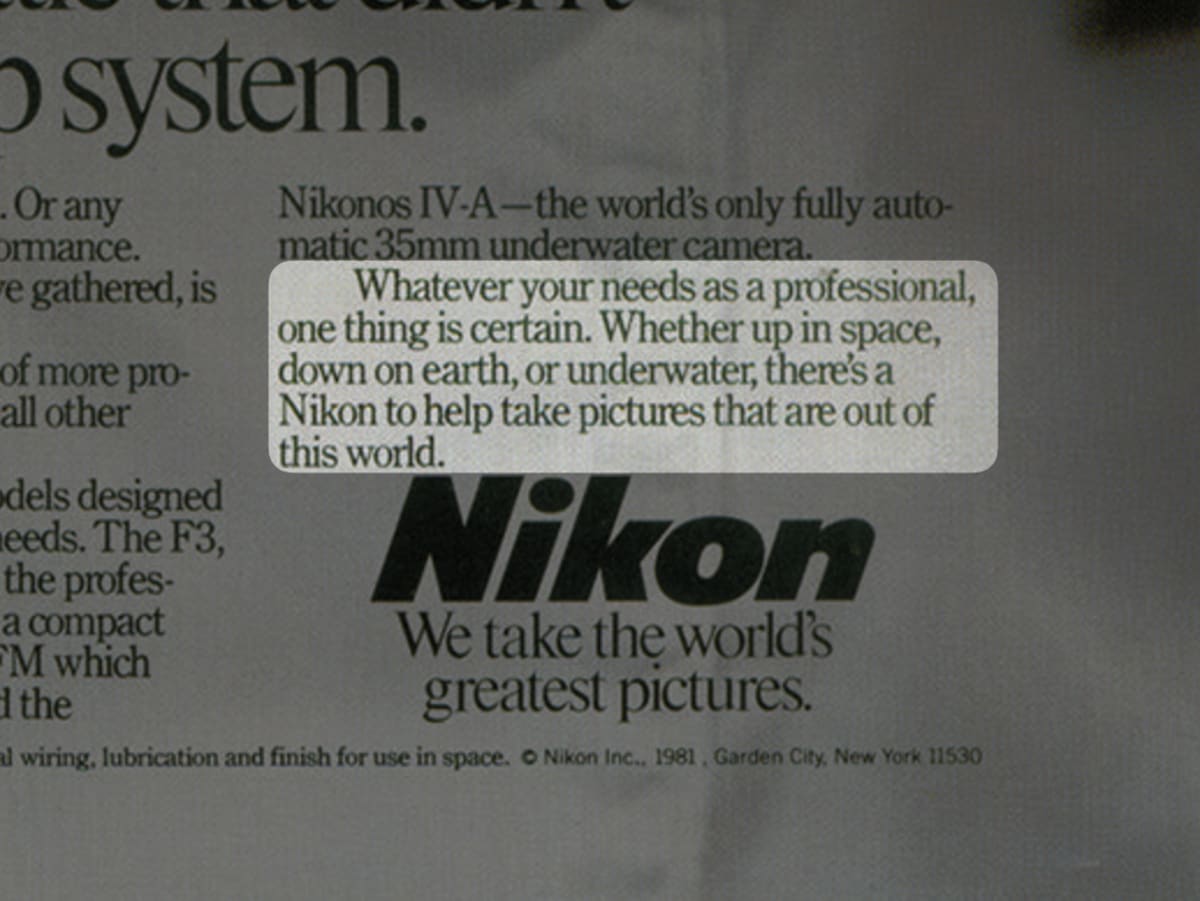
The logic is elegant: if it works without a backup on a Space Shuttle, it will certainly handle whatever you’re shooting. The extreme case becomes a guarantee for the everyday one. It’s a step that’s easy to skip—ads often open with authority and forget to land the plane.
Once you’ve proven your product can handle the impossible, you still need to explicitly connect that to your reader’s daily reality. They won’t always make the leap themselves.
4. Sell the outcome, not the object
The tagline lands the whole thing:
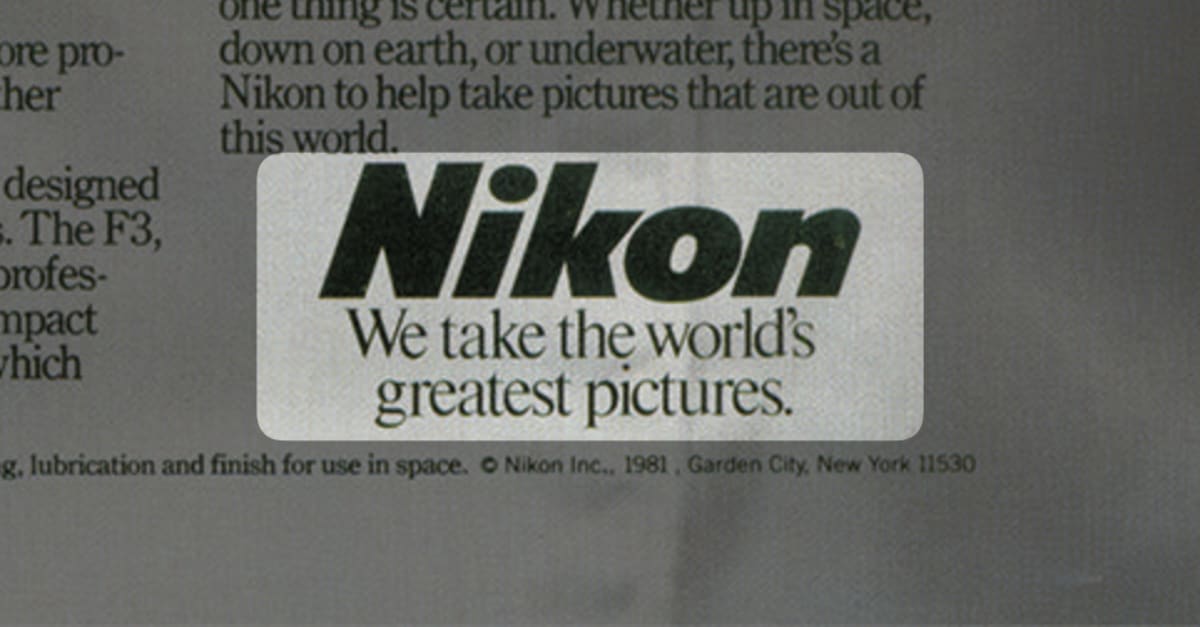
Not “we make the world’s greatest cameras.” The result, not the product. By the time you reach that line, it doesn’t feel like a boast—it feels like a logical conclusion. Worth asking of your own tagline: are you describing what you sell, or what the customer gets?
A final thought
Most companies try to prove reliability with words. Nikon proves it with context.
Instead of saying “trust us,” they place their product inside a world where trust is non-negotiable—and let that world do the talking. The principles at work here aren’t unique to cameras or space travel. Borrowed authority, proof by absence, strategic honesty—each one is available to any business willing to look for the right context to put them in.
And in case you’re wondering, NASA still trusts Nikon for its photographic requirements, including on the Artemis II lunar flyby—the farthest any human has travelled from Earth.
See you next time on Copywriting Friday.
How much did you like this article?
What’s your goal today?
1. Hire us to grow your company
We’ve generated hundreds of millions for our clients, using our unique CRE Methodology™. To discover how we can help grow your business:
- Read our case studies, client success stories, and video testimonials.
- Learn about us, and our unique values, beliefs and quirks.
- Visit our “Services” page to see the process by which we assess whether we’re a good fit for each other.
- Schedule your FREE website strategy session with one of our renowned experts.
Schedule your FREE strategy session
2. Learn how to do conversion
Download a free copy of our Amazon #1 best-selling book, Making Websites Win, recommended by Google, Facebook, Microsoft, Moz, Econsultancy, and many more industry leaders. You’ll also be subscribed to our email newsletter and notified whenever we publish new articles or have something interesting to share.
Browse hundreds of articles, containing an amazing number of useful tools and techniques. Many readers tell us they have doubled their sales by following the advice in these articles.
Download a free copy of our best-selling book
3. Join our team
If you want to join our team—or discover why our team members love working with us—then see our “Careers” page.
4. Contact us
We help businesses worldwide, so get in touch!
© 2026 Conversion Rate Experts Limited. All rights reserved.
A Brandwidth Group Company.