Copywriting Friday: What Don Draper knew about copy
Copywriting Friday highlights the tools and techniques of persuasive content. Some of the examples may seem dated, but the principles are timeless (and critical for conversion rate optimization). Enjoy.
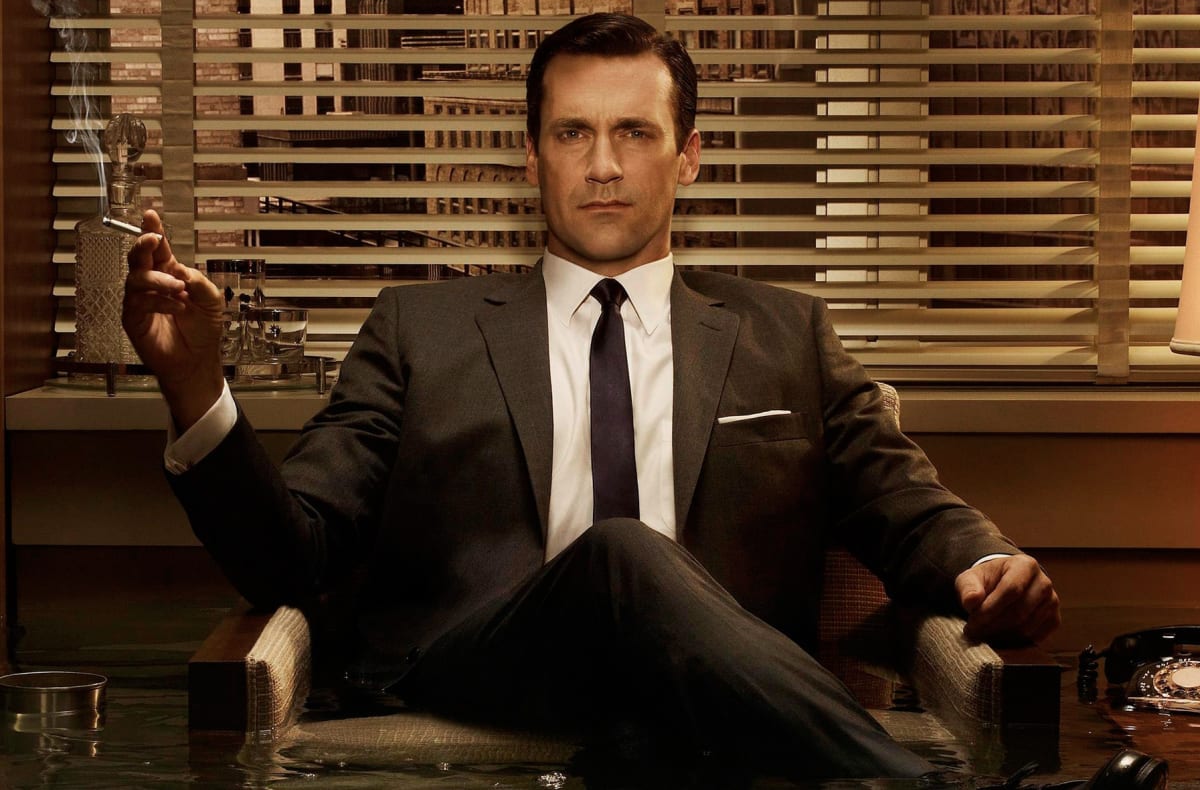
If that sentence means nothing to you, don’t worry. While we recommend all seven seasons of Mad Men, the lessons here are valuable whether you know the show or not. (We did this to you once before with Breaking Bad and Better Call Saul, and learned a lot.)
If you have seen it, you’ll already know that the creative pitch scenes are among the best scenes in the show. They are dramatic, of course, but what makes them endlessly rewatchable for us is that much of the craft in those scenes is real.
In this Copywriting Friday, we’ll see what we can learn from four of our favorite Mad Men pitch scenes. (It’s okay. This is work.)
1. Positioning: “It’s not called the Wheel. It’s called the Carousel.”
In the 13th episode of season 1, Don is tasked with pitching ideas to market Kodak’s Donut or Wheel… a slide projector with a rotating tray.
It is one of the most famous scenes in the show, and it deserves to be. It is also a great example of positioning. We’ve linked to the wider sequence here, but the pitch meeting starts at 1 minute 10 seconds.
As the meeting gets underway, Don describes how a mentor called Teddy taught him that “new” was the most important idea in advertising…
“But he also talked about a deeper bond with the product. Nostalgia. It’s delicate but potent. Teddy told me that in Greek, nostalgia literally means the pain from an old wound… This device isn’t a spaceship. It’s a time machine. It goes backward, forwards. It takes us to a place where we ache to go again. It’s not called the Wheel. It’s called the Carousel. It lets us travel the way a child travels, around and around, and back home again, to a place where we know we are loved.”
Leaving aside the subtext of Don’s family life, his positioning of the Wheel as the Carousel (a real product Kodak launched in 1961) creates a deeper emotional connection to the device.
The critical thing, of course, is that nothing really changes about the product. What changes is how we feel about it. By framing the narrative a certain way, copywriters and marketers can change how their audience feels. That’s the magic of positioning.
Real-world example
Mad Men is high drama, and it’s easy to fall into the trap of thinking these kinds of ideas don’t really apply to our day-to-day work. To help bring the concepts home, we’ll illustrate each one with a relevant win from our archive of Win Reports.
DiamondBack Covers builds truck bed covers in the United States, and its product pages showed a 12- to 15-day lead time. This turned out to be a major objection, so we added a line beside the price, “Built to order in the USA,” and rewrote the faster-shipping tooltip to emphasize production time.
As with Mad Men’s Wheel, nothing really changed about the product. The lead time didn’t get shorter, but we repositioned the delay in visitors’ minds. Instead of implying inefficiency, it became evidence that someone would be crafting the product, and that would take time. Conversions rose 22%.
2. Eavesdropping: “One of a hundred colors.”
Earlier in Season 1, a lipstick maker called Belle Jolie needs a new campaign. Sterling Cooper fills a room with its own secretaries, hands them the entire product line, and has the copywriters watch from behind a one-way mirror.
One obvious thing to say up front. Mad Men is a fictional show set in a time when the roles and sensibilities of men and women were very different from today.
The scene that follows is an in-person user test (we approve) in which real users try and comment on the products in question. There’s also a structured set of questions, but the real magic comes after the session is over.
Peggy has taken part with everyone else, but doesn’t get the shade she wanted. When Freddy, the male ad man, asks why she didn’t just choose another color, she responds with a classic user-testing insight.
“I’m very particular… I don’t think anyone wants to be one of a hundred colors in a box.”
Later, in the pitch, Don repeats almost the same line…
“Every woman wants choices, but in the end none wants to be one of a hundred in a box. She’s unique. She makes the choices, and she’s chosen him. She ‘marks her man’ with her lips…”
Notice where the Mark Your Man campaign came from. The research did its job. The core insight came from a throwaway line in the unstructured five minutes afterward, from the one person in the room nobody was watching for ideas.
Real-world example
We’ve seen similar results so many times by listening to the unstructured voice of the customer. It’s why the most powerful Conversion Rate Optimization (CRO) questions aren’t multiple choice; they are open-ended so that participants have space to use their own words.
When we evaluated competitors for StatusCake, our test participants kept mentioning how much they liked the screenshots that other services showed. “I like that there are screen grabs… it shows me how the app looks.”
We hadn’t asked them about imagery specifically, but the number of comments inspired us to test a screenshot in place of one of StatusCake’s hand-drawn images. Trial sign-ups rose 96%.
When you talk to people (or survey them), give them the space to express what they actually feel.
3. Reframing: “There may be chaos at home…”
The Burger Chef pitch from season 7 is for a fast-food restaurant chain. The idea comes from Don and Peggy talking about their own lives, late at night.
It’s a longer scene, but their angst boils down to losing connection with the people you are supposed to love most. Family dinner has become a battleground. Women work all day and then have to put something on the table. The TV is always on (and six feet from the table). The modern world is killing that precious time together.
None of this insight is an advertisement, but it diagnoses a problem that sets Peggy up to ask the question that breaks the campaign open:
“What if there was a place where you could go where there was no TV and you could break bread and whoever you were sitting with was family?”
Which becomes the key line in the pitch:
“There may be chaos at home, but there’s family supper at Burger Chef.”
The pitch never mentions burgers, or speed, or price. Instead, it solves a very specific problem. Advertising isn’t conversion rate optimization, but the arc of this pitch follows a process we use all the time called Diagnose–Problem–Solution.
Real-world example
Our client Optibac sells probiotics, and its subscription service should have been an easy yes for customers already buying every month. Although our research cataloged 24 separate objections to starting a subscription, one accounted for way more responses than anything else. Customers feared getting stuck with subscriptions they didn’t need.
That was the diagnosed problem that stopped people from converting.
Optibac’s subscriptions were already easy to cancel, but potential customers didn’t know it. When we fixed that problem, new subscriptions rose 39%.
4. Subtraction: “Pass the Heinz.”
In season 6, Heinz Ketchup puts multiple agencies in a bake-off. The team arrives for the pitch with three photographs of food. No ketchup appears anywhere, and the only copy is three words. Pass the Heinz.
When the Heinz team counters that this “feels like half an ad,” Don’s defense is a huge insight into how advertising (and persuasion) actually works:
“The greatest thing you have working for you is not the photo you take or the picture you paint. It’s the imagination of the consumer. They have no budget. They have no time limit. And if you can get into that space, your ad can run all day.”
The core idea here, that the magic happens in the audience’s head, is one we have met before in this series. In The hard way and the Apple way, we saw how an Apple ad from 1992 presented facts about the “real” price of a PC laptop, but let the audience do the math. (Allowing someone to draw their own conclusion is almost always more persuasive than stating it for them.)
Don’s “Pass the Heinz” pitch takes a similar move to its limit, by removing the product altogether. His contention that an imagined ketchup would be more engaging than a product shot was never tested because they lost the pitch.
At least… it was never tested in the show.
In March 2017, Heinz actually made the campaign. Its real agency, DAVID Miami, ran three executions on billboards and in print, with the credit line reading Don Draper, Sterling Cooper Draper Pryce.
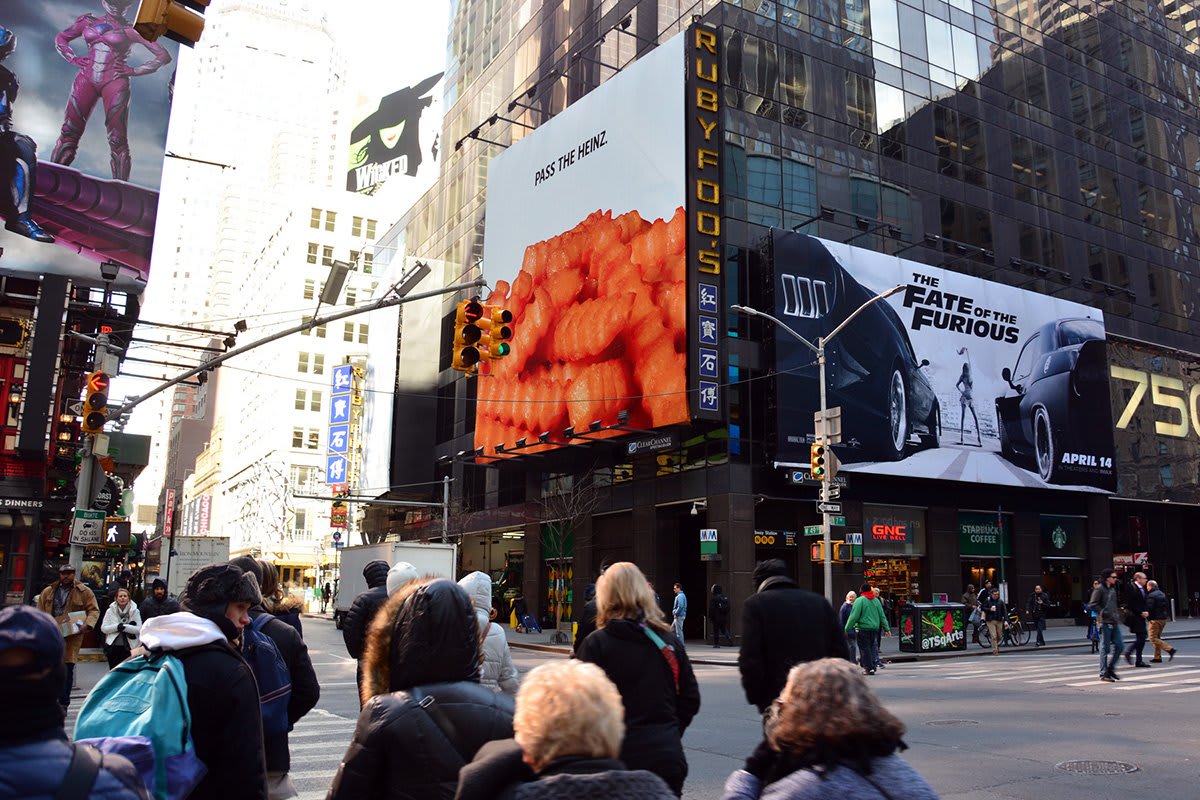
The campaign was pitched as the first “reverse product placement” in advertising history. It generated $55 million in earned media and won a Gold Lion at Cannes.
Of course, this success was more about the Mad Men connection than about testing Don’s imagination premise. No matter, because we see it working all the time. When we give an audience part of something but let them draw their own conclusions, powerful things can happen.
Our real-world example
When we blurred the deals Glimp was about to offer its customers, sign-ups rose by 108%. Like mouthwatering ketchup, the savings were right there in the visitor’s imagination. Those are my offers. I can almost touch them. How much money will I save?
That’s a bare plate of fries with a sign-up form attached.
What the mad men and women knew (and we can all use)
Mad Men was a great show, but these pitch scenes hold up because the writers understood what great advertising and copywriting are built on… deeply knowing the audience.
All four pitches work because something was already in the customer’s head. Don and Peggy never really try to create something new; they tap into something that already exists.
If the show has one technical flaw, it’s that it often sidelines real research for dramatic moments of inspiration. We can forgive that because it makes for better television, but it shouldn’t blind us to the truth. Great copywriting rests on great research.
In Mad Men, a slide projector becomes a Carousel because the ache to go home was already there. A hundred lipsticks become one woman who wants to be unique. A fast-food chain becomes an escape and a place of connection. Even an invisible ketchup ad relies on a shared understanding that the audience needs nothing more than “Pass the Heinz” to conjure the taste on their tongue.
Knowing your audience is rarely all you need to write great copy, but it’s almost always the raw material that shows you where to start.
See you next time, on Copywriting Friday.
How much did you like this article?
What’s your goal today?
1. Hire us to grow your company
We’ve generated hundreds of millions for our clients, using our unique CRE Methodology™. To discover how we can help grow your business:
- Read our case studies, client success stories, and video testimonials.
- Learn about us, and our unique values, beliefs and quirks.
- Visit our “Services” page to see the process by which we assess whether we’re a good fit for each other.
- Schedule your FREE website strategy session with one of our renowned experts.
Schedule your FREE strategy session
2. Learn how to do conversion
Download a free copy of our Amazon #1 best-selling book, Making Websites Win, recommended by Google, Facebook, Microsoft, Moz, Econsultancy, and many more industry leaders. You’ll also be subscribed to our email newsletter and notified whenever we publish new articles or have something interesting to share.
Browse hundreds of articles, containing an amazing number of useful tools and techniques. Many readers tell us they have doubled their sales by following the advice in these articles.
Download a free copy of our best-selling book
3. Join our team
If you want to join our team—or discover why our team members love working with us—then see our “Careers” page.
4. Contact us
We help businesses worldwide, so get in touch!
© 2026 Conversion Rate Experts Limited. All rights reserved.
A Brandwidth Group Company.