Copywriting Friday: What Al Pacino can teach you about copy
Copywriting Friday highlights the tools and techniques of persuasive content. Some of the examples may seem dated, but the principles are timeless (and critical for conversion rate optimization). Enjoy.
This, of course, is the famous speech from Oliver Stone’s movie, Any Given Sunday. Played by Al Pacino, the coach Tony D’Amato delivers one of the most-quoted motivational set pieces in movie history, building from a near-whisper to a dramatic roar.
Watch it with a copywriter’s eye, though, and something else emerges. Beneath the drama, it’s a lesson in persuasion that covers many of the tools and techniques we talk about in this series. (Plus, the metaphor at the heart of the coach’s speech, that life is a game of inches, is one of the truest descriptions of conversion rate optimization (CRO) we know. As we’ve said before, a slight edge is all you need.)
Here’s the video. There’s barely any swearing, but the coach does let one four-letter word fly at the emotional peak, so you may want headphones if you’re at your desk or around little ears.
It opens with a whisper (0:00–0:53)
The first thing to notice is how small D’Amato starts. No fireworks or clipboard-slamming. Just a tired admission: “I don’t know what to say, really." Conversely, the surprising lack of trying pulls us in. It takes real strength and confidence to show weakness, doesn’t it?
Great advertising has done the same. When Volkswagen set out to sell a small, odd-looking German car to a 1950s America that loved its cars big, Doyle Dane Bernbach didn’t crowd the page and shout. The famous “Think Small” ad (1959) handed most of the space over to a plain background and let a tiny Beetle sit quietly in the corner.
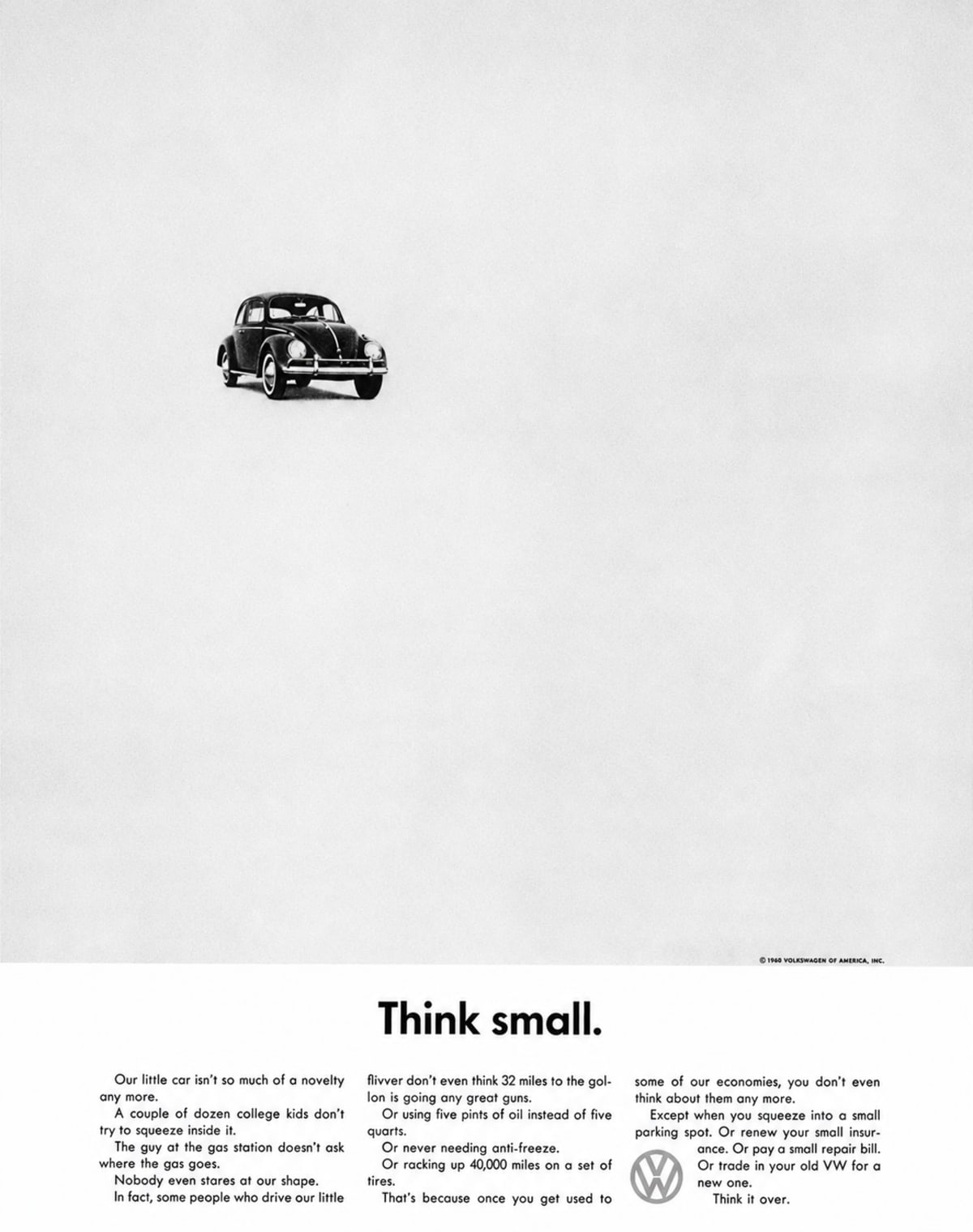
Like D’Amato’s opening, VW’s ad pulls us in by sitting back. It “reads” as surprising. The opposite of the strident sales pitch we might have expected.
The confession (0:54–1:26)
Having already set a low temperature, D’Amato does something even riskier. He turns the confession on himself.
“I look around, I see these young faces, and I think… I made every wrong choice a middle-aged man can make. I pissed away all my money, believe it or not. I chased off anyone who ever loved me. And lately, I can’t even stand the face I see in the mirror.”
As we’ve said before, an admission against your own interest is a shortcut to being believed. Nobody lies to make themselves look worse. When D’Amato owns his failures, the room starts listening.
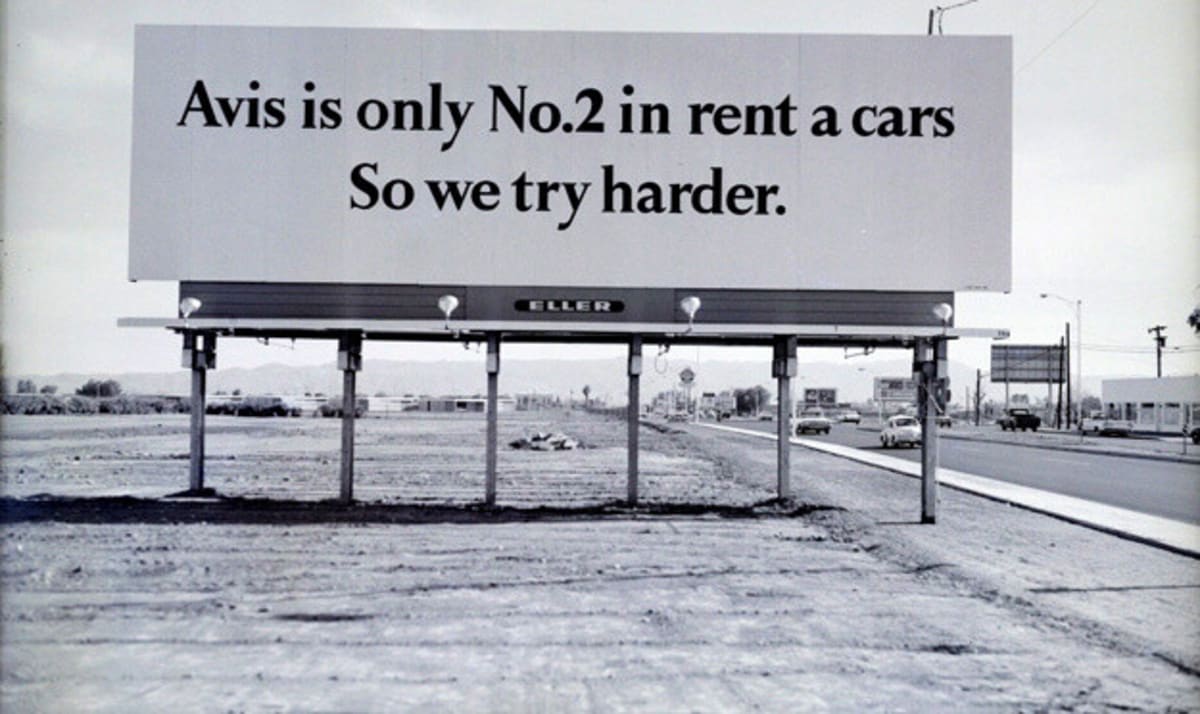
We’ve covered damaging admissions before. Avis built an entire campaign on a confession that few companies would volunteer today: “We’re only No. 2 in rent a cars. So we try harder.”
Volkswagen (again) ran a famous full-page ad under the one-word headline “Lemon,” pointing at one of its own cars pulled off the line for a blemish you’d never have spotted.

In both of these examples, the admission is the proof. You can do the same in writing. Your prospect already knows you want their money, so a flat list of strengths slides straight off them. Admit a real limitation first—this isn’t the cheapest option, it won’t suit everyone, we got this wrong for years before we fixed it—and your other claims start to carry weight. We’ve explored the move in our Copywriting Friday on admitting your flaws, and seen how the sales letter behind Cook’s Illustrated opens by conceding the market is drowning in recipes.
Life’s a game of inches (1:27–3:15)
Out of that low, honest place, D’Amato reaches for the idea that will carry the rest of the speech.
“You find out life’s this game of inches. So is football. Because in either game—life or football—the margin for error is so small. One half a step too late or too early, and you don’t quite make it. One half second too slow, too fast, and you don’t quite catch it.”
Two things happen at once here, and both are worth understanding.
First, D’Amato sets out “inches” as a single controlling idea (and never lets it go). From this moment on, everything gets pulled through the same lens: football, his ruined life, the team, the final push. It all focuses on that single controlling idea. Strong marketing copy often does the same, ensuring that readers remember one thing deeply rather than many things vaguely.
David Ogilvy’s classic 1958 Rolls-Royce ad is the most famous copywriting example of this. It stemmed from his discovery that the cars were built around an obsessive standard of quietness, which became the controlling idea for the ad.
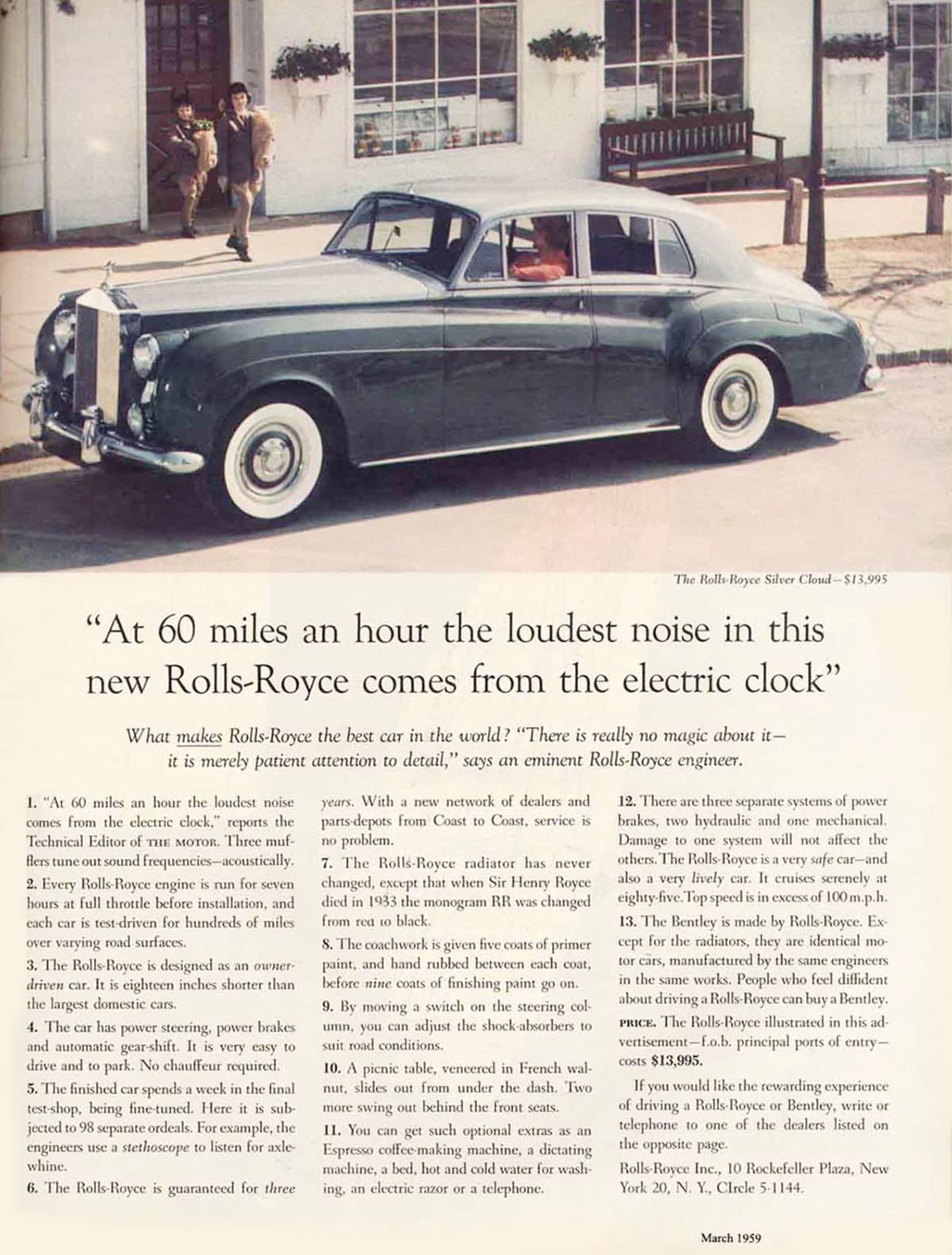
Notice how the ad doesn’t just claim that the car is quiet in the abstract; it gives the reader something extraordinarily concrete:
“At 60 miles an hour the loudest noise in this new Rolls-Royce comes from the electric clock”
Back in the locker room, D’Amato’s speech gets concrete too. Instead of urging the team to “try harder” or “stay focused,” he describes the half-a-step or half-a-second that might make the difference.
This is concrete language, and concrete language out-persuades abstract language every time. Your audience can picture something concrete, and a picture feels true in a way a generality never does. It’s the specificity principle that runs through all good direct response, through our guide to proof, and through the model lines in our Copywriting Friday on getting specific with proof. “Many customers” persuades no one, but “103,500 users” does. “Save money” is forgettable, but “$340 a year off your energy bill” is far more likely to stick.
The fork in the road (3:16–3:47)
As the speech peaks, D’Amato’s rhetoric shifts again:
“Either we heal now, as a team, or we will die as individuals.”
This is what copywriters call a crossroads close. By collapsing a messy, frightening situation into two paths, he makes the comfortable option (doing nothing) the losing one. If you’ve read our article on persuading skeptical people, you may remember this exact technique from the SawStop video.
“It’s the choice between a wound you can treat with a band-aid, and hundreds of thousands of dollars in medical expenses.”
Put like that, keeping your old saw stops feeling safe. That’s the job in your own copy, too. The status quo is your real competitor, because most prospects don’t choose a rival; they choose to do nothing. Our task, as marketers, is to explain why standing still is a costly decision, rather than a comfortable default.
What are you gonna do? (3:48–4:10)
After all that, you’d expect a command. A “now get out there and win.” Instead, D’Amato ends on the quietest note of all.
“Now I can’t make you do it… Now, what are you gonna do?”
By closing on a question rather than an order, he hands the power and ownership back to his team. This works because we tend to feel more committed to choices and conclusions that we feel we’ve made ourselves.
You don’t even need a literal question to pull this off. For more than thirty years, The Economist has handed readers the decision and trusted them to reach it. Here’s David Abbott’s classic 1988 poster.
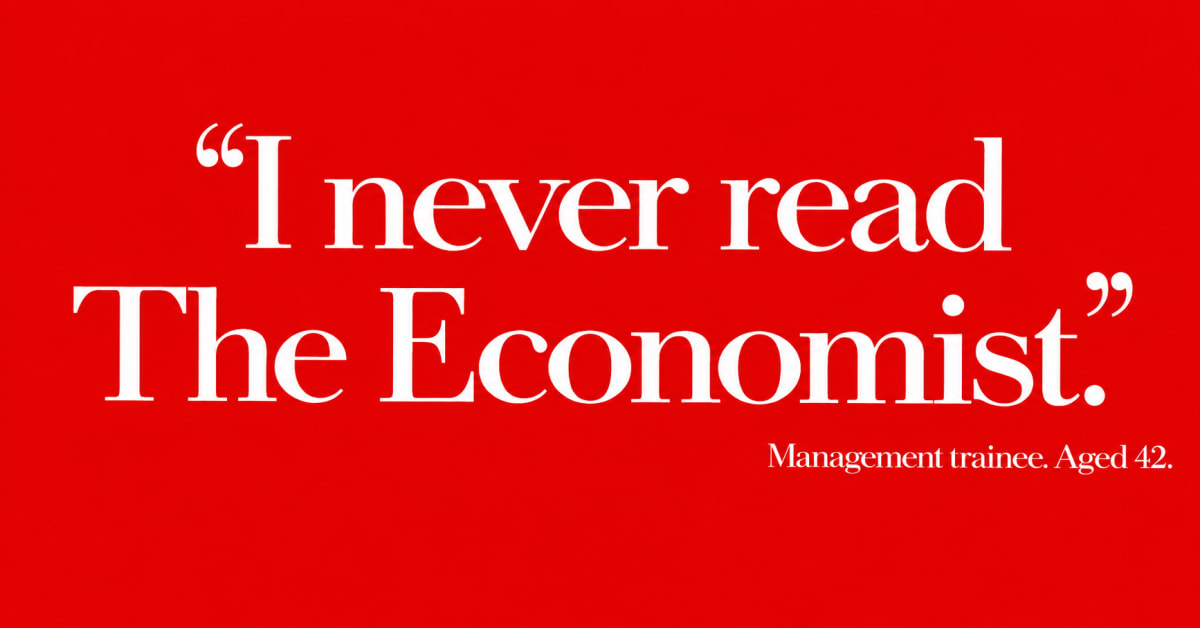
There’s no call to action here. The ad sets the scene and lets you arrive, unprompted, at the thought it wants you to have. And because you supply the conclusion yourself, it’s more likely to stick.
Although CTAs are incredibly important, the best ones feel like the safe next step that you have decided to take yourself. They don’t shove; they frame the next move as the reader’s to make, then get out of the way. A good CTA reads as the natural end of the reader’s own reasoning. Here’s where you are, here’s what’s possible, the next step is yours.
A few inches at a time
If we strip away the drama, D’Amato’s speech is a powerful persuasion template.
He quiets the room, earns belief, anchors everything to a vivid idea, and frames the moment as a critical choice. Then, and only then, does he hand the decision back to his audience.
For those of us dedicated to growing businesses, our own and other people’s, the controlling idea also lands especially hard. The media rightly celebrates the big swings in business, but growing is mostly a game of inches. Remorseless and relentless improvement. The clearer headline here, a stronger piece of proof there, one bold test that finally moves the number.
You don’t earn those inches by tweaking timidly. You earn them the way D’Amato’s team does, by fighting for each one with everything you’ve got.
See you next time on Copywriting Friday.
How much did you like this article?
What’s your goal today?
1. Hire us to grow your company
We’ve generated hundreds of millions for our clients, using our unique CRE Methodology™. To discover how we can help grow your business:
- Read our case studies, client success stories, and video testimonials.
- Learn about us, and our unique values, beliefs and quirks.
- Visit our “Services” page to see the process by which we assess whether we’re a good fit for each other.
- Schedule your FREE website strategy session with one of our renowned experts.
Schedule your FREE strategy session
2. Learn how to do conversion
Download a free copy of our Amazon #1 best-selling book, Making Websites Win, recommended by Google, Facebook, Microsoft, Moz, Econsultancy, and many more industry leaders. You’ll also be subscribed to our email newsletter and notified whenever we publish new articles or have something interesting to share.
Browse hundreds of articles, containing an amazing number of useful tools and techniques. Many readers tell us they have doubled their sales by following the advice in these articles.
Download a free copy of our best-selling book
3. Join our team
If you want to join our team—or discover why our team members love working with us—then see our “Careers” page.
4. Contact us
We help businesses worldwide, so get in touch!
© 2026 Conversion Rate Experts Limited. All rights reserved.
A Brandwidth Group Company.