Where to spend your AI budget? Google has just given you the answer
(By the way, to get articles like this free in your inbox, subscribe to our newsletter.)
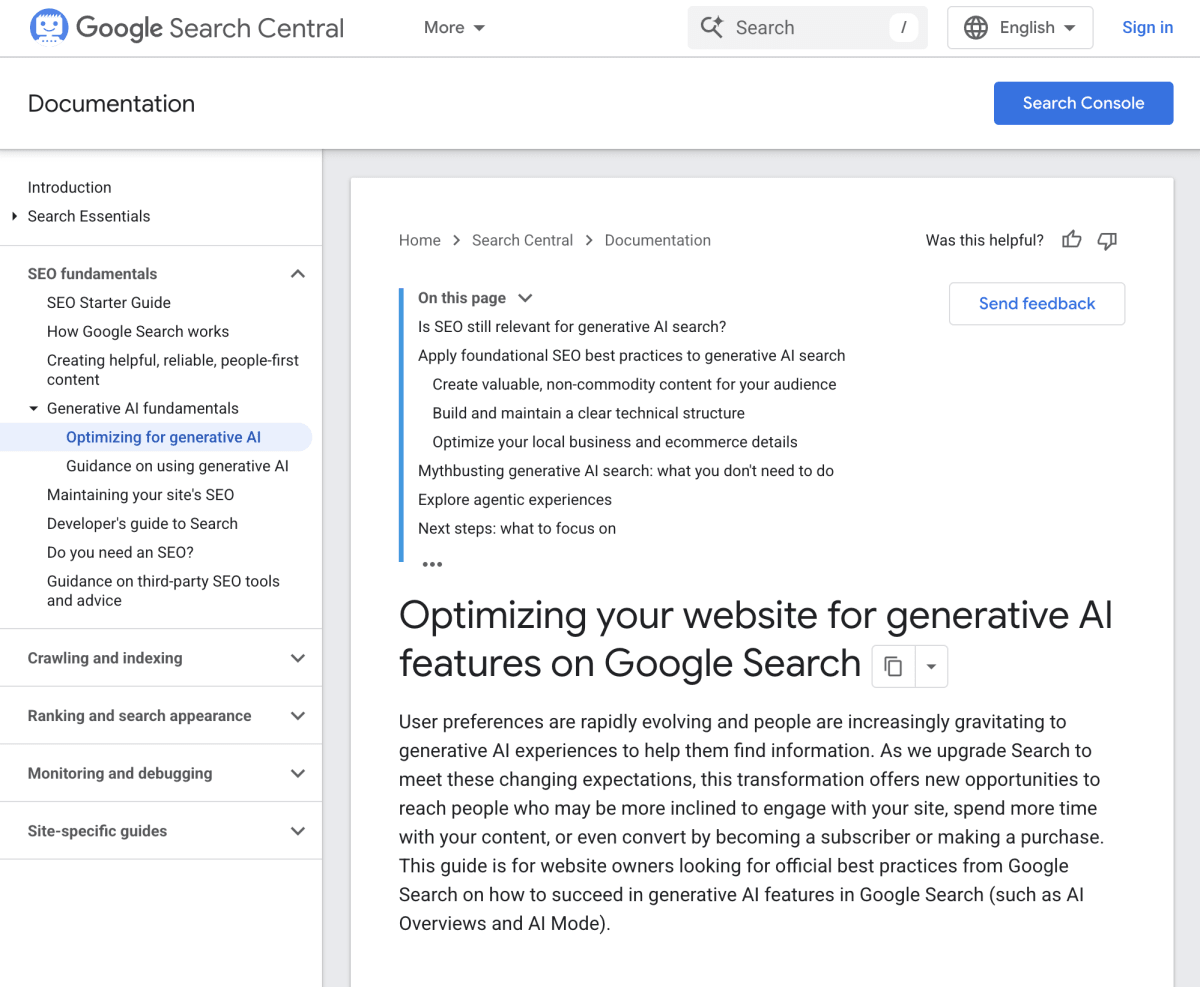
Google has recently published its official guidance on the subject. It’s worth reading carefully—not because it’s revolutionary, but because it isn’t. Google’s answer is, in effect, do what you should have been doing all along—better SEO, better content, and a site that is useful, compelling, clearly structured, and provides the proof required to convert visitors.
What Google actually said
Google’s guide makes one thing very clear. Optimizing for AI search is not a new discipline. In fact, it’s remarkably similar to the ranking advice they’ve given for decades. Creating content that people find unique, compelling, and useful will do more for your AI search visibility than any tactical intervention.
The sites that perform best in AI-powered search are those that create genuinely useful, non-commodity content—demonstrating real expertise and first-hand experience, with strong technical foundations, a clear information hierarchy, and no barriers to crawling.
In other words, better websites.
That’s significant because a lot of the money currently being spent on “AI optimization” is going toward something that shouldn’t exist as a distinct category. AEO and GEO aren’t new disciplines. They’re the same job under different names, and Google has explicitly said so.
When agents do the research, the bar for evidence rises
Around the same time, Google’s web.dev team published guidance on building websites for AI agents—software that browses, evaluates, and completes tasks on behalf of users. The checklist is recognizable to anyone who has ever run a usability or accessibility audit—semantic HTML, clear page hierarchy, stable layouts, predictable interfaces.
A button that is hard for an agent to find is almost always a struggle for humans, too. What makes a site legible to a machine also makes it clearer for a person. In other words, as Google itself notes, building for agents is a reason to recommit to building well.
But there is an important shift to understand. A person evaluating your site reads between the lines. They infer, they give you the benefit of the doubt, and hunt around for the missing detail. An agent is more systematic and less forgiving. Vague value propositions, thin proof, unanswered evaluation questions—the weaknesses that have always quietly suppressed your conversion rate—now also suppress your AI visibility.
And the solution is the same—better websites.
Surely something has changed?
Of course, it would be naive to say that nothing has changed. Here are three to focus on.
- Monitoring. You can no longer judge performance solely by rankings and organic traffic. You now need to know which AI surfaces cite you, for which queries, from which pages—across AI Overviews, AI Mode, and the assistants your buyers actually use. That’s a new monitoring discipline, and it’s worth investing in.
- Delivery. Agents and AI crawlers need your important content available in the served HTML, not reliant on client-side JavaScript, or personalization layers that hand a machine an incomplete page.
- Earned authority. Building an accurate, consistent third-party presence—citations, reviews, mentions in credible sources—is now a visibility input in its own right. But it sits on the same foundation—you can’t earn a clear off-site reputation without a clear on-site proposition.
Notice the shape of all three. They’re a thin layer on top of a thick foundation. They pay off only once the content, structure, clarity, and trust signals beneath them are sound. Get the order wrong, and you’re investing in the visibility of a site that gives no one anything worth citing.
A question that exposes the real problem
If you’re thinking about where to invest in AI, ask yourself the following question:
“Could an AI agent, reading only your website, produce a specific, credible, well-evidenced recommendation of you to someone in your target market?”
If the honest answer is no, you have a CRO problem—and you had it long before agents existed. Investing in making your site agent-ready is the same as investing in CRO done properly. The same improvements that lift conversion rates now also shape how AI systems understand, navigate, and recommend your business.
Most companies are currently asking:
“How do we get AI systems to mention us?”
But Google’s guidance points to a more useful question:
“How do we become the easiest company for both humans and machines to do business with?”
These two questions lead to very different investment decisions. The first leads to content farms, AI-specific formats, and an ever-rotating set of tactics with short shelf lives. The second leads to improvements that compound across traditional search, AI-powered search, agent interactions, and conversion rates. If you fix something properly, it will pay you back every time a customer or machine interacts with your business.
The core strategy
What strikes us most about Google’s guidance is how closely it corresponds with what CRO practitioners have been arguing for nearly two decades. CRO is the only discipline that was already answering the questions an AI agent will ask on a buyer’s behalf—is there a clear, persuasive proposition, backed by proof, with the buyer’s objections addressed, expressed so plainly that a stranger could repeat it?
As we move into this new era, the companies that act first will be hardest to catch. Not because they found a new tactic, but because they stopped looking for one.
How much did you like this article?
What’s your goal today?
1. Hire us to grow your company
We’ve generated hundreds of millions for our clients, using our unique CRE Methodology™. To discover how we can help grow your business:
- Read our case studies, client success stories, and video testimonials.
- Learn about us, and our unique values, beliefs and quirks.
- Visit our “Services” page to see the process by which we assess whether we’re a good fit for each other.
- Schedule your FREE website strategy session with one of our renowned experts.
Schedule your FREE strategy session
2. Learn how to do conversion
Download a free copy of our Amazon #1 best-selling book, Making Websites Win, recommended by Google, Facebook, Microsoft, Moz, Econsultancy, and many more industry leaders. You’ll also be subscribed to our email newsletter and notified whenever we publish new articles or have something interesting to share.
Browse hundreds of articles, containing an amazing number of useful tools and techniques. Many readers tell us they have doubled their sales by following the advice in these articles.
Download a free copy of our best-selling book
3. Join our team
If you want to join our team—or discover why our team members love working with us—then see our “Careers” page.
4. Contact us
We help businesses worldwide, so get in touch!
© 2026 Conversion Rate Experts Limited. All rights reserved.
A Brandwidth Group Company.