How to find the biggest growth lever in your business
(By the way, to get articles like this free in your inbox, subscribe to our newsletter.)

Growing a business has never been harder. Acquisition costs keep rising, and AI is changing how customers discover companies. Yet boards and investors still expect a plan for growth.
The usual response is to do more of everything, from advertising and campaigns to new channels and initiatives.
But in our work helping to grow some of the world’s fastest-growing companies over the past two decades, we’ve seen the same truth again and again.
Growth is not a function of effort. It’s a function of leverage.
In this article, you’ll learn how to find the biggest lever in your business. You’ll also learn how to pull each lever in turn, so the numbers decide where you focus, not whichever department argues loudest.
What a fighter jet can teach you about growing a business
Before our CEO, Martin, joined CRE and began optimizing businesses, he optimized fighter aircraft. He worked on the Eurofighter Typhoon, one of the most advanced fighter aircraft of its generation.

The original Typhoon prototype that Martin worked on is now a museum piece (which his sons find hilarious), but a lesson he learned from that world has shaped everything we do at Conversion Rate Experts:
The key to optimizing something very complex is to build a mathematical model of it that’s very simple.
A business works the same way. Day to day, it can feel overwhelmingly complicated. But the way money flows through almost any online business fits on one page. Once you’ve written it down, you can pull each lever in turn and see which one matters most.
First, though, it’s worth being clear about what you’re looking for.
Where to focus: The Theory of Constraints, reframed
In Eliyahu Goldratt’s 1984 business novel, The Goal, he popularized the Theory of Constraints, an idea we use to improve our own productivity. It rests on three insights:
- No process can move faster than its slowest stage (the bottleneck, or constraint).
- That one bottleneck constrains the entire process.
- Once you’ve identified the constraint, focusing on any other activity that doesn’t fix it is irrational.
That last insight is the kicker. Taken literally, it means that much of the work done in most businesses is irrational.
On a production line, the bottleneck is easy to spot. Just look for the machine with a pile of unfinished widgets waiting to go through it. If a business has no such pile, its bottleneck hides in invisible gaps between processes.
We find it useful to reframe Goldratt’s idea. Picture two businesses. One is the business you are today, and the other is the business you want to be. Your biggest constraint is the main thing stopping you from getting from one to the other.

Now turn that question around:
“What’s the biggest opportunity (the biggest lever) to change the output of the current system?”

Reframing a constraint as an opportunity is a far more useful question, for two reasons:
- It reveals constraints that don’t look like problems. When we hunt for bottlenecks, we instinctively look for things that are visibly failing and tend to ignore things that seem fine. A 1.0% conversion rate doesn’t set off any alarms, and that’s exactly what makes it dangerous. It can quietly cap the growth of the business for years.
- It can be answered with numbers. “What’s our bottleneck?” invites a debate where each department argues for its own priorities. “Which lever moves profit the most?” can be settled with arithmetic.
Goldratt’s conclusion still holds. Once you’ve found your biggest lever, it’s irrational to work on anything else.
So how do you find it? You build a simple model of your business.
Build a simple model of your business
You may already have models of parts of your business. Finance has a model of revenue and costs. Marketing has a model of traffic and cost per click. But each is siloed and optimized toward its own department’s goals. It’s rare to simulate the whole business end to end, and that’s what makes this kind of model so powerful.
To bring this to life, let’s build a model for a fictional company called WhereWoof, an online seller of dog trackers. Our examples may sound light-hearted, but the strategies are deadly serious, and the numbers are based on real data.
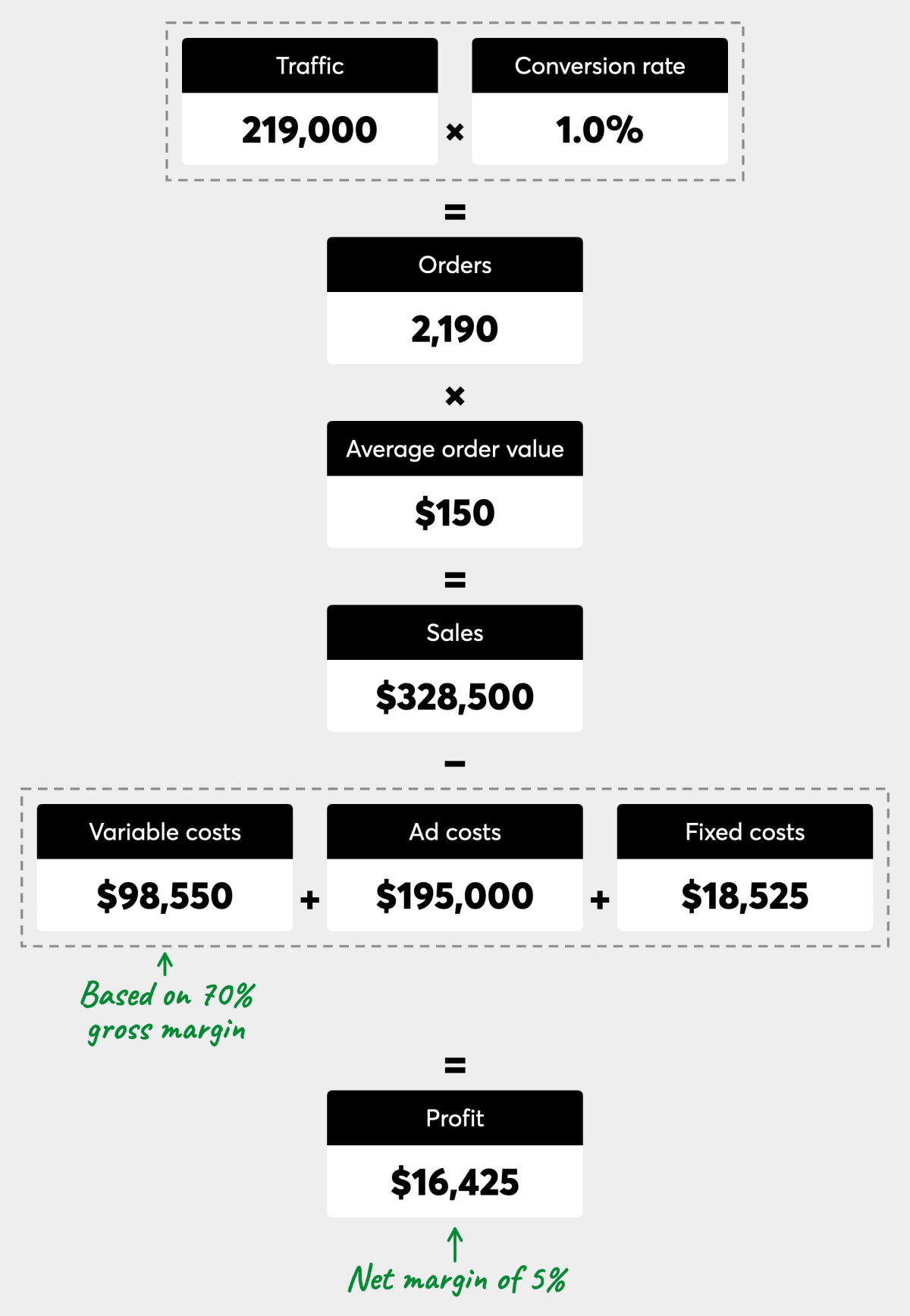
- WhereWoof spends $195,000 a month on ads, which generates 219,000 visitors to its website.
- Of those 219,000 visitors, 2,190 buy a $150 dog tracker. In other words, WhereWoof’s conversion rate is 1.0%.
- With an average order value of $150, monthly sales are 2,190 × $150 = $328,500.
- WhereWoof’s gross margin is 70%, so its variable costs (or cost of goods sold) are $98,550.
- Finally, its fixed costs (or overheads) are $18,525. Subtract the cost of goods, the ad spend, and the overheads from sales, and its net profit each month is $16,425, a net margin of 5.0%.
That’s it! We’ve built a simple (but extremely powerful) model of the entire business. Here it is:
Although this example is an ecommerce business, a similar model applies to SaaS, subscription, and lead-generation businesses.
Before pulling any levers, notice how few there really are. A business can feel endlessly complicated, yet only a handful of numbers change its underlying economics.
Pulling the levers
So imagine you’re WhereWoof’s CEO, and your board is impatient for more profit. What do you do?
Lever 1: Cut fixed costs
If we cancel the year-end party and switch to instant coffee, we can cut fixed costs by 20%. So let’s run that through the model.
In these diagrams:
- Green is the lever.
- Black shows the impact of the change in other parts of the model.
- Gray indicates no change.
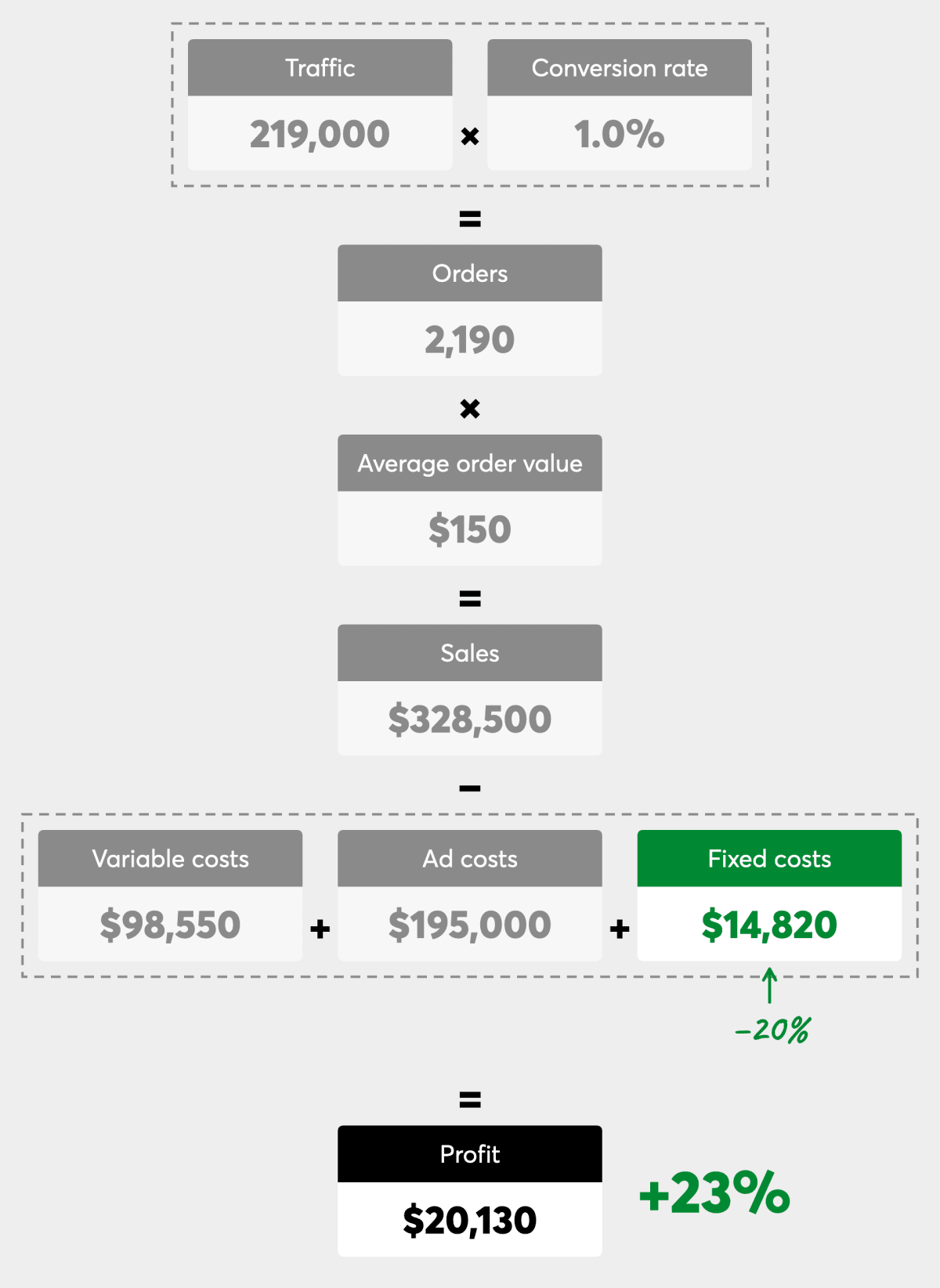
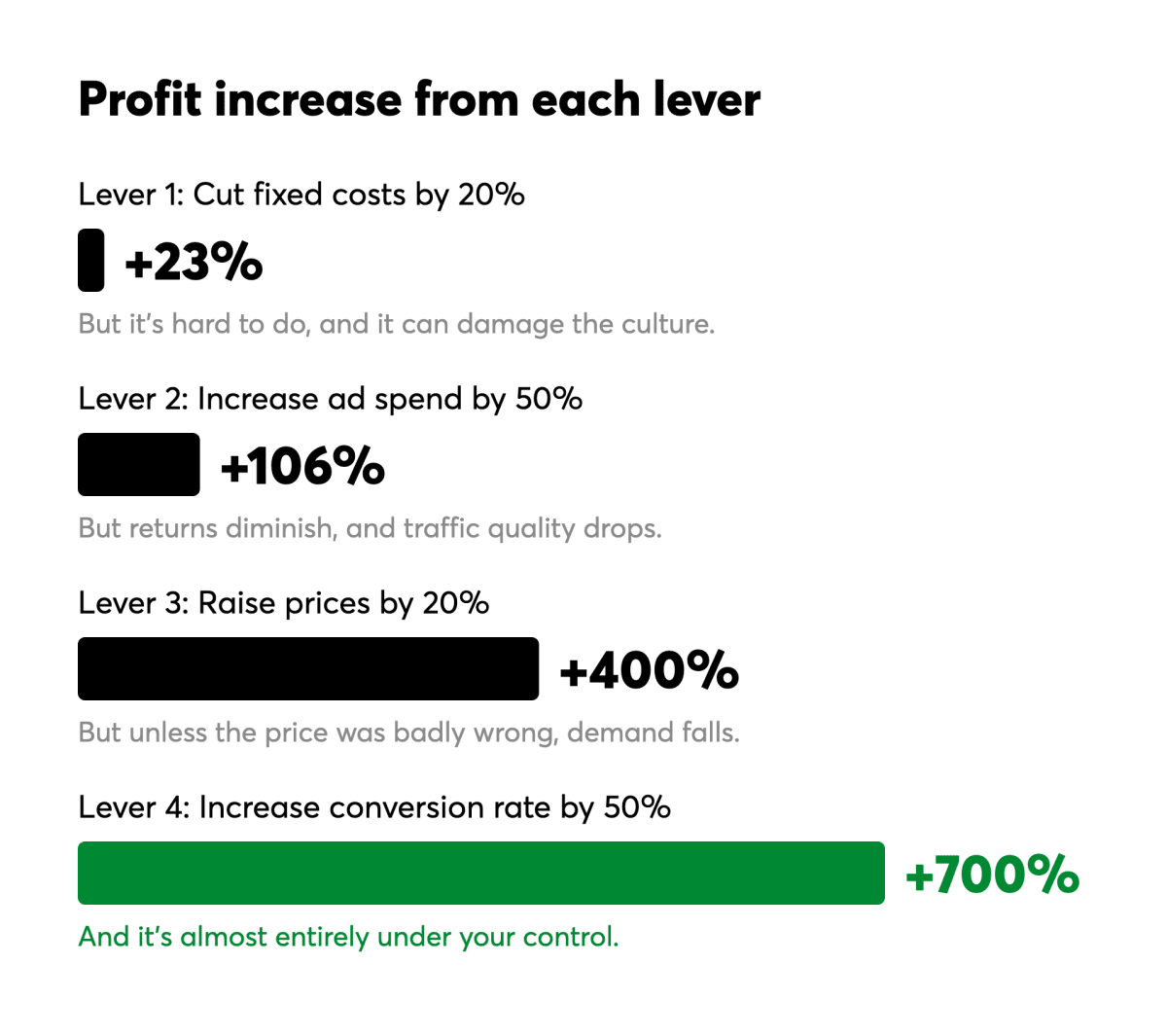
Profit increases by 23%. Not bad.
But… that was hard to do. It has damaged the culture, and it may limit WhereWoof’s ability to scale.
Lever 2: Increase ad spend
Let’s try something more positive and increase ad spend by 50%, an extra $97,500 a month.
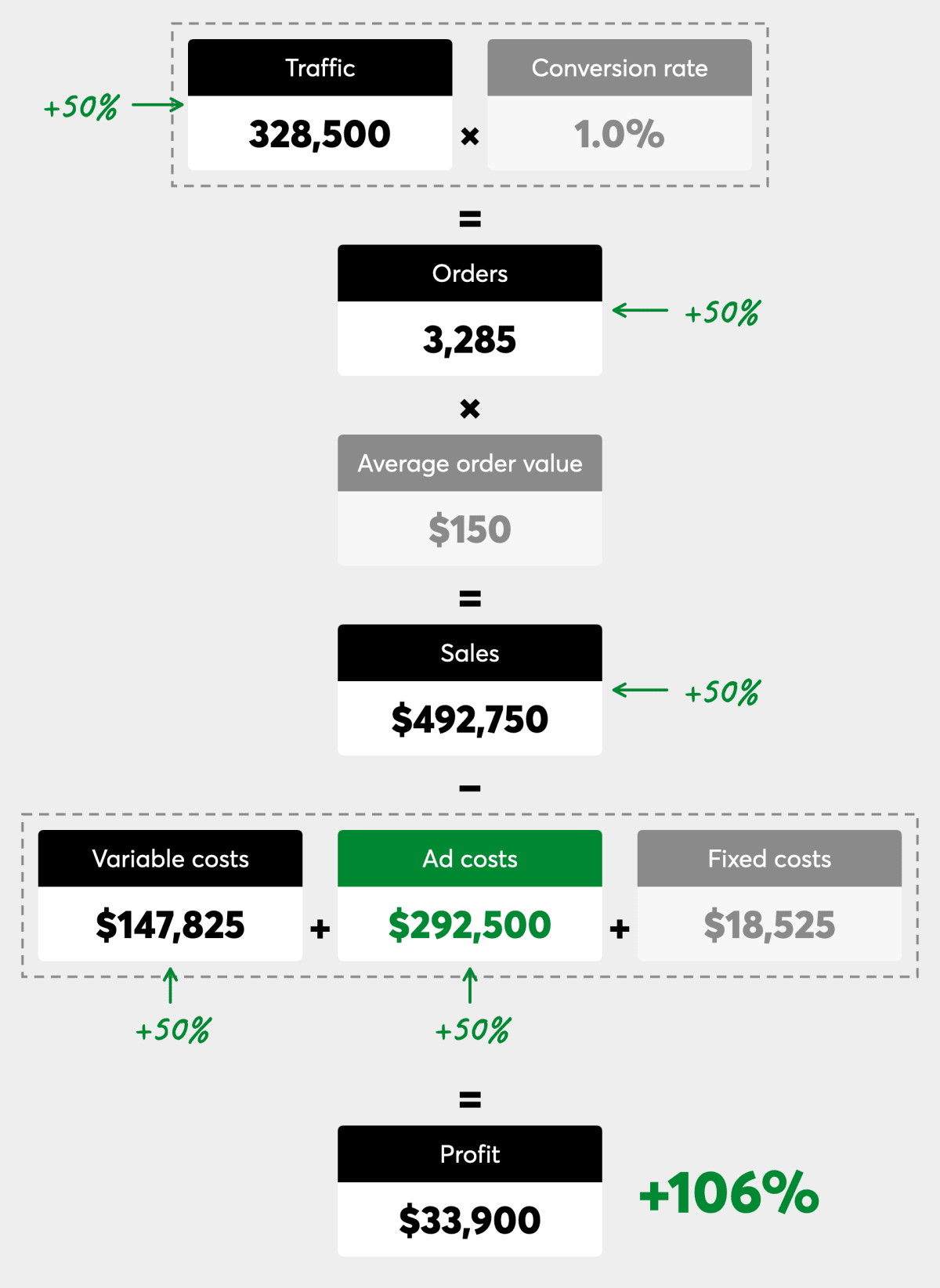
If traffic and sales also increase by 50%, profit theoretically increases by 106%.
But… that rarely happens. Returns diminish and traffic quality drops, so profit grows much more slowly, or not at all.
Lever 3: Raise prices
Surely a device that finds your lost dog is worth more than $150? Let’s increase the price by 20%, to $180.
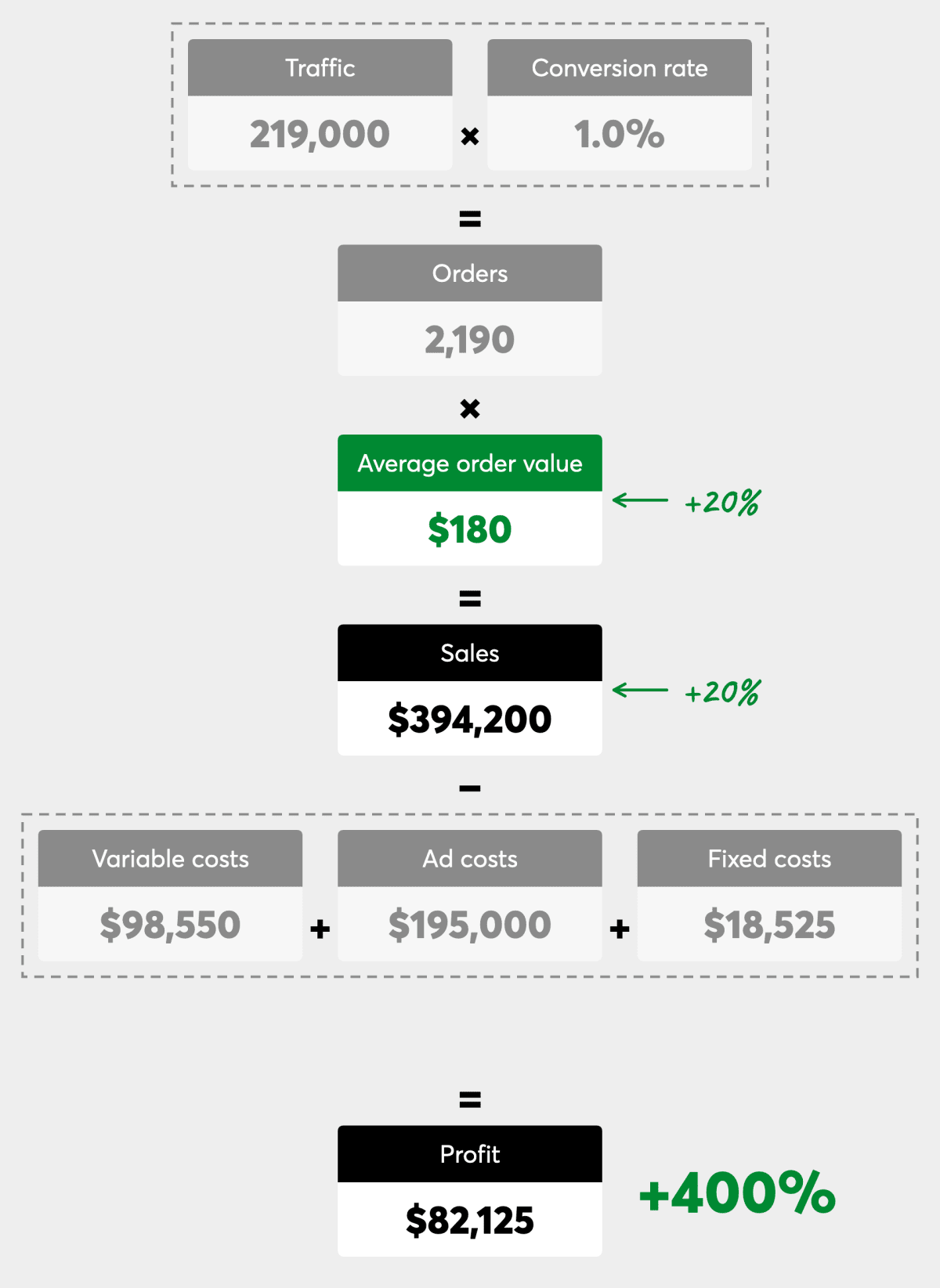
If demand holds up, profit theoretically increases by 400%.
But… unless the pricing was badly wrong (unlikely in a competitive market), demand will fall. Profit will rise by much less, and it may even fall.
Lever 4: Increase your conversion rate
There’s one lever left. Let’s increase WhereWoof’s conversion rate by 50%, from 1.0% to 1.5%. Have a guess what happens.
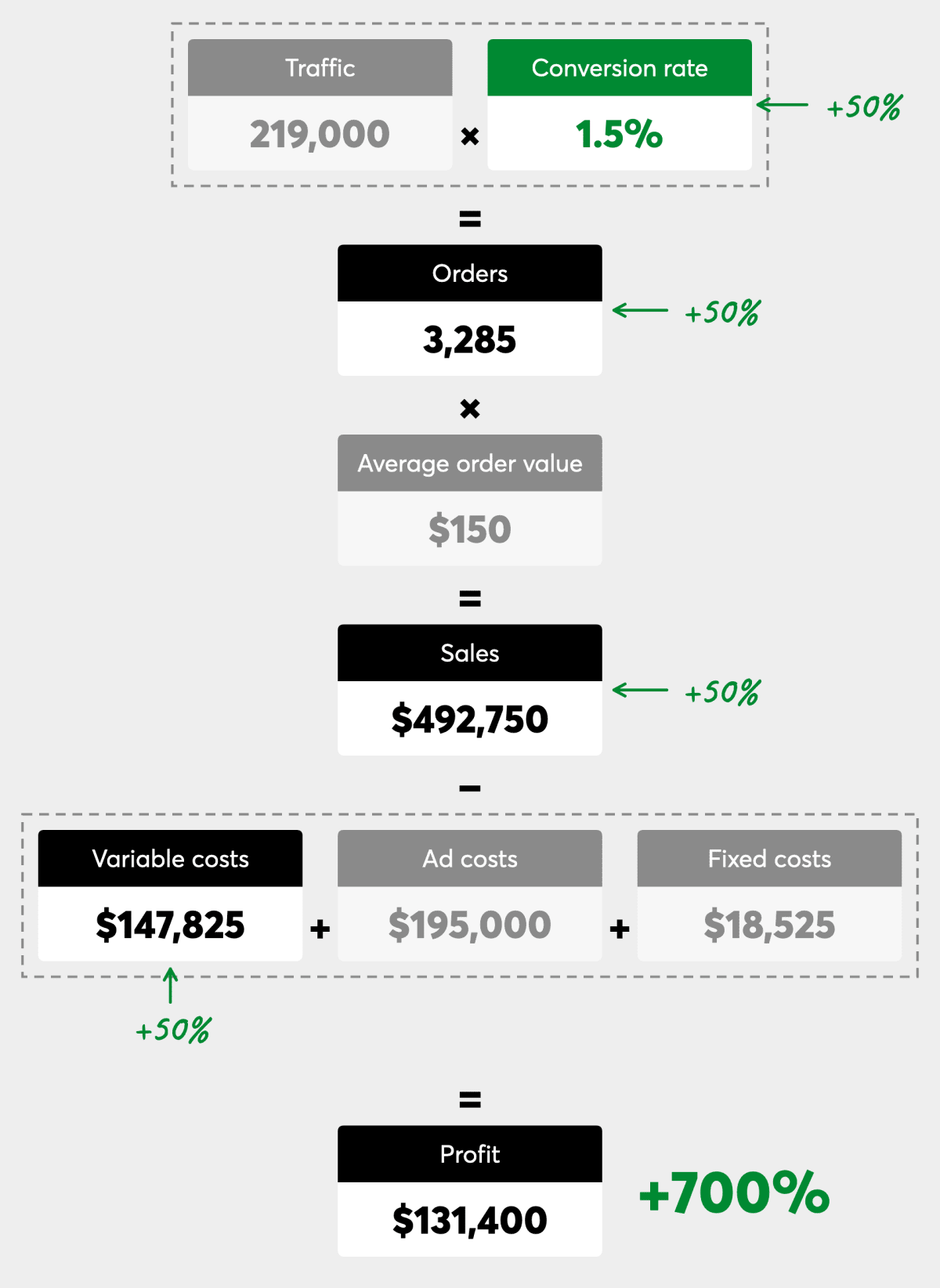
Profit increases by 700%.
But… this time there are no buts. If WhereWoof’s conversion rate increases by 50%, its profit increases by 700%. The same ad spend buys the same visitors, and 50% more of them become customers.
Of course, getting there takes investment, but WhereWoof already knows how to fund its conversion rate optimization (CRO) program.
What’s more, your conversion rate is almost entirely under your control. Competitors and ad auctions push your cost per click around, but your conversion rate depends on your offer, your proposition, and your website.
That’s the model doing its job, revealing an invisible constraint as the biggest lever in the business. And the effect doesn’t stop at profit. A higher conversion rate lowers your cost per sale, which lets you outbid competitors and break through your growth ceiling. We’ve shown how that plays out for WhereWoof when it doubled its conversion rate.
For WhereWoof, conversion rate is the biggest lever. But that’s WhereWoof. Your business may give you a different answer.
And to summarize the effect of all the levers:
How to find your biggest lever
- Build your one-page model. For most online businesses, you need ad spend, cost per click, conversion rate, average order value (WhereWoof’s $150 price), gross margin, and fixed costs.
- Pull each lever in turn, and see what happens to profit. Be realistic about how far each one can move.
- Rank the levers by their realistic effect on profit.
- Focus on the top lever relentlessly.
- Rerun the model once it moves. As Goldratt pointed out, fixing a constraint moves it somewhere else.
Don’t worry if your numbers aren’t perfectly accurate. Rough estimates are enough to rank the levers against each other, and that’s all you need.
Through his work on the Typhoon, Martin learned that the best way to understand a staggeringly complex machine is to build a simple model. A business is no different.
So which lever in your business would move profit the most? And how much of your team’s time is going into the others?
Want help building your model?
Book a free strategy session, and one of our consultants will work with you to model your own numbers. You’ll leave knowing which lever to pull first.
How much did you like this article?
What’s your goal today?
1. Hire us to grow your company
We’ve generated hundreds of millions for our clients, using our unique CRE Methodology™. To discover how we can help grow your business:
- Read our case studies, client success stories, and video testimonials.
- Learn about us, and our unique values, beliefs and quirks.
- Visit our “Services” page to see the process by which we assess whether we’re a good fit for each other.
- Schedule your FREE website strategy session with one of our renowned experts.
Schedule your FREE strategy session
2. Learn how to do conversion
Download a free copy of our Amazon #1 best-selling book, Making Websites Win, recommended by Google, Facebook, Microsoft, Moz, Econsultancy, and many more industry leaders. You’ll also be subscribed to our email newsletter and notified whenever we publish new articles or have something interesting to share.
Browse hundreds of articles, containing an amazing number of useful tools and techniques. Many readers tell us they have doubled their sales by following the advice in these articles.
Download a free copy of our best-selling book
3. Join our team
If you want to join our team—or discover why our team members love working with us—then see our “Careers” page.
4. Contact us
We help businesses worldwide, so get in touch!
© 2026 Conversion Rate Experts Limited. All rights reserved.
A Brandwidth Group Company.