Copywriting Friday: If I bought a car
(By the way, to get articles like this free in your inbox, subscribe to our newsletter.)
Copywriting Friday highlights the tools and techniques of persuasive content. Some of the examples may seem dated, but the principles are timeless (and critical for conversion rate optimization). Enjoy.
Getting past that barrier is a key job of any message that seeks to persuade. Ads that convince us that a purchase is best for both parties win. Those that don’t, fail.
Our Copywriting Friday articles are full of techniques that copywriters use to break through the barrier, but today we are looking at something a little different. An ad that attempts to remove the suspicion at the source.
The signed advertisement
In 1913, an ad ran for a brand-new car called the Reo the Fifth. It cost $1,095 (or $35,000 if adjusted to today’s prices). It was the “Farewell Car” of one of America’s most famous automotive engineers, R.E. Olds, a person who had spent 25 years figuring out how to build quality cars.
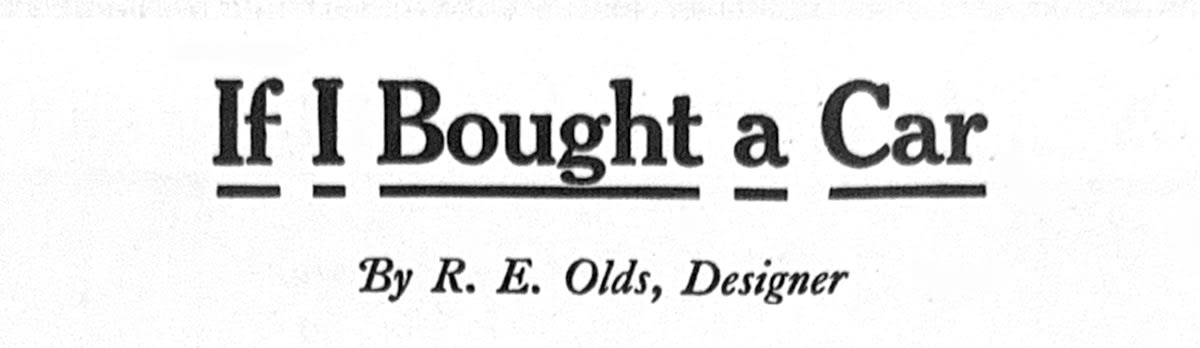
The headline is five words:
“If I Bought a Car.”
And the byline reads:
“By R.E. Olds, Designer.”
If you were truly in the ad’s target market—someone looking to spend over one thousand dollars on a new car—would you skip a personal message like this from an industry titan?
Here’s the full ad from one of our reference books of classic copywriting.
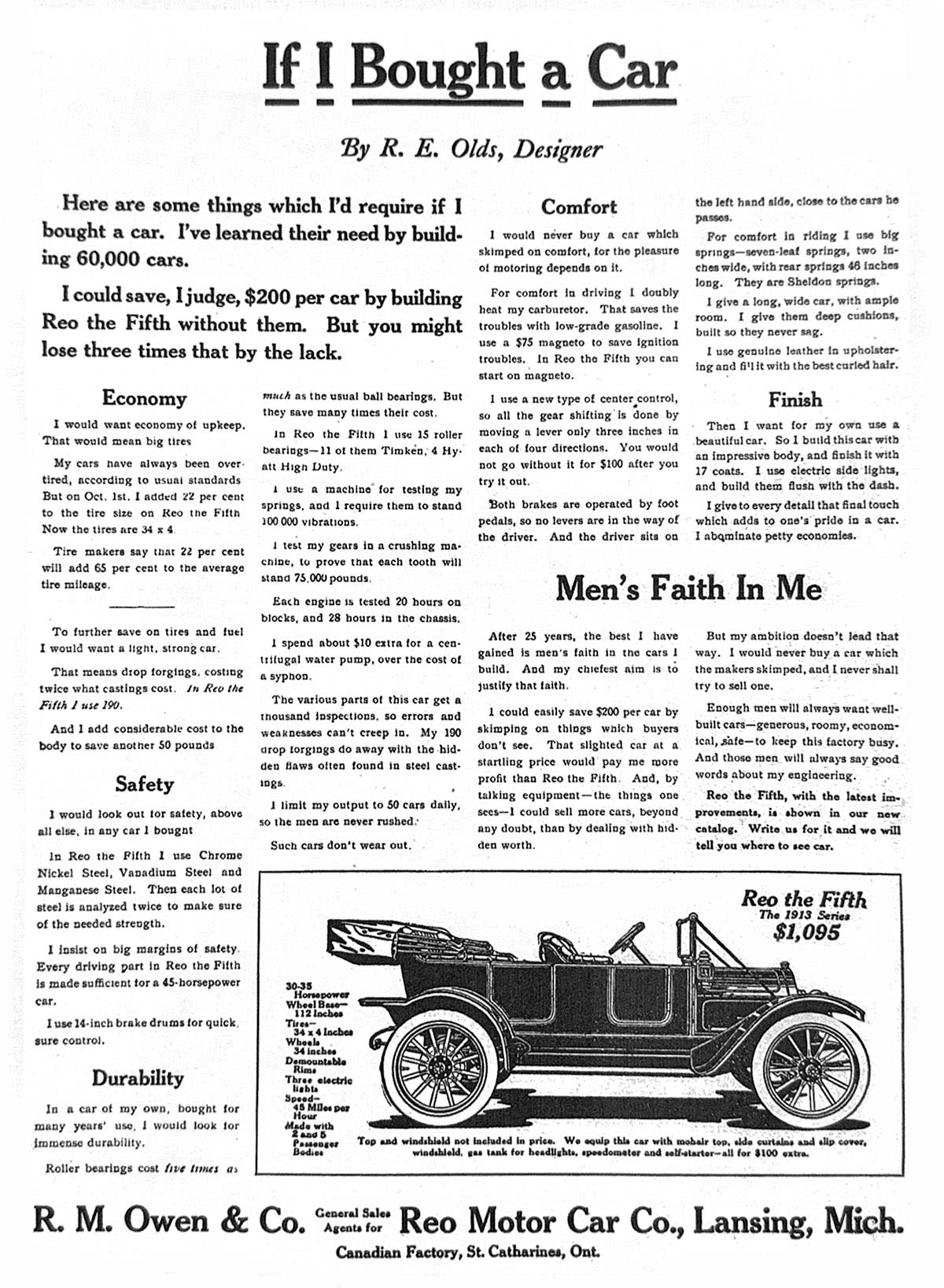
The ad wasn’t just successful in its time, it has been studied by copywriters ever since.
In this article, we’ll pick out four specific techniques, and show how you can use them in your own marketing. As you might expect for an ad that’s 113 years old, it uses “men” in the generic sense to mean buyers and customers. We’ve kept the original quotes intact rather than rewrite them, but don’t let the archaic language distract you. There’s a lot to learn here.
Start your engines: four techniques you can use today
1. Put the maker in the buyer’s seat
The ad’s premise is reinforced right there in the first paragraph:
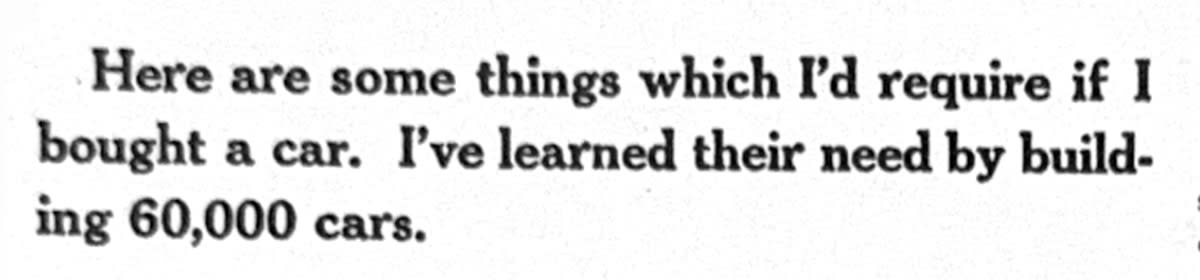
Olds isn’t telling you what you should want. He’s telling you what he would want—and he happens to be the country’s most experienced person on the subject. The buyer and the maker are on the same side of the table, looking at the same list of requirements.
Most ads work the other way. The seller stands across from the buyer and tries to talk them into a transaction. The buyer’s defenses are up by default. As we’ve written in our guide to earning your customers’ trust, the most persuasive position is the one where you’ve quietly moved around to the buyer’s side.
As we’ve seen, the ad’s headline and byline perform this maneuver with great economy. By the time you’ve reached the first body paragraph, the question in your head isn’t “What’s this guy trying to sell me?” It’s “What does he know that I don’t?”
A modern parallel: You see the same move today when a founder or engineer explains the product themselves. When James Dyson appears to tell you what still frustrates him about cleaning (and how he’s fixed it), he’s doing exactly what Olds did—standing next to you, not across from you. “This is what I want for myself”… he’s saying… “and for you.”
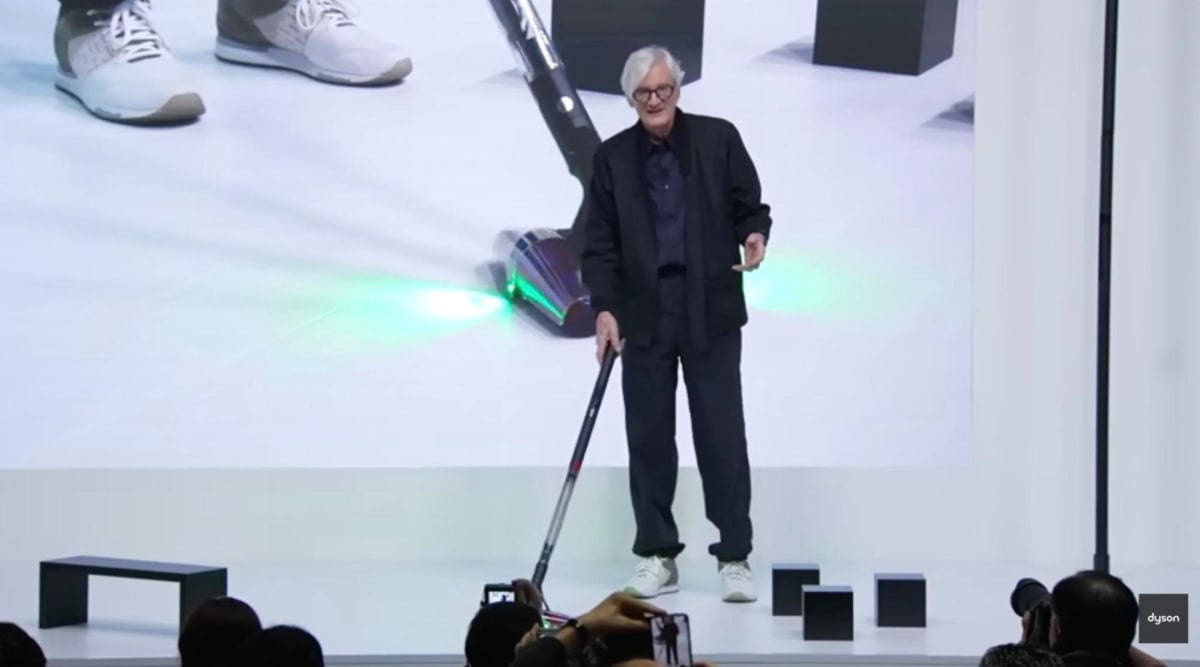
The same instinct powers the best about-us pages on websites, or the makers who take us through their trade-offs in minute detail.
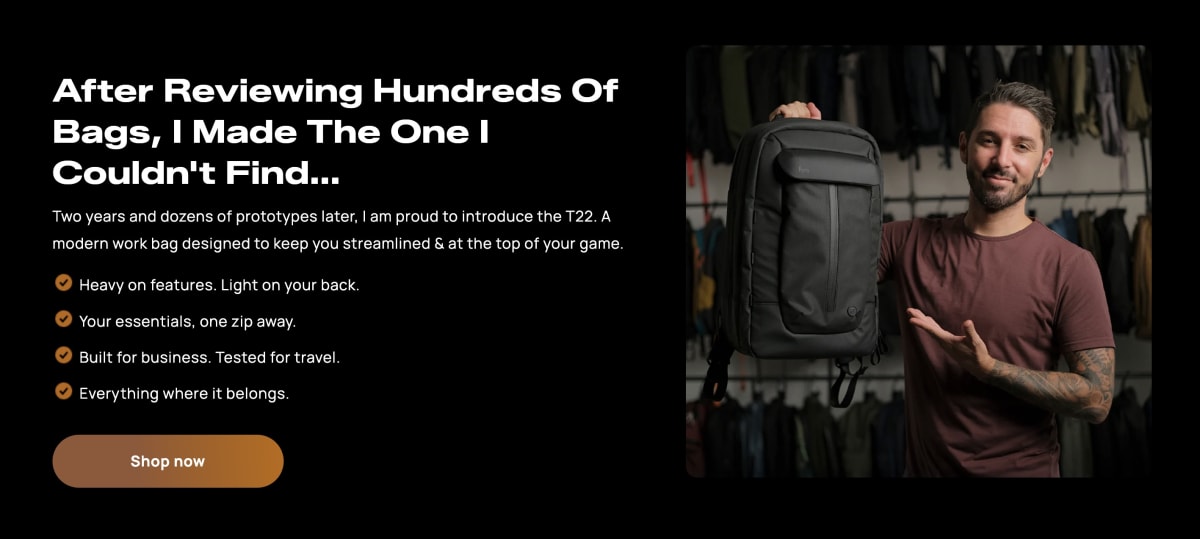
How could you use this? The maker (or trusted expert) who is on the buyer’s side is one of the most recognizable formats online, for good reason. It works.
You don’t need to be a famous founder to use this technique—you need to be (or have) a credible voice who’s able to put themselves in a real buyer’s shoes. After that, the framing is simple: “Here’s what I’d want, look for, or avoid if I were the one buying.”
As long as you can do this honestly, it can be a powerful way to create videos, product pages, and emails that resonate with audiences. And if part of that is explaining where and why your product made trade-offs, so much the better.
2. Build credibility by admitting what you could have skimped on
As you read the ad, you may notice something unusual. Olds keeps telling you, in dollars, what each decision cost him. Here are just three examples from a pattern that the ad repeats over and over:
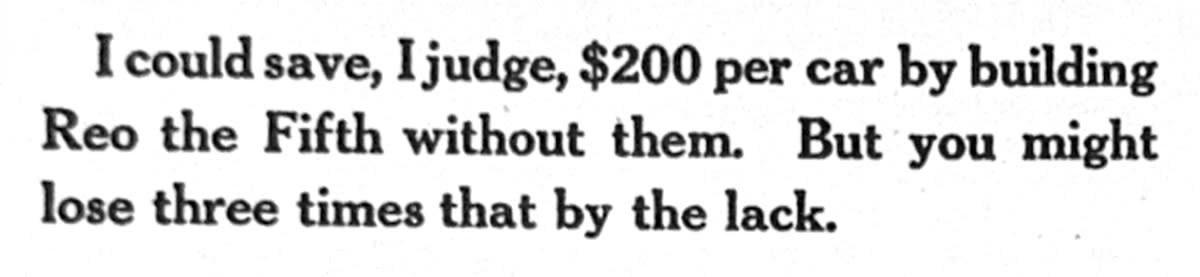
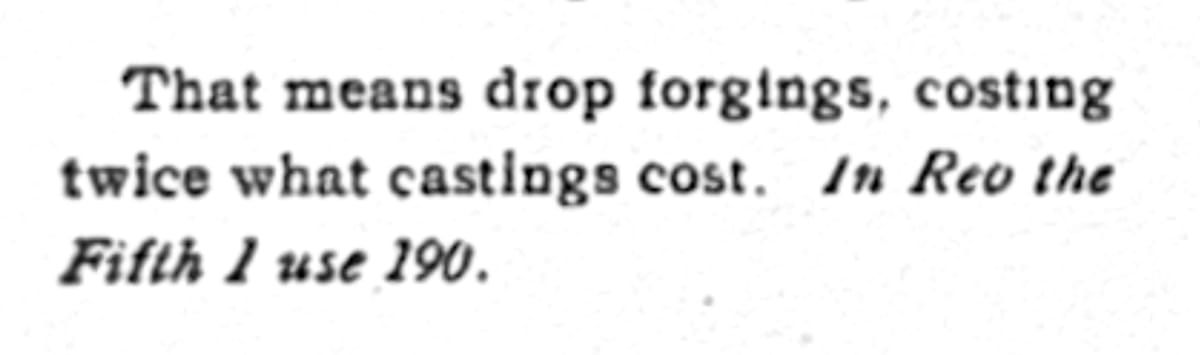
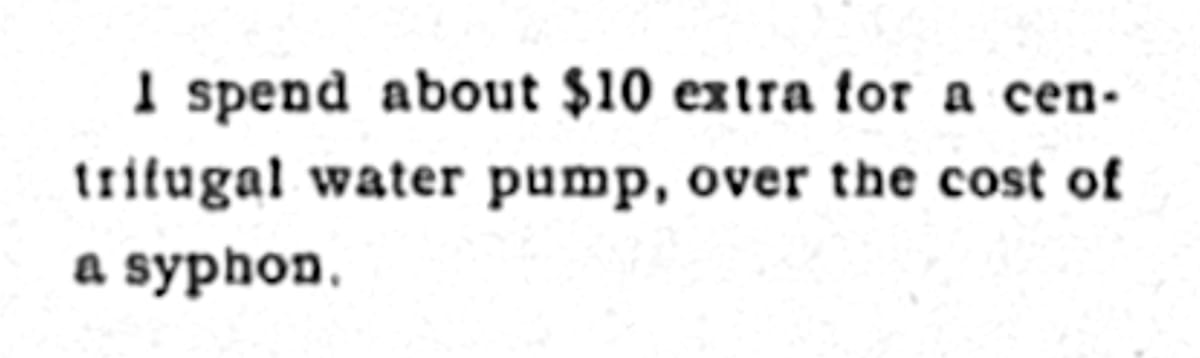
In these cases, and the others, Olds is explaining why he chose to spend money that he didn’t “need” to spend.
As we discussed in our article about competing with giants, this technique is what copywriters call a damaging admission. In essence, it involves openly volunteering something that, on the face of it, hurts your sale. Done badly, it just hurts. Done well, it does the most valuable thing any piece of copy can do: it makes everything else you say more believable.
The mechanism in the Reo the Fifth ad is subtle. By repeatedly volunteering what he could have done to make more money on each car, Olds reframes the whole ad. You stop hearing it as “buy my car” and start hearing it as “let me show you my work.” When someone openly admits what could count against them, you’re more likely to believe them on the points that don’t.
Notice the second move in that opening line: “But you might lose three times that by the lack.” He doesn’t just admit the cost, he immediately reframes it as the reader’s savings. The structure is: here’s what I could have skimped on; here’s why you’d regret it if I had.
3. Flood the reader with specifics
Once you start counting the numbers in this ad, you can’t stop. In the Durability section alone:
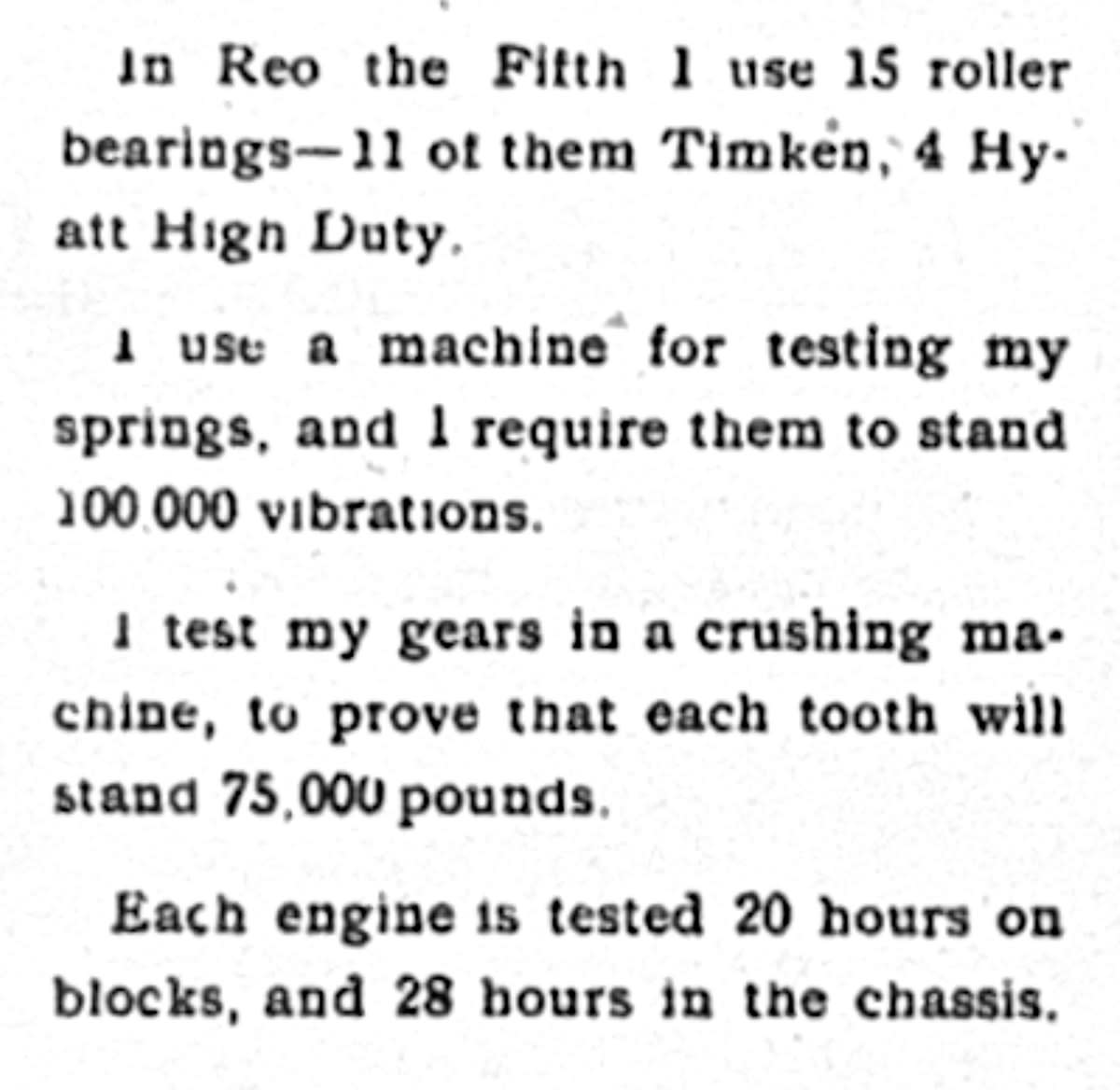
But it’s not just numbers—it’s all kinds of specific details. While reading this ad, we learn of three different kinds of steel, the exact size of the brake drums, and why Olds chooses a 45-horsepower drivetrain to power a 35-horsepower car. And much more.
The cumulative effect is slightly overwhelming, and that’s the point. A general claim like “we use quality parts” might well trigger a reader’s “you-would-say-that” defense. A specific claim (“11 of them Timken; 4 at High Duty”) doesn’t, because the reader has nothing to argue with. The specificity is the proof.
As copywriting great Gary Bencivenga puts it: “Never make your claim bigger than your proof." It’s a principle we’ve made the centerpiece of an entire guide to proof and a separate Copywriting Friday on a similar theme. The test is brutally simple: could a competitor truthfully write the same sentence? If the answer is yes, consider rewriting it.
Here’s a great example, from Winkbeds:
We put our beds in an independent testing facility and do 80,000 punishing compression repetitions, simulating over 20 years of sleeping to ensure long term durability.
4. Close on trust, not on price
The final section of the ad is titled “Men’s Faith In Me.” The dated framing aside, the structure of the close is worth studying carefully:
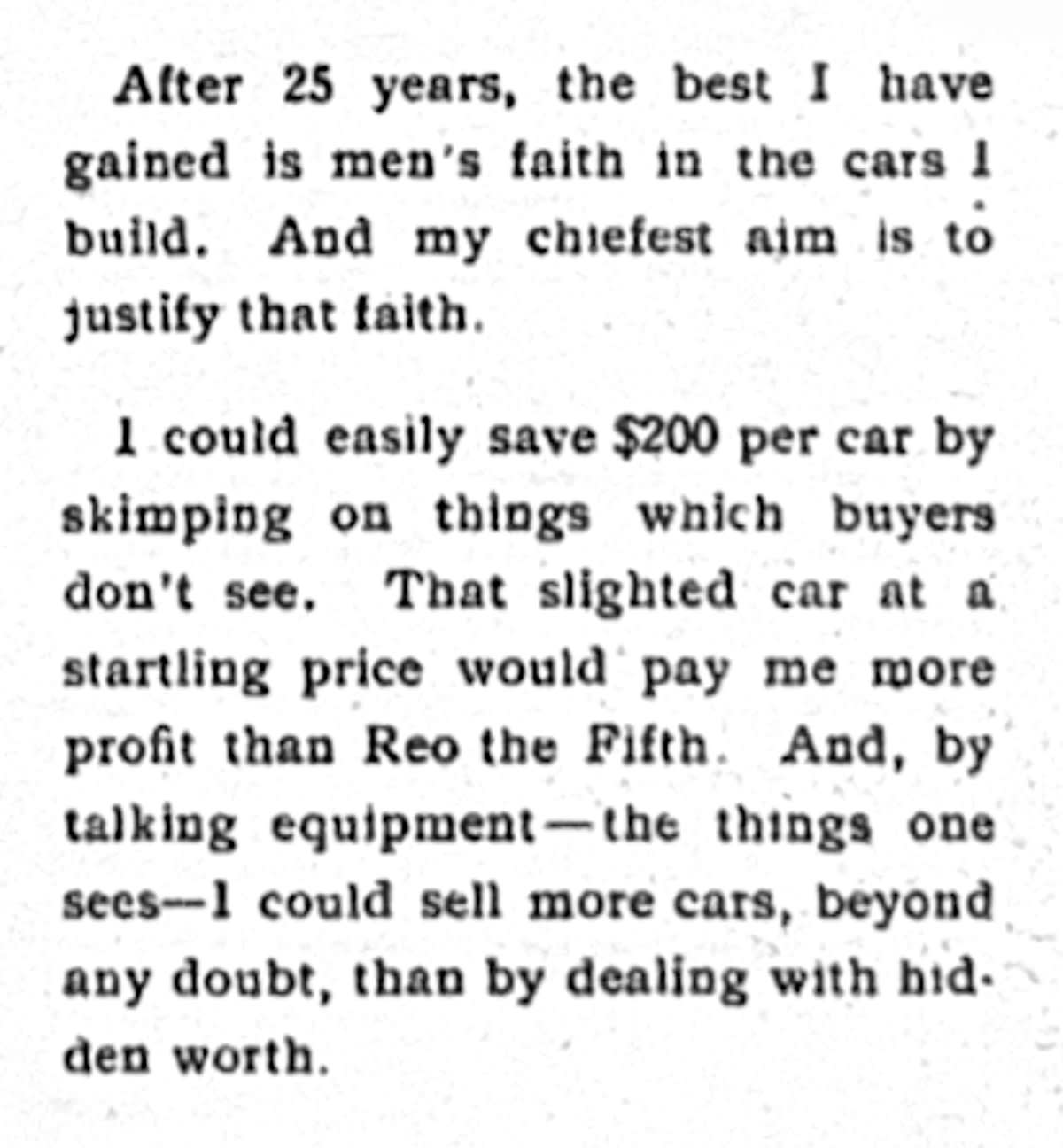
This is what good founder-story copy actually looks like. It’s a value statement, delivered at the moment of decision, by the one person whose word matters most—the person who’d be personally embarrassed if the product fell short.
Notice that there’s no “buy now” at the end of the ad. There’s barely even a price—the $1,095 sits quietly in the photo caption. What there is, instead, is a founder’s implicit promise: I have spent 25 years earning your trust, and I would rather earn less per car than risk losing it.
Trust in business may be in shorter supply these days, but we can still recognize it when it happens. Whether it’s Patagonia’s Don’t Buy This Jacket ad, Darn Tough’s lifetime guarantee, or Zappos’ year-long returns—each one closes on the same idea: we’d rather keep your trust than win this one sale.
How could you use this? A trust close like the one in the Reo the Fifth ad works best when the brand already has a history of keeping their promises, but subtler variations are often easier to ship and test:
- Put the promise where the price usually shouts. A one-line guarantee directly under the buy button often does the work of a whole closing paragraph. (In general, guarantees are a powerful way to build trust.)
- Talk the wrong buyer out of it. A line like “If you only need X, save your money—the basic plan is plenty” reads as honesty and lifts the qualified buyers you really want.
- The easy return. Amazon is one of the most data-driven (and successful) companies on the planet. Have you noticed how prominent their returns policy is? It’s not buried in a FAQ somewhere—it’s usually right there, close to the price.
A closing thought (as we drive our Reo into the sunset)
If you strip away the date and the typography, the persuasive engine of this ad still runs today:
- Put the maker in the buyer’s seat.
- Volunteer what your standards cost you.
- Flood the reader in specifics no competitor could honestly copy.
- Then close not on price, but on the promise that the person whose name is on the door cares more about the world’s good opinion than a few extra dollars.
As Olds himself put it:
“I would never buy a car which the makers skimped, and I never shall try to sell one.”
See you next time on Copywriting Friday.
How much did you like this article?
What’s your goal today?
1. Hire us to grow your company
We’ve generated hundreds of millions for our clients, using our unique CRE Methodology™. To discover how we can help grow your business:
- Read our case studies, client success stories, and video testimonials.
- Learn about us, and our unique values, beliefs and quirks.
- Visit our “Services” page to see the process by which we assess whether we’re a good fit for each other.
- Schedule your FREE website strategy session with one of our renowned experts.
Schedule your FREE strategy session
2. Learn how to do conversion
Download a free copy of our Amazon #1 best-selling book, Making Websites Win, recommended by Google, Facebook, Microsoft, Moz, Econsultancy, and many more industry leaders. You’ll also be subscribed to our email newsletter and notified whenever we publish new articles or have something interesting to share.
Browse hundreds of articles, containing an amazing number of useful tools and techniques. Many readers tell us they have doubled their sales by following the advice in these articles.
Download a free copy of our best-selling book
3. Join our team
If you want to join our team—or discover why our team members love working with us—then see our “Careers” page.
4. Contact us
We help businesses worldwide, so get in touch!
© 2026 Conversion Rate Experts Limited. All rights reserved.
A Brandwidth Group Company.