Copywriting Friday: A Mac walks into a room
(By the way, to get articles like this free in your inbox, subscribe to our newsletter.)
Copywriting Friday highlights the tools and techniques of persuasive content. Some of the examples may seem dated, but the principles are timeless (and critical for conversion rate optimization). Enjoy.
In September 2005, Apple CEO Steve Jobs handed the company’s ad agency the briefest of briefs. He wanted “a powerful ad campaign” to drive home the fact that the new Intel-driven Macs were beating Windows PCs at their own game.
The answer they eventually arrived at produced one of the most studied advertising campaigns of the last twenty years. Sixty-six TV ads, all 30 seconds long, all on a plain white background, all opening with the same eight words: “Hello, I’m a Mac. And I’m a PC.”
The ads may be low resolution, but their insights-per-pixel are off the scale.
The setup may seem simple, but Campaign magazine’s oral history of Get a Mac (free account required) reveals that the idea almost broke the team that created it. According to creative director Jason Sperling, his reactions in the weekly Marcom meetings were typically short: “That’s stupid. That is so inane. Who the hell cares about that?” By month seven, Jobs was threatening to fire the agency.
The breakthrough came when two associates, Barton Corley and Scott Trattner, simplified the brief in conversation.
Corley: “Let’s make it really simple. A Mac walks into the room right now. What does he say?”
Trattner: “Hello, I’m a Mac. And there could be a guy who says, ‘I’m a PC,’ and they talk about being computers.”
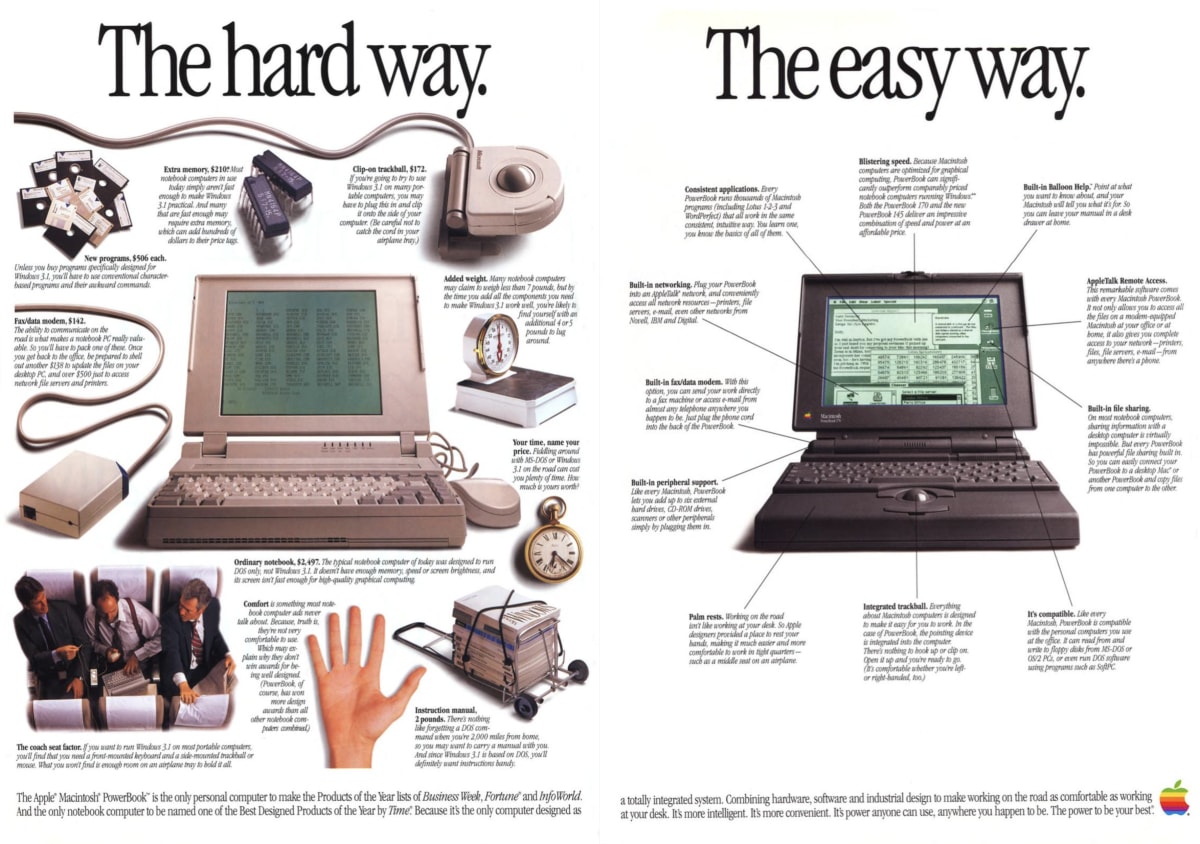
If you read our article on The hard way and the Apple way, you may find this framing somewhat familiar. As with the print ad below, the Get a Mac campaign wasn’t fought over features, it was staged with two scenes side by side, doing the comparing for you.
In this Copywriting Friday, we’ll examine the strategy at the heart of the Get a Mac campaign, then pull three specific lessons you can apply to your own marketing.
The core strategy: Talk about PC, not Mac
The breakthrough wasn’t really “make it simple.” It was an audience flip.
The agency had been coming up with reasons for people to like the Mac, but as their planning team eventually found, that wasn’t the problem. As creative director Eric Grunbaum put it:
“The problem isn’t that people don’t know Macs are great. The problem is that people that use PCs don’t understand that PCs suck. So that got us thinking, ‘We can’t just talk about the merits of Mac. We also need to talk about the challenges or the difficulty of the PC.’”
That’s a big pivot. Once the team accepted it, the format almost wrote itself. If a Mac walked into the room and started talking, he wouldn’t talk about Mac. He’d talk about PC. He’d join the conversation Windows users were already having in their heads.
Get a Mac is what comparison advertising looks like when you stop talking about yourself.
The PowerBook ad had done it on the page, with two photographs and two captions. Get a Mac did it on screen, with two characters and a white room. Both were really saying the same thing: here is what life is like with the alternative. The audience does the rest.
The three techniques below are all variations on that one move. None require a TV budget. They work just as well on a landing page, in an email, or in a sales deck.
1. Personify the choice—and make your competitor likeable
Look at almost any spot in the campaign and you’ll see the same setup: Mac, calm and easy-going. PC, well-meaning but slightly out of touch. The viewer isn’t asked to evaluate features. They’re asked to identify with one of two people.

In the Out of the Box spot at 2:35, Mac is unboxed and ready to go:
“I might make a whole movie, or maybe create a website, try out my built-in camera. I can do it all right out of the box. So what about you?”
PC, polite and apologetic, is still in his box:
“Well, first I got to download those new drivers, and I got to erase the trial software that came on my hard drive. And I’ve got a lot of manuals to read.”
Then, almost shyly: “The rest of me is in some other boxes—so I’ll meet up with you later.”
There are no comparison tables here, just one character ready to live and another character explaining why he’s not yet. If you watched it on mute, you’d still know which computer to buy.
A key part of why this works is that the PC has to be likeable. The Get a Mac team explicitly resisted the idea that PCs were stupid because their target audience was PC users. PC may be bumbling, but he’s funny and loveable. Mac may be “better”, but he’s supportive and encouraging.
Like the Short course in railroading we studied in a previous article, Get a Mac shows the power of treating your competitors fairly. The sympathetic personification of PC let the audience see themselves in the losing character without resenting the comparison. The subtext through all the ads is that PC users aren’t idiots; they just got handed the wrong computer at work.
How could you use this? If you had to play yourself and your biggest competitor as two characters in a sketch, who would they be? Not just what would they say—who would they be? For example:
- A consultancy might contrast “the agency that’s always pitching” with “the team that’s already shipping.”
- A premium e-commerce brand could play the patient craftsman against the disposable bargain-bin upstart.
The trick is that the personification has to be honest and sympathetic. PCs did come with lots of manuals and unwanted software. If the competitor feels like a straw man or a punching bag, the audience will smell it and turn away.
2. Let your competitor voice the objection
The technique that does the heaviest lifting in the campaign is the way it handles objections. In the Windows 7 launch ad at 32:10, PC tells Mac:
“Windows 7 is out and it’s not going to have any of the problems my last operating system had.”
Mac, deadpan:
“I feel like I’ve heard this before, PC.”
Cut to a flashback montage of PC promising the exact same thing about Vista. Then about Windows ME. Then 98. Then 95. Then Windows 2.

The objection being addressed is trust: why should I believe Apple’s claims about reliability when the whole industry makes claims like this? Apple doesn’t address the objection in their own voice. They put it in PC’s mouth, then let PC discredit himself.
This is a much stronger move than the standard testimonial-and-feature combo. As we explored in our analysis of how SawStop persuades skeptical people, the most powerful objections are the ones the audience didn’t quite know they had until you named them. Naming them through a competitor figure makes the move feel more honest, even when it’s clearly partisan.
How could you use this? What does your prospect quietly worry about that your category has earned a bad reputation for? If you collect client testimonials (and you should), ask your customers what they were worried about before they chose you. Their answers will address your skeptics far more efficiently than any rebuttal you could write.
3. Trade abstractions for specifics
Most copy makes abstract claims. Faster. More reliable. Easier to use. The claims aren’t really information, they’re marketing.
Get a Mac almost never makes abstract claims. It dramatizes specific moments instead.
In the MagSafe spot at 4:05, PC has been knocked to the floor.
“I was sitting on my desk, someone walked by, carelessly tripped over my power cord, yanked me straight down to the ground. Bam.”

The spot is about just one specific feature of the Mac: MagSafe. There’s no mention of price, screen, OS, software, or speed. Just Mac talking about the power cord that connects magnetically, so when it gets pulled it just “pops right off.”
Notice what the spot doesn’t do. It doesn’t claim MacBooks are “more durable” or that PCs are “vulnerable to damage.” It just shows the moment after a cord gets tripped over, and two different outcomes. This is a scenario that every prospect has imagined or lived through, and they supply their own conclusion: I want the cord that pops off.
The specificity of the MagSafe ad is what makes the one-sided comparison feel honest instead of partisan. Abstract claims feel like marketing. Specific scenarios feel like reporting.
How could you use this? We still see huge amounts of marketing that focuses on lists of abstract benefits: Save time, cut costs, improve efficiency. And because audiences have a tough time picturing abstractions, little of it sticks.
Look at the last benefit-statement you wrote. How would you dramatize it? Where does the prospect start? What happens to them? What is the moment of relief or frustration?
If you can’t picture the scene, your prospect can’t either, and the benefit-statement probably isn’t doing much work.
The hidden ratio inside the campaign
We started this article by recounting how hard it was for the ad team to get a new campaign approved by Steve Jobs. You might have thought that was the hardest part, but you’d be wrong.
The Get a Mac campaign consisted of 66 ads, but can you guess how many the team wrote, shot, and edited?
323.
That means that 257 ads—roughly four out of every five—never made it onto the air. This is a crazy ratio for advertising. Typically, an ad that is shot is aired. It’s exceedingly rare that something finished is pulled, let alone 80%.
For Apple, this was a deliberate policy. Steve Jobs killed scripts that other clients would have aired without a second thought. Spots starring Tony Robbins, James Carville, and Zach Galifianakis got scrapped because they weren’t exactly right.
And pushing for “exactly right” worked. In the four years the campaign ran, Apple’s share of the US computer and laptop market went from 4% to 8.8%, and Microsoft eventually fired back with a $300 million “I’m a PC” campaign… the surest sign that Get a Mac had got under their skin.
To be clear. The lesson of Get a Mac isn’t “shoot 323 spots,” it’s be willing to throw out good ideas so you can deliver on great ones. If your product or service walked into a room with your target audience… what would it say?
See you next time on Copywriting Friday.
How much did you like this article?
What’s your goal today?
1. Hire us to grow your company
We’ve generated hundreds of millions for our clients, using our unique CRE Methodology™. To discover how we can help grow your business:
- Read our case studies, client success stories, and video testimonials.
- Learn about us, and our unique values, beliefs and quirks.
- Visit our “Services” page to see the process by which we assess whether we’re a good fit for each other.
- Schedule your FREE website strategy session with one of our renowned experts.
Schedule your FREE strategy session
2. Learn how to do conversion
Download a free copy of our Amazon #1 best-selling book, Making Websites Win, recommended by Google, Facebook, Microsoft, Moz, Econsultancy, and many more industry leaders. You’ll also be subscribed to our email newsletter and notified whenever we publish new articles or have something interesting to share.
Browse hundreds of articles, containing an amazing number of useful tools and techniques. Many readers tell us they have doubled their sales by following the advice in these articles.
Download a free copy of our best-selling book
3. Join our team
If you want to join our team—or discover why our team members love working with us—then see our “Careers” page.
4. Contact us
We help businesses worldwide, so get in touch!
© 2026 Conversion Rate Experts Limited. All rights reserved.
A Brandwidth Group Company.