The ROAS equation that explains why top advertisers can outbid everyone else
Why can some advertisers afford to outbid everyone else while still making money, and grow to dominate their competitors? In this article, we’ll follow InflataFish, our (fictional) online boat seller, as it grapples with competition from bitter rivals, PunctureCraft and BarelyAfloatBoat.
Our examples may sound light-hearted, but the strategies below are deadly serious. There is math involved, but if math isn’t your bag, don’t worry—we’ll work through it together.
And by the end you’ll see why mastering a simple equation is the key to dominating your market.
How much bang are you getting for your advertising buck?
Before we get to our examples, let’s look at the basic math.
If your business buys traffic, it’s likely you’ll be familiar with return on ad spend (ROAS). In fact, you may well be obsessed by it.
ROAS is the total revenue you’re generating for every dollar you spend on advertising. In effect, it’s a measure of the efficiency and profitability of your campaigns, making it a crucial metric to gauge the success of your advertising (and the trajectory of your business).
Let’s first define how to calculate ROAS.
This standard definition gives us two options to increase ROAS:
- Increase the revenue without increasing ad spend; or
- Reduce ad spend without reducing the revenue from ads.
You’ve probably already spotted the limitations of these approaches. Unless we change something else, the two components of the equation are linked and proportionate. If we increase one, the other increases, and vice versa. So we’re stuck.
We can unstick ourselves by breaking down the components of ROAS as follows:
Your ad spend is based on the number of clicks at an average cost per click (CPC)…
…and if your conversion rate (CR) tells you what percentage of clicks become customers, and each customer is worth your lifetime value (LTV), then…
Substituting our new definitions back into the original equation for ROAS gives us…
…and by cancelling clicks we get the following, new (and much more useful) definition for ROAS:
This new definition gives us three exciting new options to increase our ROAS:
- Increase our conversion rate.
- Increase our lifetime value.
- Reduce our cost per click.
Chasing the honey (trap)
Despite the three clear paths available to improve ROAS, many companies we speak to are focusing on just one—reducing cost per click. That’s because:
- It’s visible and immediate. Platforms like Google Ads and Meta make cost per click a headline metric in dashboards. Marketers see it daily and feel rewarded when it goes down.
- It’s the only one of the three levers that can be pulled. Often, responsibility for ROAS sits with the ad teams or PPC agency, meaning the conversion rate and lifetime value are ignored (or given token attention).
- It feels controllable. Adjusting bids, targeting, or ad creative can quickly affect CPC. That immediacy creates the illusion that lowering CPC is the best lever to profitability.
But beware—focusing on CPC can actually reduce your ROAS.
That’s because cheap clicks are worthless if they don’t convert. Chasing lower CPC often means broadening targeting to less-qualified audiences, which reduces conversion rates and drags down ROAS.
Don’t make that mistake.
Why you should focus on conversion rate and LTV
Let’s return to our equation to calculate ROAS, and look at the other two paths:
We can see the ROAS is directly proportional to both conversion rate (CR) and lifetime value (LTV), that is:
- If you double your conversion rate, you double your ROAS; and
- If you double your LTV, you (also) double your ROAS.
And this time there are no traps—the relationships hold true, no matter how you achieve the increases.
What’s more, when you focus on these paths there are powerful secondary effects at play:
- They improve ROAS without increasing ad spend or changing the traffic source.
- Every improvement multiplies the value of all of your traffic—not just your PPC.
- The higher your customer value, the more you can profitably bid for clicks. That means CR and LTV can neutralize high CPC: if conversion rate doubles, you can afford to pay double the CPC and still maintain the same ROAS.
| Scenario | CPC | CR | LTV | ROAS |
|---|---|---|---|---|
| Baseline | $2 | 2% | $200 | 2.0 |
| Increase CR by 50% | $2 | 3% | $200 | 3.0 |
| Increase LTV by 50% | $2 | 2% | $300 | 3.0 |
| Increase CR & LTV by 50% | $2 | 3% | $300 | 4.5 |
The little-understood extra benefit of working on your conversion rate
This is the exciting part, but it also comes with a warning. We’re going a little deeper into the math, here, as well as the mechanics of ad auctions. Don’t be put off—as long as you grasp the concepts, you’ll be fine.
Let’s return once again to the ROAS formula…
…and take a closer look at cost per click. (We fell out with cost per click earlier, calling it a “trap”, but we love it really.)
Your cost per click is determined by two things:
- Your competitors’ bids (or their Ad Rank).
- Your Quality Score.
We can express this mathematically by saying cost per click is a function of these variables (we can’t express the formula exactly because Google doesn’t reveal their algorithms), like this:
Let’s simplify things by assuming that your competitor Ad Rank is constant, so the equation becomes:
In other words, your cost per click is inversely proportional to your Quality Score. (When your Quality Score increases, your cost per click goes down.)
So what affects your Quality Score? Again, we can express that mathematically because Google tells us that it is a function of your click-through rate (CTR), your Ad Relevance, and your Landing Page Experience. In other words:
On smaller screens, you may need to horizontally scroll to see the whole formula.
And since we’re looking at the impact of working on conversion rate, we can assume that click-through rate and Ad Relevance are constant, in which case we can simplify to:
We know that Landing Page Experience is closely related to your conversion rate because studies show that it exhibits the highest correlation when assessed against other factors. So the equation becomes…
We don’t know exactly how the function works—because Google doesn’t reveal the specific weighting of its algorithms—but we can model the relationship conceptually, like this…
…where a and b are factors associated with other effects like click-through rate, Ad Relevance etc.
In other words, your Quality Score rises non-linearly with your conversion rate.
Substituting back into the equation for CPC (and introducing another variable, k, to represent Ad Ranks and auction conditions), we get…
If the math feels like too much at this point, focus on the takeaway: As your conversion rate rises (bringing your Quality Score with it), your cost per click falls—disproportionately.
Bringing it all together
Let’s return one last time to the equation for ROAS that we derived earlier…
…and substitute in our new model for CPC…
And that’s it! This equation explains why some campaigns scale effortlessly while others can’t escape gravity, because:
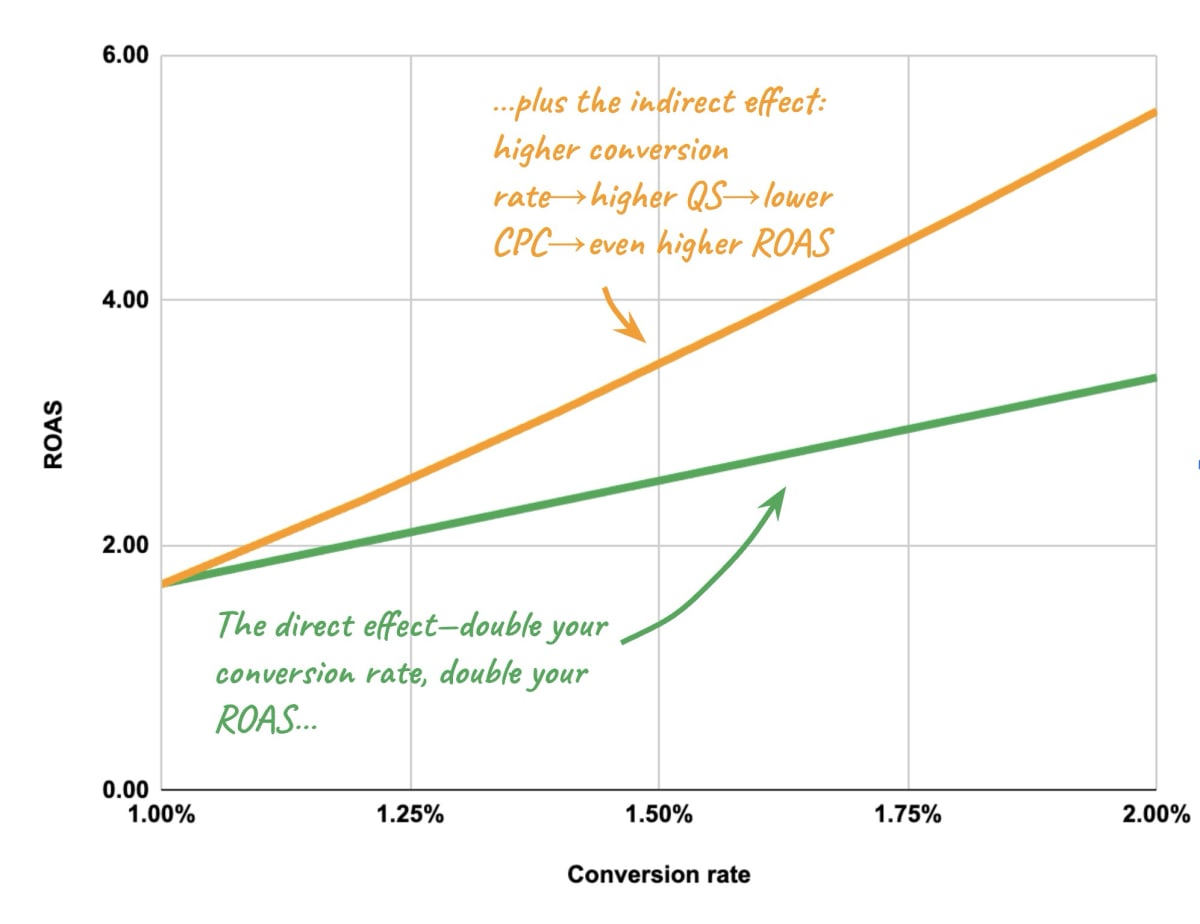
- The direct effect of conversion rate (highlighted in green in the formula above) immediately multiplies every click’s value.
- The indirect effect of conversion rate (highlighted in orange)—higher CR improves QS → lower CPC—further boosts ROAS.
In other words, ROAS grows super-linearly (faster than linear) with conversion rate. That’s because conversion rate is the only lever that both increases the revenue you earn from each click and reduces your effective cost per click. No other change improves two parts of the equation at once.
Putting theory into practice
That’s it for the theory—phew—but how does it translate to InflataFish and their competitors?

As luck would have it, InflataFish has recently launched a new initiative to increase their ROAS. Meanwhile, their bitter rivals, PunctureCraft and BarelyAfloatBoat, have embarked on similar initiatives—but with different approaches.
(In another almost unbelievable coincidence, all three companies spent the same on ads and had the same cost per click, lifetime value and conversion rate at the start of their initiatives.)
To see what happened, let’s look at the strategies each company adopted:
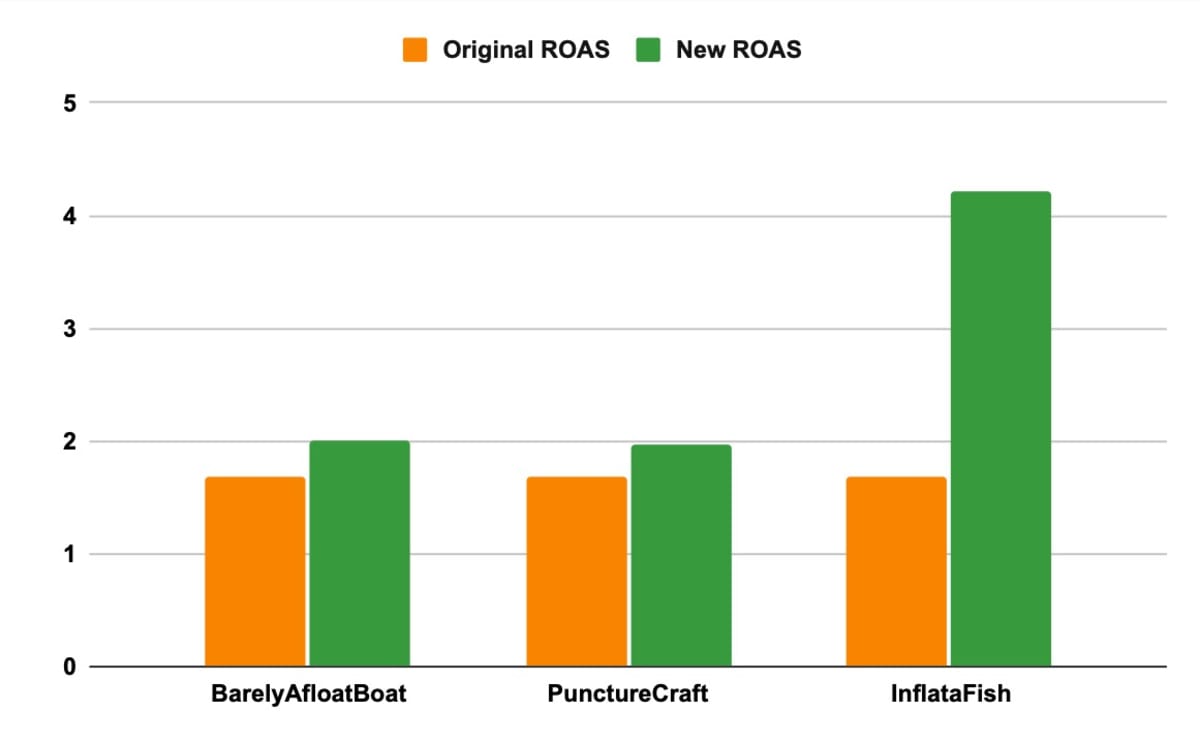
- BarelyAfloatBoat tasked their PPC agency with reducing cost per click. The agency optimized towards cheaper, lower-intent, lower-quality clicks. Cost per click reduced by 44% but—due to lower quality traffic—conversion rate also reduced by 33%.
- PunctureCraft worked on lifetime value, adding an upsell with an exclusive repair kit priced at $50. The result? After strong promotions and exclusive offers half of new customers now add the kit when they buy a boat—and lifetime value has increased from $150 to $175.
- InflataFish focused on their conversion rate, gathering voice-of-customer research and testing improvements to their funnel. Conversion rate increased from 1% to 1.5% and—as a result of an increased Quality Score—cost per click reduced by 40%.
When we look at the impact on the ROAS of each company—remembering that they each started with the same value—we can see the stark effect of the equations we derived earlier:

Focusing on conversion rate has enabled InflataFish to leverage the compounding effect of increased sales and lower cost per click.
They are now in a position to dominate their market because their higher conversion rate has created headroom—the ability to tolerate higher cost per clicks, outbid competitors and leverage other channels without sacrificing profitability.
Your mental model to grow ROAS and dominate your competitors
You don’t need to remember how to derive each equation in this article. But developing a mental model of how the relationships work is key if you’re going to use math to gain a competitive advantage.
Here are some summary notes to help you:
- You have to increase your ROAS to survive and beat your competitors. To win, you need to outsmart them.
- Focusing solely on cost per click is a trap, which can reduce conversion rates and drag down ROAS.
- The advertisers who win aren’t those who achieve the lowest cost per click—they’re the ones who turn every click into more revenue and extract the most lifetime value from each customer.
- Conversion rate increases ROAS directly and through reducing cost per click—you can use this disproportionate relationship to rapidly increase your ROAS.
- Improving your conversion rate is a shelter from the storm:
- Cost per click is largely market-driven—competitors and auction dynamics push it around.
- Conversion rate is business-controlled—your website, your funnel, your offer.
- Increasing your conversion rate creates headroom: it lets you tolerate higher costs for each click, outbidding competitors who have weaker websites or funnels.
In a volatile market, this is your advantage. When costs rise and margins tighten, the companies that thrive aren’t those who flinch and cut bids—they’re the ones who’ve mastered the math to make every click work harder.
A short video interview with a client
You can see the power of this strategy in the conversation we had with our client, Unbiased, the UK’s leading financial advice platform. Here’s Marco Fernandes, Head of Performance Marketing at Unbiased.
How much did you like this article?
What’s your goal today?
1. Hire us to grow your company
We’ve generated hundreds of millions for our clients, using our unique CRE Methodology™. To discover how we can help grow your business:
- Read our case studies, client success stories, and video testimonials.
- Learn about us, and our unique values, beliefs and quirks.
- Visit our “Services” page to see the process by which we assess whether we’re a good fit for each other.
- Schedule your FREE website strategy session with one of our renowned experts.
Schedule your FREE strategy session
2. Learn how to do conversion
Download a free copy of our Amazon #1 best-selling book, Making Websites Win, recommended by Google, Facebook, Microsoft, Moz, Econsultancy, and many more industry leaders. You’ll also be subscribed to our email newsletter and notified whenever we publish new articles or have something interesting to share.
Browse hundreds of articles, containing an amazing number of useful tools and techniques. Many readers tell us they have doubled their sales by following the advice in these articles.
Download a free copy of our best-selling book
3. Join our team
If you want to join our team—or discover why our team members love working with us—then see our “Careers” page.
4. Contact us
We help businesses worldwide, so get in touch!
© 2026 Conversion Rate Experts Limited. All rights reserved.
A Brandwidth Group Company.