Copywriting Friday: How to outmaneuver competitors without raising your voice
(By the way, to get articles like this free in your inbox, subscribe to our newsletter.)
Copywriting Friday highlights the tools and techniques of persuasive content. Some of the examples may seem dated, but the principles are timeless (and critical for conversion rate optimization). Enjoy.
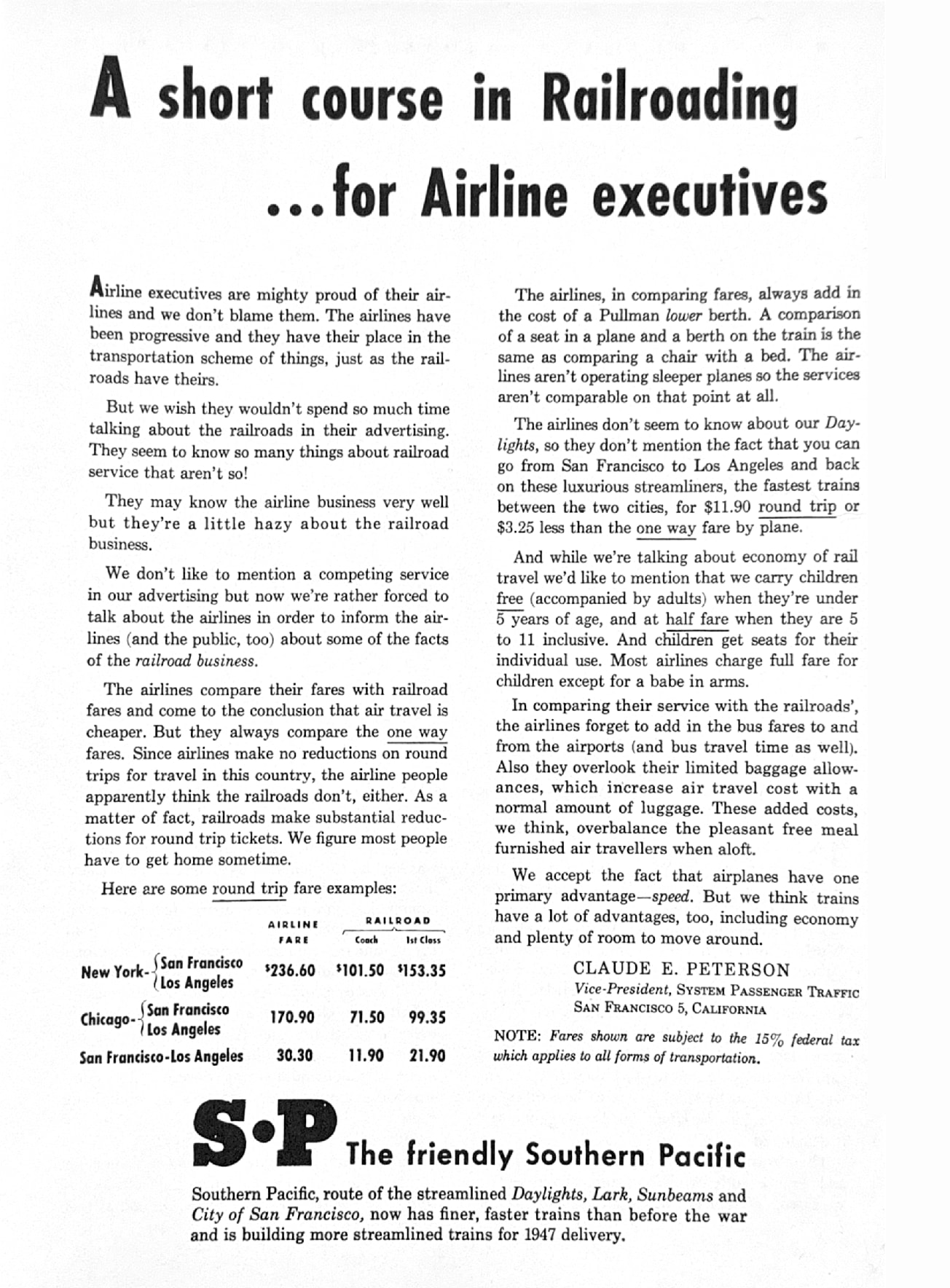
In 1946, America’s commercial airlines were booming. Railroads, which had dominated long-distance travel for decades, suddenly found themselves positioned as slow and old fashioned. In response to the challenge, Southern Pacific Railroad published the ad we are analyzing today, “A short course in Railroading… for Airline executives.”
It may not look like a modern-day ad, but it’s a treasure trove of techniques for anyone in a competitive market.

While the ad is addressed to airline executives, its true audience is everyone else. And now, eighty years later, we still get to learn from the ways that Southern Pacific’s copywriters used to attack the problem.
Let’s look at what makes it work, and how you can use these techniques for your own business.
Five techniques that you can use
1. Address your competitors to reach your audience
The ad’s headline begins with misdirection:
A short course in Railroading… for Airline executives
Of course the ad isn’t for airline executives at all. It’s for the traveling public—business travelers, families, anyone deciding between a train ticket and a plane ticket.
So why not just say that?
By addressing airline executives, Southern Pacific accomplishes two things at once:
- It positions the railroad as the travel authority. The word “course” implies the airlines need educating. Southern Pacific is the teacher. The power dynamic is established before the reader finishes the headline.
- It flatters the real reader. If you’re a regular traveler reading this ad, you feel like you’re eavesdropping on an insider conversation. You’re getting access to information the airlines don’t want you to know.
Gary Bencivenga, widely regarded as one of the greatest living copywriters, talked about the importance of calling out your audience in the very first line. This headline calls out two audiences simultaneously—the stated one (airline executives who need an education) and the real one (travelers, who feel like insiders).
How could you use this? Think about who your competitors are talking to, and consider addressing them directly. A project management tool might write “A quick guide to productivity—for spreadsheet lovers.” A boutique hotel might write “What the big chains don’t tell their guests.” You’re not really talking to the competitor’s customers. You’re talking to your prospects, and making them feel like they’re getting the real story.
2. Kill them with kindness (and then with facts)
Watch how the ad opens:
Airline executives are mighty proud of their airlines and we don’t blame them. The airlines have been progressive and they have their place in the transportation scheme of things, just as the railroads have theirs.
This is generous. Warm, even. The reader’s guard drops immediately. This doesn’t read like a competitor on the attack; it reads like a reasonable person being fair.
Then comes the pivot:
But we wish they wouldn’t spend so much time talking about the railroads in their advertising. They seem to know so many things about railroad service that aren’t so!
And a few lines later:
We don’t like to mention a competing service in our advertising but now we’re rather forced to talk about the airlines in order to inform the airlines (and the public, too) about some of the facts of the railroad business.
This approach works because although people instinctively resist being sold to, they welcome being informed. Copywriting legend Joe Sugarman called this the difference between pushing a product and pulling the reader in. By framing the ad as a reluctant correction—“we’d rather not, but someone has to set the record straight,” Southern Pacific transforms a competitive attack into an act of public service. And as we explored in our article on persuading skeptical people, replacing emotional language with hard facts is exactly how you win over an audience that doesn’t want to be sold to.
How could you use this? If you need to position against a competitor, start by genuinely acknowledging what they do well. Then introduce the specific area where they fall short, not as an attack, but as a correction. Here’s a basic template:
“[Competitor] is ideal for small teams. But once you’re scaling, the differences become significant—here’s what they look like.”
The lesson is that the concession makes the critique more credible.
3. Reframe the comparison (and expose the hidden costs)
The airlines had been running ads comparing their fares to railroad fares and claiming air travel was cheaper. Southern Pacific doesn’t just dispute this, it reframes the entire comparison.
First, the one-way vs. round-trip reframe:
… they always compare the one way fares. Since airlines make no reductions on round trips for travel in this country, the airline people apparently think the railroads don’t, either. As a matter of fact, railroads make substantial reductions for round trip tickets. We figure most people have to get home sometime.
That last sentence—“We figure most people have to get home sometime”—is a lovely piece of writing. It’s funny, it’s common sense, and it makes the airlines look like they have something to hide.
Then the apples-to-oranges reframe:
The airlines, in comparing fares, always add in the cost of a Pullman lower berth. A comparison of a seat in a plane and a berth on the train is the same as comparing a chair with a bed.
And later, on the hidden costs:
The airlines forget to add in the bus fares to and from the airports (and bus travel time as well). Also they overlook their limited baggage allowances, which increase air travel cost with a normal amount of luggage.
This works because it doesn’t rely on opinion. It simply changes the frame of reference—and once you see the comparison the right way, the airlines’ claims start to strain under their own logic.
We’ve seen this principle at work many times. Often, the winning move isn’t to argue harder within your competitor’s frame, it’s to change the frame entirely. If your competitor is winning the “cheapest” argument, shift the conversation to total cost of ownership. If they’re winning on features, shift to outcomes.
How could you use this? Look at how your competitors frame their comparisons. Are they cherry-picking metrics? Comparing apples to oranges? Ignoring hidden costs or trade-offs? Don’t just counter their claims, reframe the comparison so the reader sees the full picture.
4. Let the numbers do the fighting
In the center of the ad sits a simple fare comparison table:

There’s no spin here. The table is just the numbers, side by side.
This is one of the most reliable principles in copywriting: specifics are more persuasive than generalities. As Gary Bencivenga put it, never make your claim bigger than your proof. Southern Pacific doesn’t say they’re cheaper. They show you exactly how much cheaper, on specific routes, in both coach and first class.
Notice too that the table includes first class railroad fares—which are still dramatically cheaper than the airline’s standard fare. The reader doesn’t have to do any mental math.
We wrote an entire guide to how proof works in persuasion, and this ad is a textbook example. When your proof is this strong, you don’t need to editorialize. You just present it and let the reader draw the obvious conclusion.
How could you use this? Wherever possible, replace claims with data. Don’t say “we’re more affordable,” show a side-by-side comparison. Don’t say that your customers get faster results, show the median time to value.
And when you make a comparison, make it easy to scan. Tables, charts, and side-by-side layouts do the heavy lifting so your visitors don’t have to.
5. Concede your competitor’s real advantage (and watch your credibility soar)
We’ve touched on this in technique 2, but it’s worth emphasizing again here because of what the copywriter does near the end of the ad:
We accept the fact that airplanes have one primary advantage—speed. But we think trains have a lot of advantages, too, including economy and plenty of room to move around.
By the time the reader reaches this line, Southern Pacific has spent the entire ad proving the airlines wrong on fares, on comfort, on baggage, on family travel, on total cost. The reader might be thinking: Okay, but planes are obviously faster.
And then the ad says it for them.
This does two things. First, it eliminates the reader’s main objection as a reason to dismiss everything they’ve just read. Second, and more importantly, it makes every other claim in the ad more believable. If Southern Pacific were just shilling, they’d never admit the airlines have any advantage. The fact that they do without hedging tells the reader something important: These people are honest. I can trust the rest of what they’re saying.
Sixteen years later, Copywriter Paula Green would turn this principle into one of advertising’s most famous campaigns: “Avis is only No. 2 in rent a cars. So we try harder.”
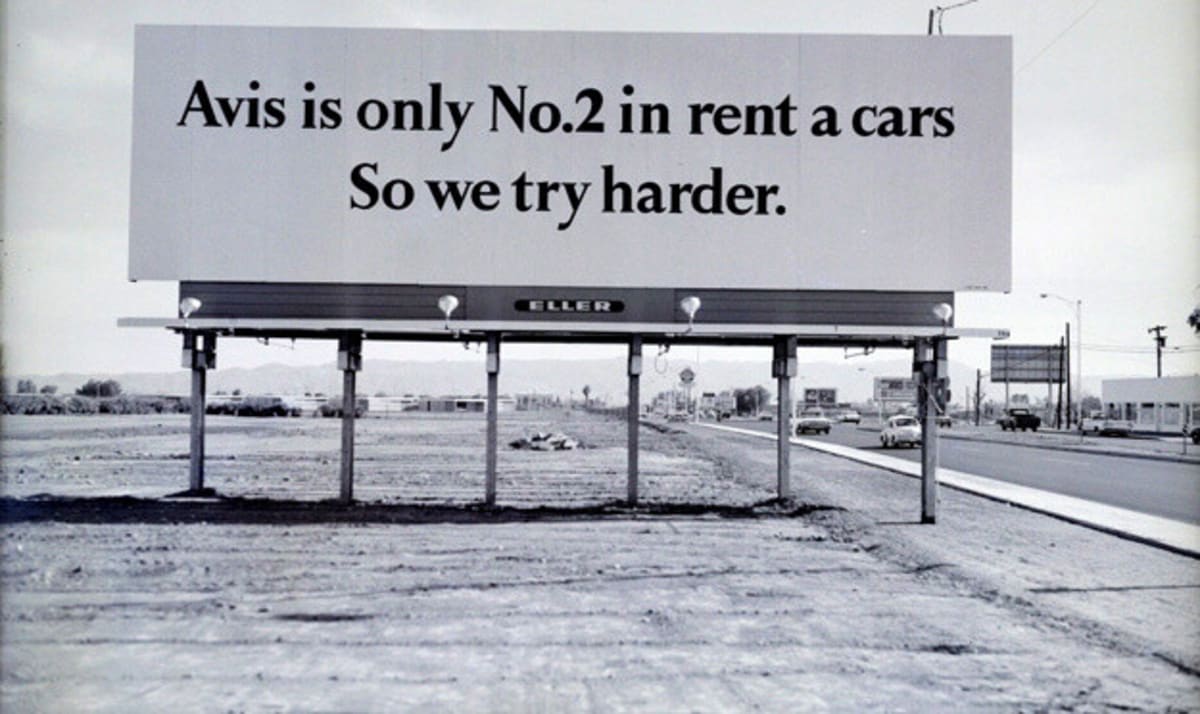
That campaign worked for exactly the same reason as the Southern Pacific ad does… admitting a weakness makes everything else you say more believable. Concede the ground you can’t win, and you fortify every position you hold.
How could you use this? Identify your competitor’s genuine, undeniable advantage and say it out loud.
Yes, [Competitor] is faster to set up. That’s because we spend the first week configuring the system to your exact workflow, so you don’t spend the next year working around a generic setup.
Concession isn’t a weakness. It’s often the foundation for your strongest argument.
The art of the velvet glove
What makes this ad remarkable isn’t just the individual techniques, it’s the tone. Southern Pacific demolishes every one of the airlines’ claims, and they do it while sounding reasonable, generous, and faintly amused. There’s no chest-thumping, just a calm, fact-filled correction from someone who clearly knows what they’re talking about.
The ad is signed by Claude E. Peterson, Vice-President, System Passenger Traffic. It’s not a faceless corporation speaking—it’s a named individual, putting his reputation behind every claim. That personal touch adds a final layer of credibility.
If you’re in a competitive market, and who isn’t, the instinct is usually to either ignore your competitors entirely or attack them head-on. This ad shows the third option: to be so generous, so specific, and so transparently honest that your audience makes the case for you.
See you next time on Copywriting Friday.
How much did you like this article?
What’s your goal today?
1. Hire us to grow your company
We’ve generated hundreds of millions for our clients, using our unique CRE Methodology™. To discover how we can help grow your business:
- Read our case studies, client success stories, and video testimonials.
- Learn about us, and our unique values, beliefs and quirks.
- Visit our “Services” page to see the process by which we assess whether we’re a good fit for each other.
- Schedule your FREE website strategy session with one of our renowned experts.
Schedule your FREE strategy session
2. Learn how to do conversion
Download a free copy of our Amazon #1 best-selling book, Making Websites Win, recommended by Google, Facebook, Microsoft, Moz, Econsultancy, and many more industry leaders. You’ll also be subscribed to our email newsletter and notified whenever we publish new articles or have something interesting to share.
Browse hundreds of articles, containing an amazing number of useful tools and techniques. Many readers tell us they have doubled their sales by following the advice in these articles.
Download a free copy of our best-selling book
3. Join our team
If you want to join our team—or discover why our team members love working with us—then see our “Careers” page.
4. Contact us
We help businesses worldwide, so get in touch!
© 2026 Conversion Rate Experts Limited. All rights reserved.
A Brandwidth Group Company.